
OpenAI builds and deploys advanced AI models like GPT-4o for autonomous agents and workflows.

claude-phantom
0Popularity
About claude-phantom
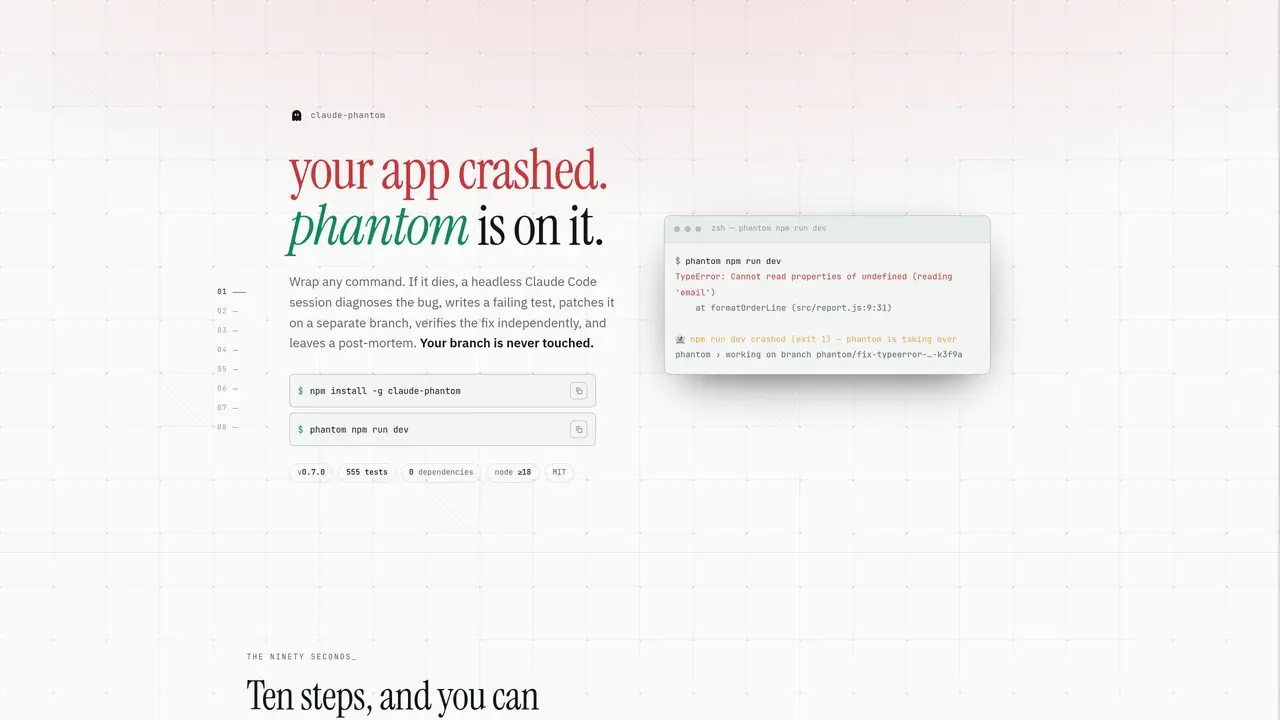
claude-phantom is a command-line tool that intercepts application crashes, automatically diagnoses the root cause using a headless Claude Code session, writes a failing regression test, and applies a patch on a dedicated branch. It then re-runs the original command and test suite to verify the fix independently before returning control to the user. All operations occur without modifying the user’s working branch, and a detailed post-mortem report is generated for review. The tool is designed to handle crashes signaled by non-zero exit codes or uncaught signals, capturing stack traces, file references and redacted output while preserving the original environment. It enforces strict guardrails including branch isolation, secret redaction, rate and token limits, and a kill switch for interruptions. claude-phantom supports wrapping any command and integrates with CI pipelines by passing through exit codes unchanged.
Key features
- Wraps any command and captures crashes automatically
- Creates isolated phantom/fix-* branches for patches
- Runs headless Claude Code sessions with explicit allow/deny rules
- Writes failing regression tests before attempting fixes
- Re-runs original tests and commands to verify fixes independently
- Generates structured post-mortem reports and crash captures
- Redacts sensitive data from output and command lines
- Supports kill switch and automatic cleanup on interruption
Use cases
- Automatically fixing crashes in development workflows
- Reducing manual debugging time after test failures
- Verifying patches in CI pipelines without manual intervention
Pros
- Automates crash diagnosis and patching without touching the user’s branch
- Generates regression tests and verifies fixes independently of the AI session
- Enforces branch isolation, secret redaction and rate limiting via guardrails
- Preserves original exit codes for safe use in CI and command chains
- Provides detailed post-mortem reports and crash captures for review
Cons
- Requires Node.js version 18 or higher
- No sandboxing beyond lexical guards; containerization recommended for isolation
- Redaction is pattern-based and not guaranteed to catch all sensitive data formats
Frequently asked questions about claude-phantom
What does claude-phantom do when my application crashes?
claude-phantom intercepts the crash, diagnoses the root cause using a headless Claude Code session, writes a failing regression test, applies a patch on a dedicated branch, and verifies the fix independently before returning control to the user.
Who is claude-phantom designed for?
It is designed for developers who want to automate crash debugging and patching without manually modifying their working branch or risking unintended changes to their codebase.
How does claude-phantom handle sensitive data like secrets?
It enforces strict secret redaction through permission deny rules, a PreToolUse guard hook, and a post-session audit that hard-reverts the branch if any secrets are detected.
Can claude-phantom be integrated into CI pipelines?
Yes, it integrates with CI pipelines by passing through exit codes unchanged, allowing it to work seamlessly within existing workflows.
What guardrails does claude-phantom enforce?
It enforces branch isolation, secret redaction, rate and token limits, and includes a kill switch for interruptions to ensure safe operation.
How do I get started with claude-phantom?
Run `phantom doctor` to check prerequisites, then wrap any command with `phantom ` to enable automatic crash handling and patching.