
OpenAI builds and deploys advanced AI models like GPT-4o for autonomous agents and workflows.

ContextForge Memory
$9/moStarting price
0Popularity
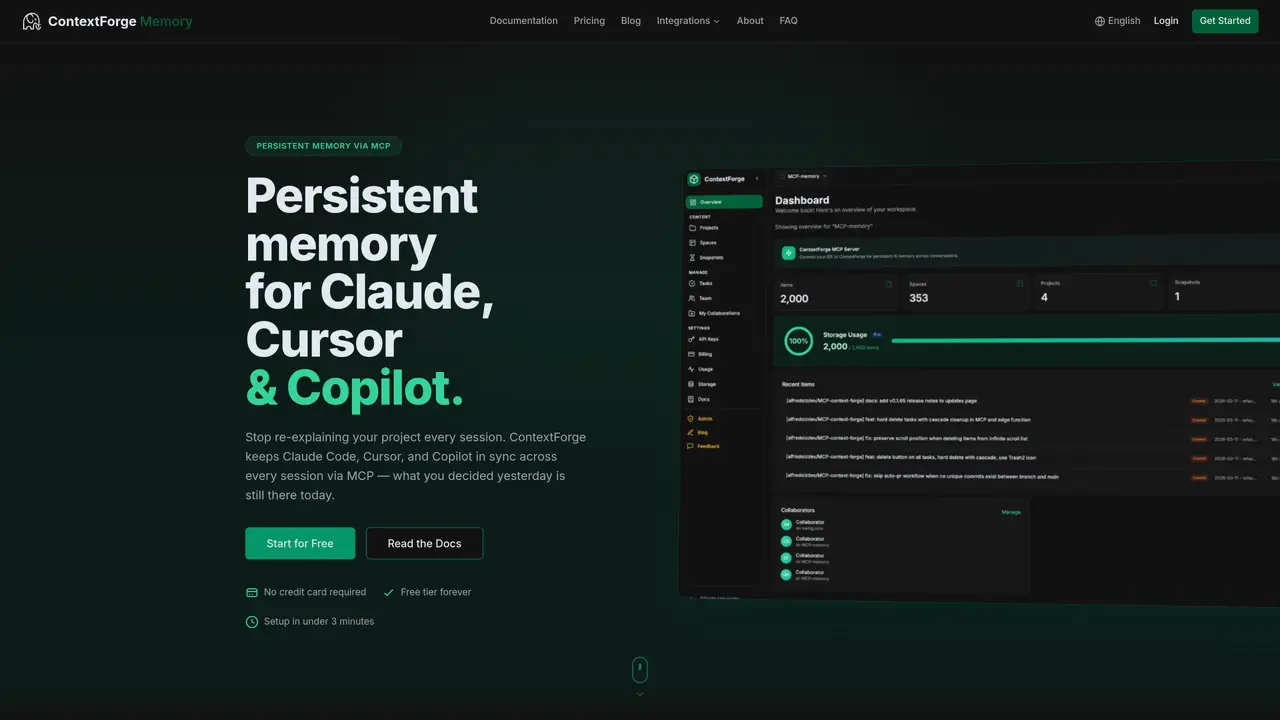
About ContextForge Memory
ContextForge Memory provides persistent memory for AI coding agents such as Claude Code, Cursor, and GitHub Copilot through the MCP protocol. It eliminates the need to repeatedly explain project context by maintaining memory across sessions, including architecture decisions, naming conventions, and git history. The tool integrates with existing workflows via a simple MCP configuration change, enabling agents to retain and retrieve relevant project knowledge automatically. It supports semantic search, git integration, and real-time session presence tracking to coordinate team work without blocking access. Projects are organized into spaces and grouped under projects, with each space maintaining its own embeddings index for focused retrieval. Users can import and export data, manage API keys, and create snapshots for backup. The service offers a free tier with limited queries and storage, alongside paid plans for higher usage and team collaboration.
Key features
- Persistent memory via MCP
- Semantic search in plain English
- Git integration and auto-sync
- Projects and spaces organization
- Session presence tracking
- API keys management
- Import/export functionality
- Snapshots for backup and restore
Use cases
- Maintaining project context across multiple AI coding sessions
- Team collaboration with shared project memory
- Semantic search for codebase documentation and decisions
Pros
- Persistent memory across sessions via MCP
- Semantic search for natural language queries
- Git integration for automatic sync with repositories
- Real-time session presence tracking
- Projects and spaces for organized knowledge management
Cons
- Limited free tier with capped queries and storage
- Requires MCP-compatible agent setup
- No mobile or web interface beyond desktop apps
Frequently asked questions about ContextForge Memory
What is ContextForge Memory and what does it do?
ContextForge Memory provides persistent memory for AI coding agents like Claude Code, Cursor, and GitHub Copilot via the MCP protocol. It retains project context across sessions, including architecture decisions, naming conventions, and git history, eliminating the need to repeatedly explain the project.
Which AI coding agents are compatible with ContextForge Memory?
ContextForge Memory works with AI coding agents such as Claude Code, Cursor, GitHub Copilot, ChatGPT desktop app, and Windsurf. It integrates via the MCP protocol to provide persistent memory across these tools.
How do I set up ContextForge Memory with my AI coding agent?
Setup requires adding a JSON block to your MCP config file, which typically takes under three minutes. Once configured, the agent will automatically retain and retrieve relevant project knowledge across sessions.
Does ContextForge Memory support team collaboration?
Yes, projects are organized into spaces and grouped under projects, allowing teams to share context and control access. Session presence tracking also helps coordinate team work in real time without blocking access.
What features does ContextForge Memory offer for project organization?
It supports organizing projects into spaces with separate embeddings indexes for focused retrieval. Users can manage API keys, import and export data, create snapshots for backup, and track tasks within the platform.
Is there a free tier available for ContextForge Memory?
Yes, ContextForge Memory offers a free tier with limited queries and storage. Paid plans are available for higher usage and additional team collaboration features.