
OpenAI builds and deploys advanced AI models like GPT-4o for autonomous agents and workflows.
Efficio
0Popularity
About Efficio
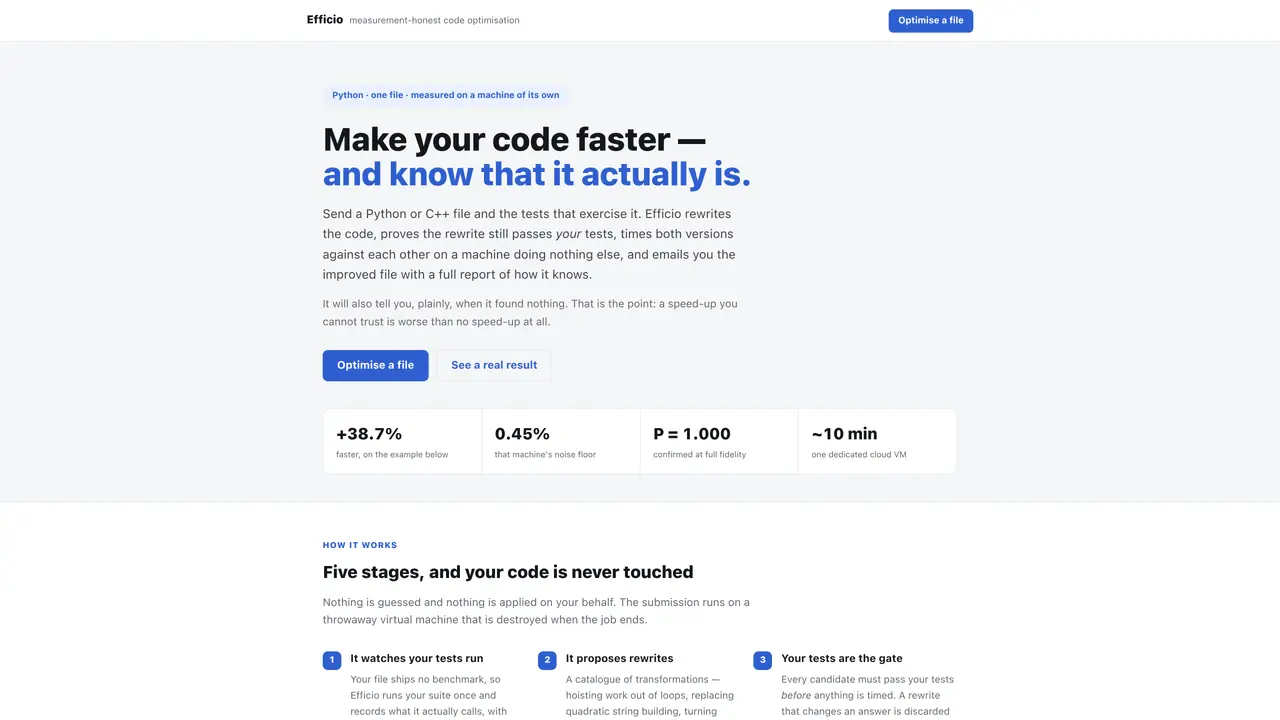
Efficio optimises Python or C++ source files by rewriting them and verifying that the changes preserve correctness. It runs the provided test suite to identify the actual code paths exercised, then applies a catalogue of transformations such as loop hoisting, set-based membership tests, and quadratic string building optimisations. Each candidate rewrite is validated against the tests before any timing begins. Survivors are measured on a dedicated cloud virtual machine, interleaving the original and rewritten versions to control for machine noise. The result is delivered by email as an improved source file, a diff, and a PDF report detailing the measured speed-up or memory changes. The process is fully automated but produces checkable evidence rather than opaque claims.
Key features
- Automated test-driven rewrite validation
- Exhaustive application of known optimisation patterns
- Dedicated cloud VM for isolated, low-noise measurement
- Interleaved before/after timing to control drift
- Memory and latency reporting on separate axes
- Full PDF report with diff, metrics, and reasoning
- Email delivery of results and improved file
- Explicit handling of ‘no change’ and ‘could not measure’ outcomes
Use cases
- Optimising hot code paths in Python web applications
- Refactoring C++ numerical libraries for performance
- Validating compiler-like transformations without manual benchmarking
Pros
- Preserves correctness by validating every rewrite against user tests before measurement
- Reports both speed and memory impact, avoiding misleading single-axis claims
- Runs on a dedicated, isolated cloud VM to minimise measurement noise
- Provides a full PDF report with raw data and reasoning
- Explicitly reports when no optimisation is possible
Cons
- Limited to Python and C++ files, one file at a time
- Requires PyPI-only packages; git repositories, URLs, and local paths are not accepted
- No direct integration with version control systems or automated deployment
- JavaScript engine exists but is not exposed on this interface
Frequently asked questions about Efficio
What does Efficio do?
Efficio optimises Python or C++ source files by rewriting them and verifying that the changes preserve correctness. It runs the provided test suite to identify actual code paths, applies transformations, validates each rewrite against the tests, and measures performance on a dedicated cloud virtual machine before delivering an improved source file, diff, and PDF report.
Who is Efficio for?
Efficio is for developers or teams working with Python or C++ who want to optimise their code while ensuring correctness. It suits those who need measurable, verifiable performance improvements rather than opaque claims.
How does Efficio ensure the optimisations are correct?
Every candidate rewrite must pass the original test suite before any timing begins. The process records which code paths are exercised and discards any rewrite that alters the output, ensuring correctness before performance is measured.
What kind of optimisations does Efficio apply?
Efficio applies transformations such as loop hoisting, set-based membership tests, and optimisations for quadratic string building. These are applied exhaustively, not sampled, based on the code paths identified by the test suite.
How does Efficio measure performance?
Surviving rewrites are measured on a dedicated, quiet cloud virtual machine, interleaving the original and rewritten versions to control for machine noise. The results include speed-up and memory changes, delivered via email with a PDF report.
What are the limitations of Efficio?
Efficio currently supports Python or C++ files one at a time and only installs packages from PyPI by name. It does not support JavaScript optimisation on this page, and URLs, git repositories, or local paths for package installation are refused.