
OpenAI builds and deploys advanced AI models like GPT-4o for autonomous agents and workflows.

Euthynos
FreeStarting price
0Popularity
About Euthynos
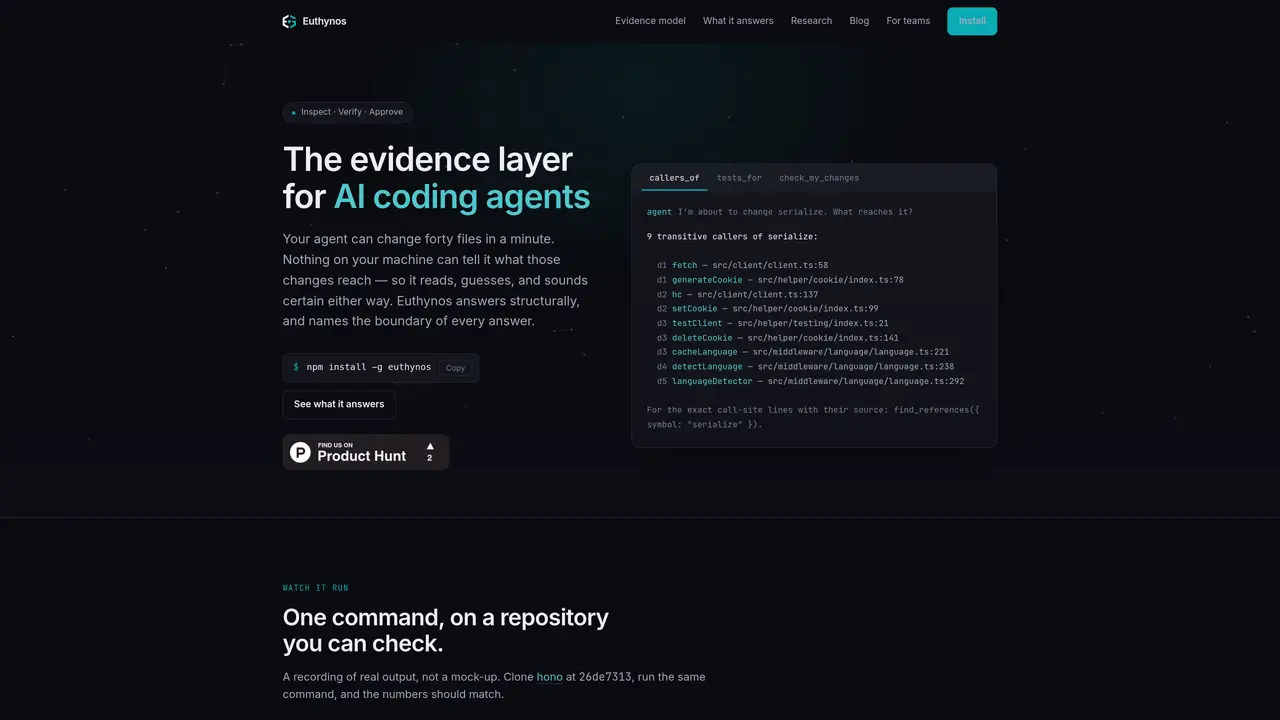
Euthynos serves as an evidence layer for AI coding agents by providing structural insights into codebases without making prescriptive claims about safety or correctness. It maps code dependencies, call graphs, and test relationships to help agents understand what changes affect, what tests relate to a symbol, and what boundaries are crossed. The tool indexes repository structure, tracks changes, and generates route-labeled evidence such as callers, tests, and potential blast radius, all while clearly defining the boundaries of its analysis. Euthynos operates through read-only queries, producing outputs that specify what was examined and what was excluded due to size or parse failures. It supports teams in verifying AI-generated changes by offering measurable signals about code locality, health, and impact rather than asserting architectural soundness. The system is designed to assist human reviewers by providing factual, boundary-aware evidence to inform decisions about code changes. It integrates with AI agents via 23 read-only tools over the MCP protocol, ensuring no modifications are made to the repository except for a gitignored index that can be safely deleted. The tool emphasizes transparency by stating the limitations of its analysis, such as its inability to detect dynamic dispatch or unindexed files, and by clearly labeling the methods used to derive evidence, such as structural resolution versus name conventions.
Key features
- Transitive call graph resolution with depth and location
- Change impact analysis with modified symbols and blast radius
- Route-labeled test discovery without coverage claims
- Near-duplicate implementation detection
- Repository mapping with structural signals
- Boundary violation checks for deep imports
- Symbol and reference lookup with span-accurate source reads
- Health and locality metrics with named inputs
Use cases
- Auditing AI agent changes to identify affected functions and tests
- Reviewing refactors or large code edits for unintended impacts
- Understanding test coverage relationships for specific symbols
Pros
- Provides structural evidence without asserting correctness
- Maps transitive callers and test relationships with depth and location
- Supports 23 read-only tools over MCP for agent integration
- Reports exclusions and boundaries explicitly
- Measured signals like health and locality with named inputs
Cons
- Limited to static analysis; does not handle dynamic dispatch or reflection
- Only examines tracked code files; excludes binary or oversized blobs
- Strongest resolution in TypeScript; weaker in other languages
- No claims about architectural soundness or safety
Frequently asked questions about Euthynos
What does Euthynos do?
Euthynos provides structural evidence for AI coding agents by mapping code dependencies, call graphs, and test relationships. It answers questions about what a change affects, which tests relate to a symbol, and what boundaries are crossed, without asserting architectural soundness.
Who is Euthynos designed for?
Euthynos is designed for teams using AI coding agents who need to verify changes and understand their impact. It assists human reviewers by providing measurable signals about code locality, health, and change impact.
How does Euthynos work?
Euthynos operates by indexing repository structure, tracking changes, and producing route-labeled evidence such as callers, tests, and blast radius. It uses read-only queries and outputs evidence with clear boundaries, including what was examined and what was excluded.
What kind of evidence does Euthynos provide?
Euthynos provides evidence such as transitive callers with depth and location, changed symbols and their blast radius, route-labeled test files, near-duplicate implementations, and structural signals about the repository. It never claims to verify safety or correctness.
Does Euthynos modify the repository?
No, Euthynos does not modify the repository. It only writes a gitignored index that is safe to delete at any time. All interactions are read-only, and the tool operates via 23 read-only tools over the MCP protocol.
What are the limitations of Euthynos?
Euthynos cannot detect dynamic dispatch, unindexed files, or production-specific behaviors. Its analysis is limited to structural resolution, name conventions, and text matches, and it explicitly states the boundaries of its findings.