
OpenAI builds and deploys advanced AI models like GPT-4o for autonomous agents and workflows.

FetchSandbox
FreeStarting price
2.1KMonthly visits
5Popularity
About FetchSandbox
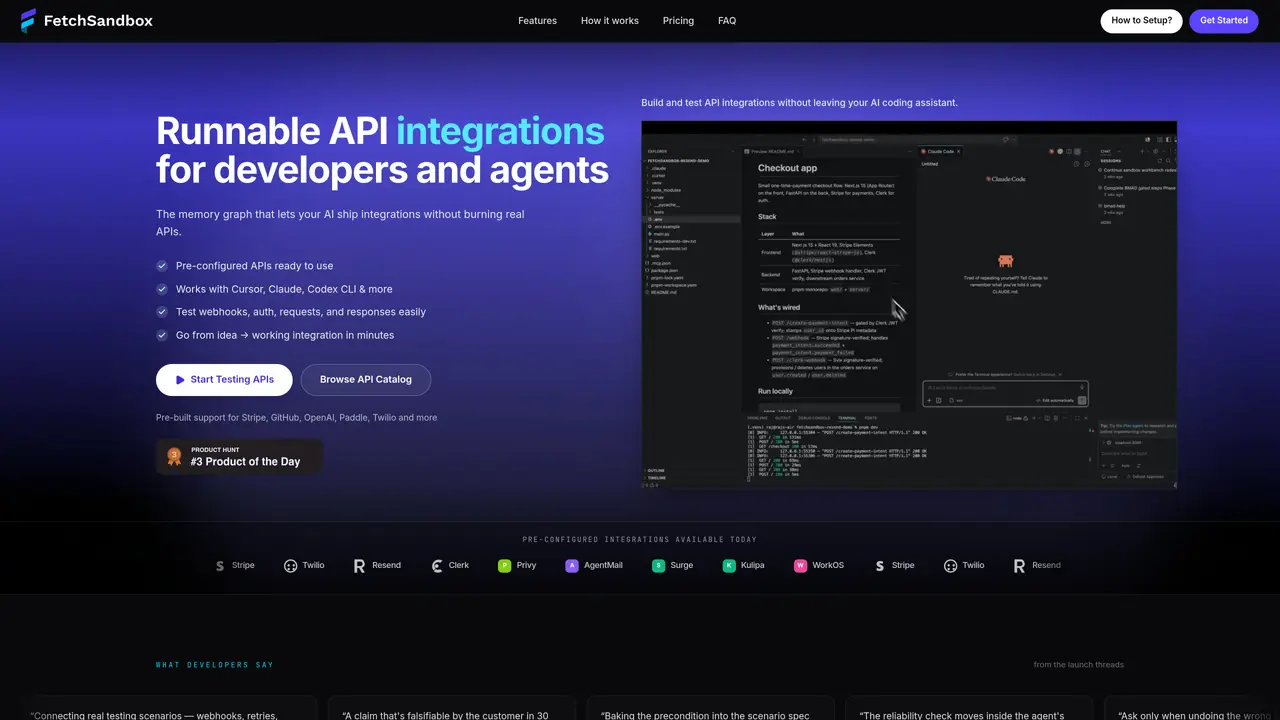
FetchSandbox provides runnable API environments that simulate real integrations without consuming production resources. It integrates with AI coding assistants like Cursor and Claude to let developers test webhooks, authentication, requests, and responses in an isolated sandbox. The tool uses pre-configured APIs and workflows to reproduce end-to-end scenarios, including state changes and webhook delivery, ensuring integrations behave correctly before deployment. Developers can import OpenAPI specs or use bundled APIs for Stripe, GitHub, OpenAI, and others. Each run captures the full workflow state, terminal conditions, and failure modes, producing a replayable receipt for debugging and documentation. The platform emphasizes deterministic testing and avoids burning real API quotas during development.
Key features
- Runnable API integrations without leaving the IDE
- Pre-configured APIs for Stripe, GitHub, OpenAI, Paddle, Twilio, and more
- Webhook simulation and delivery verification
- Stateful workflow testing with terminal state validation
- OpenAPI spec import for custom API testing
- Replayable receipts for debugging and documentation
- CLI and MCP server for integration with AI coding tools
- Private integrations and shared environments for teams
Use cases
- Testing Stripe payment integrations before production
- Debugging webhook delivery and duplicate event handling
- Validating GitHub webhook workflows in isolated sandboxes
Pros
- Simulates real API behavior including state changes and webhooks
- Integrates directly with AI coding assistants via MCP and CLI
- Pre-configured APIs for common services like Stripe and GitHub
- Deterministic test runs with replayable receipts for debugging
- No API keys or production data required for testing
Cons
- Free tier limited to 1,000 runs per month
- Paid plans required for private integrations and higher limits
- Hosted backend dependency for core functionality
- No on-prem option without enterprise plan
Frequently asked questions about FetchSandbox
What does FetchSandbox do?
FetchSandbox provides runnable API environments that simulate real integrations directly within an AI coding assistant like Cursor or Claude. It allows developers to test webhooks, authentication, requests, and responses in an isolated sandbox without consuming production resources or API quotas.
Who is FetchSandbox designed for?
The tool is designed for developers and AI agents who need to build, test, and debug API integrations efficiently. It is particularly useful for those working with pre-configured APIs such as Stripe, GitHub, OpenAI, and others.
How does FetchSandbox integrate with AI coding assistants?
FetchSandbox integrates via MCP (Model Context Protocol), enabling developers to test integrations directly within their AI coding environment like Cursor or Claude Code. This eliminates the need to switch between dashboards or tools.
Can FetchSandbox test webhooks and workflow states?
Yes, FetchSandbox verifies webhook delivery, workflow state changes, and end-to-end behavior, including terminal conditions and failure modes. It reproduces real-world scenarios to ensure integrations behave correctly before deployment.
Does FetchSandbox support importing custom API specifications?
Yes, developers can import OpenAPI specs or use FetchSandbox’s pre-configured APIs for services like Stripe, GitHub, OpenAI, Paddle, Twilio, and others to build and test integrations.
How does FetchSandbox help with debugging and documentation?
Every workflow run in FetchSandbox generates a replayable receipt that captures the full workflow state, terminal conditions, and failure modes. This receipt serves as public, verifiable proof for debugging and documentation purposes.
FetchSandbox Website Engagement
Last Update: 9 days ago
Total Monthly Visits
0
Bounce Rate
0%
Visit Duration (avg)
0.00s
Pages Per Visit
0
Country Rank
0
United States
Global Rank
0
Monthly Traffic
Traffic Sources
Traffic Share By Country
- United States64.1%
- Brazil18.6%
- India9.2%
- Vietnam8.2%