
OpenAI builds and deploys advanced AI models like GPT-4o for autonomous agents and workflows.

Godot MCP Studio
€39Starting price
208Monthly visits
0Popularity
About Godot MCP Studio
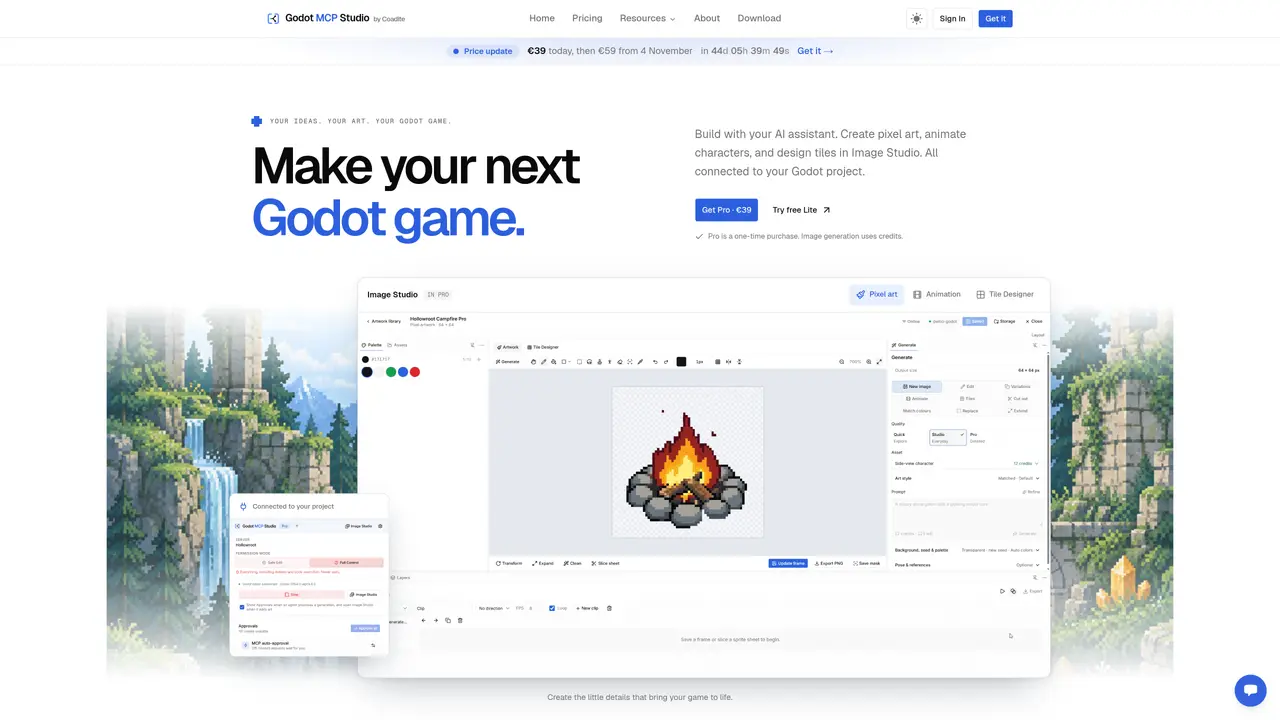
Godot MCP Studio connects AI assistants to a Godot project for game development tasks. The desktop application bridges the Godot editor with supported AI clients such as Claude Code, Cursor, and Cline, enabling agents to work directly within the open project. It includes Image Studio for creating pixel art, animating sprites, and designing tiles, with AI generation available in the Pro version using credits. The tool provides permission modes to control AI actions, including Safe Edit which requests confirmation before deletions or code execution, and Full Control which allows unrestricted changes. Pro features include on-demand playbooks for common game systems, ready-to-install templates, and runtime tools for playtesting by capturing screenshots and inspecting errors. Both Lite and Pro editions run locally with a Rust-based MCP server and a Godot editor addon that maintains a live connection to the project. The setup process is streamlined with a four-step configuration that detects the Godot project and installs the necessary components without requiring terminal commands.
Key features
- Local Rust MCP server
- Godot editor addon with live bridge
- Safe Edit and Full Control permission modes
- Image Studio with pixel art, animation, and tile design tools
- On-demand playbooks for controllers, combat, NPCs, and multiplayer
- Ready-to-install templates for common game systems
- Runtime playtesting with screenshot capture and error inspection
- MCP config generation for multiple AI clients
Use cases
- Developing game assets with AI assistance while maintaining project context
- Prototyping game mechanics using AI-generated templates and playbooks
- Iterative playtesting with AI agents capturing runtime feedback
Pros
- Local-only operation with no cloud dependency
- Live connection to the Godot editor including scene tree and runtime state
- Image Studio for pixel art, animation, and tile design integrated with the project
- Permission modes to control AI actions and prevent unwanted changes
- One-time purchase with lifetime updates for the v1.x line
Cons
- Image generation requires credits in Pro version
- No mobile or web version available
- Windows and macOS only
- Lite edition lacks advanced features like templates and playtesting tools
Frequently asked questions about Godot MCP Studio
What is Godot MCP Studio and what does it do?
Godot MCP Studio connects AI assistants like Claude Code, Cursor, or Cline directly to a Godot project, enabling agents to perform game development tasks such as creating pixel art, animating sprites, designing tiles, and editing code within the open project.
Who is Godot MCP Studio designed for?
The tool is designed for game developers, artists, and teams who want to integrate AI assistants into their Godot workflow to streamline tasks such as asset creation, scripting, and playtesting.
What are the permission modes available in Godot MCP Studio?
The tool offers two permission modes: Safe Edit, which requests confirmation before deletions or code execution, and Full Control, which allows unrestricted changes by the AI assistant.
Does Godot MCP Studio support image generation?
Yes, Image Studio in the Pro version supports AI-generated pixel art, animations, and tiles using credits, while drawing and editing tools are available without credits.
How do I set up Godot MCP Studio?
Setup involves four steps: selecting your Godot project, installing the editor addon with one click, generating the MCP configuration for your AI client, and testing the connection to start building.
What integrations does Godot MCP Studio support?
The tool supports major AI clients including Claude Code, Cursor, Codex, Gemini CLI, Cline, Windsurf, OpenCode, Zed, Antigravity, and VS Code through MCP configuration files.
Godot MCP Studio Website Engagement
Last Update: 19 hours ago
Total Monthly Visits
0
Bounce Rate
0%
Visit Duration (avg)
—
Pages Per Visit
0
Country Rank
—
Unknown
Global Rank
—