OpenAI builds and deploys advanced AI models like GPT-4o for autonomous agents and workflows.

GPT-3 Python Sandbox
$0.07Starting price
0Popularity
About GPT-3 Python Sandbox
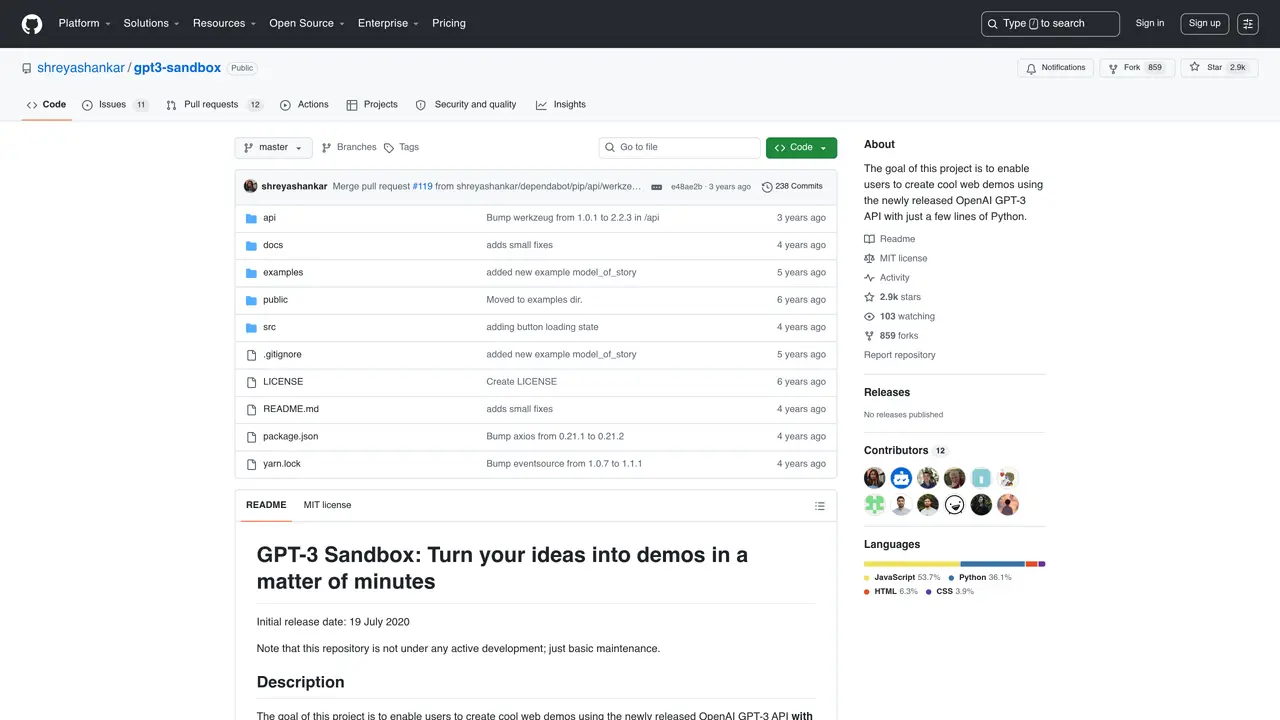
GPT-3 Python Sandbox is an open-source tool that provides easy access to the powerful GPT-3 natural language processing (NLP) API. With GPT-3 Python Sandbox, developers can quickly implement advanced NLP applications without having to write complex code. This makes it an ideal choice for developers of all skill levels, from beginners to experienced professionals. GPT-3 Python Sandbox offers a range of features that make it simple to use. It provides an intuitive user interface, making it easy to configure and use the API. It also offers pre-trained models and templates, so you don’t have to spend time building your own. In addition, it supports a variety of languages, including English, French, Spanish, and Chinese. With GPT-3 Python Sandbox, developers can create applications that can understand and respond to human language.
GitHub, Inc.
San Francisco, California, US · Founded 2008
- Founders
- Tom Preston-Werner, Chris Wanstrath, PJ Hyett, Scott Chacon
- Founded
- 2008
- Headquarters
- San Francisco, California, US
- Legal status
- Subsidiary of Microsoft (NASDAQ: MSFT)
Key features
- Easy access to the powerful GPT-3 NLP API
- Intuitive user interface for easy configuration and use
- Pre-trained models and templates for quick implementation
- Supports multiple languages, including English, French, Spanish, and Chinese
- Create applications that can understand and respond to human language
Use cases
- Generate natural language responses to user queries
- Create automated dialogue agents
- Automatically build and deploy NLP applications
Pros
- Simplifies creation of web demos using GPT-3 with minimal Python code
- Provides a local web app for testing and showcasing ideas without complex setup
- Includes pre-configured examples to demonstrate priming GPT-3 for specific tasks
- Offers a structured approach to format inputs and outputs for effective pattern-matching
- Open-source and community-maintained with accessible documentation
Cons
- Not intended for production use, limiting scalability and reliability
- Requires manual setup of Python, Node.js, and OpenAI API key
- Lacks active development, which may result in outdated dependencies or features
- Limited to local deployment, restricting remote accessibility and collaboration
Frequently asked questions about GPT-3 Python Sandbox
What is GPT-3 Python Sandbox?
GPT-3 Python Sandbox is an open-source tool designed to help users create web demos using the OpenAI GPT-3 API with minimal Python code. It simplifies the process of priming the model and deploying interactive demonstrations.
Who is GPT-3 Python Sandbox for?
The tool is aimed at developers, researchers, and enthusiasts who want to experiment with GPT-3 without extensive web development or complex API integration. It is suitable for those looking to quickly prototype NLP applications.
How do I get started with GPT-3 Python Sandbox?
To get started, clone or fork the repository, set up a Python virtual environment, install dependencies (including Node.js and yarn), and configure your OpenAI API key. Example scripts are provided to guide initial usage.
Does GPT-3 Python Sandbox support custom prompts?
Yes, the tool allows users to prime GPT-3 with custom examples directly in the code or via the web interface. Users can define input-output pairs to guide the model's responses for specific tasks.
What are the technical requirements for running GPT-3 Python Sandbox?
The tool requires Python 3, an OpenAI API key, Node.js 16, and yarn for frontend dependencies. A virtual environment is recommended for setup, and the backend uses Flask while the frontend is built with React.
Is GPT-3 Python Sandbox suitable for production use?
No, the repository is not intended for production use. It is designed for experimentation, prototyping, and demonstration purposes, with basic maintenance only.