
Revolutionize transcription with unmatched accuracy, speed, and language support.
CMU Pocketsphinx
0Popularity
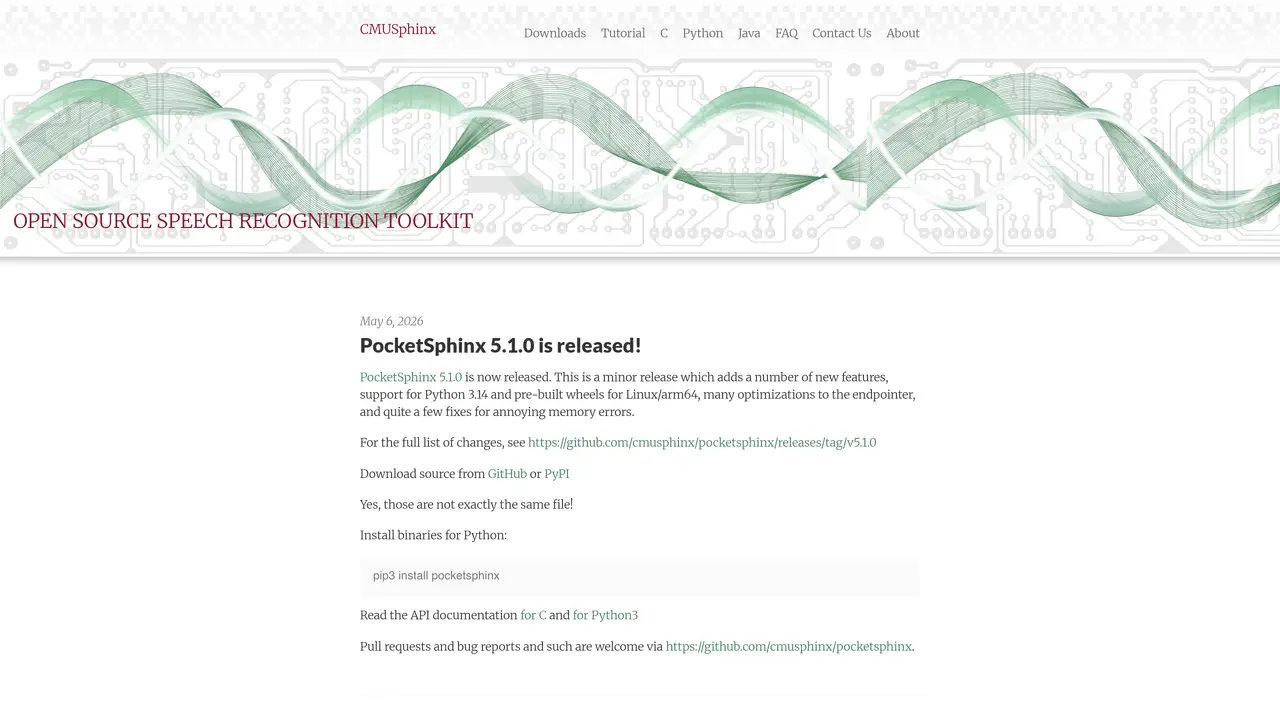
About CMU Pocketsphinx
CMU Pocketsphinx is an open-source, real-time speech recognition system developed by Carnegie Mellon University. It is designed to recognize spoken language from a wide range of sources, including voice commands, dictations, and natural conversations. With this powerful tool, users can quickly and easily convert speech into text, making it a great choice for a variety of applications.CMU Pocketsphinx is highly accurate and offers a wide range of features. It can recognize multiple languages, including English, Spanish, French, and Chinese, and can be trained to recognize new languages. It also supports speech-to-text dictation, allowing users to quickly and accurately transcribe their spoken words into text. Additionally, its advanced noise reduction capabilities make it suitable for use in noisy environments.For developers, CMU Pocketsphinx is also a great choice. It is easy to install and comes with extensive documentation and tutorials.
Key features
- Convert spoken words to text quickly and accurately
- Recognize multiple languages, including English, Spanish, French, and Chinese
- Advanced noise reduction capabilities for noisy environment use
- Supports speech-to-text dictation
- Can be trained to recognize new languages
- Easy to install and comes with extensive documentation and tutorials
Use cases
- Transcribing spoken words into text for documents, emails, or other written content
- Recognizing voice commands or dictations in a noisy environment
- Converting audio recordings into text for analysis or transcription purposes
Pros
- Open-source and freely available for modification and redistribution
- Supports multiple programming languages including C, Python, and Java
- Offers real-time speech recognition with noise reduction capabilities
- Regularly updated with new features and bug fixes
- Provides pre-built binaries for easier installation across platforms
Cons
- Requires technical knowledge for installation and configuration
- Limited language support compared to some commercial alternatives
- Documentation may be less accessible for non-developers
Frequently asked questions about CMU Pocketsphinx
What is CMU Pocketsphinx?
CMU Pocketsphinx is an open-source speech recognition toolkit developed by Carnegie Mellon University. It converts spoken language into text in real time and supports multiple programming languages including C and Python.
Who should use CMU Pocketsphinx?
Developers and researchers who need an offline, lightweight speech recognition system for applications such as voice commands, dictation, or transcription in various languages.
How do I install CMU Pocketsphinx?
Pocketsphinx can be installed via pip for Python users with the command 'pip3 install pocketsphinx'. Source code is also available on GitHub for manual installation and customization.
Does CMU Pocketsphinx support multiple languages?
Yes, it supports several languages including English, Spanish, French, and Chinese, with the ability to be extended or trained for additional languages.
What programming languages are supported by CMU Pocketsphinx?
Pocketsphinx provides APIs for C and Python, allowing integration into applications written in these languages.
Where can I find documentation or support for CMU Pocketsphinx?
Extensive documentation is available for both C and Python APIs on the official website. Users can also report issues or contribute via the GitHub repository.