
OpenAI builds and deploys advanced AI models like GPT-4o for autonomous agents and workflows.

hax
2.3KMonthly visits
6Popularity
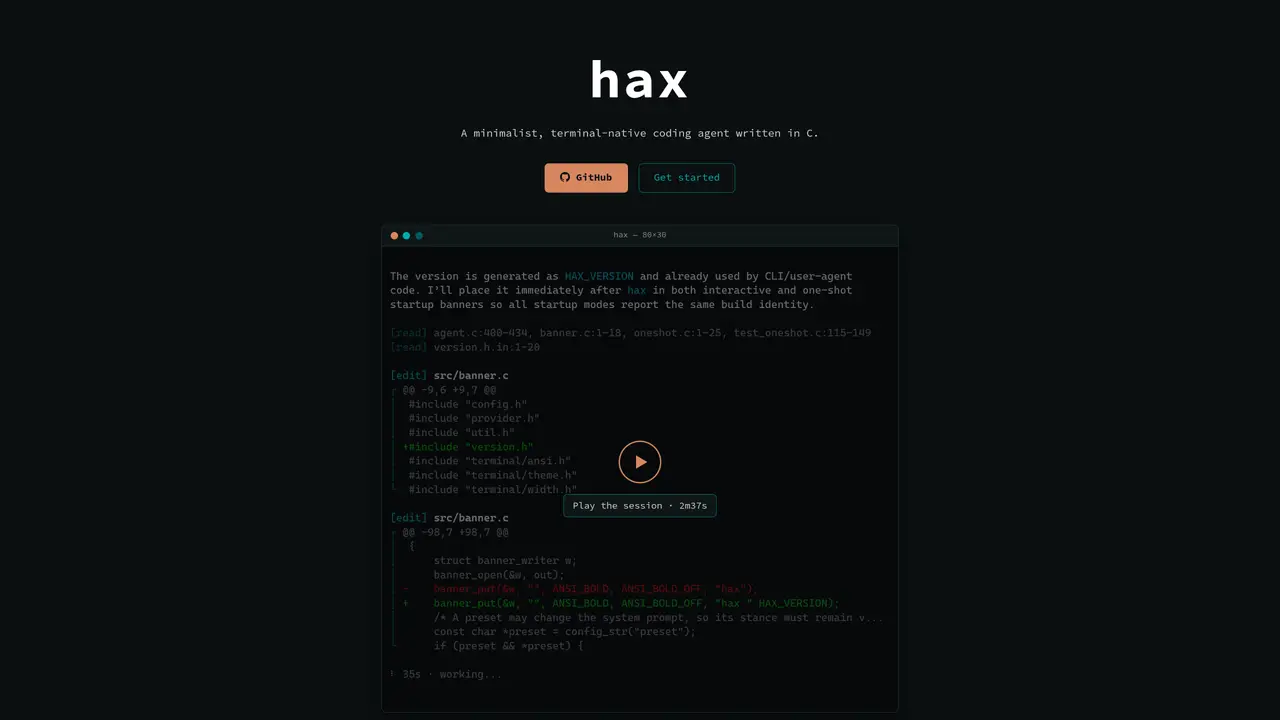
About hax
hax is a terminal-native coding agent designed for developers who prefer working within a command-line environment. It operates as a lightweight, single-binary tool written in C, minimizing dependencies and memory usage while maximizing responsiveness. The agent auto-discovers local model and runtime capabilities, supporting providers like llama.cpp, OpenAI, Anthropic, and OpenRouter without requiring complex configuration. It streams Markdown and tool output directly to the terminal, preserving native scrollback and avoiding terminal takeover. Sessions are inspectable through a transcript view and optional wire protocol traces, providing transparency into model interactions. hax adheres to Unix conventions, using XDG paths, plain-text config files, and subprocess-based composition rather than plugin architectures. It targets developers who run local models, audit tools, package software, or operate in resource-constrained environments.
Key features
- Terminal-native streaming output
- Auto-discovery of local models
- Transcript and trace inspection
- XDG path compliance
- Plain-text config and session files
- Subprocess-based composition
- Multiple provider support
- @file completion with fzf
Use cases
- Running local models in resource-constrained environments
- Auditing AI tool behavior through inspectable sessions
- Automating coding tasks within a terminal workflow
Pros
- Single native C binary with minimal dependencies
- Auto-discovers local model and runtime capabilities
- Streams Markdown and tool output while preserving terminal scrollback
- Inspectable sessions with transcript and wire protocol traces
- Supports multiple providers including llama.cpp, OpenAI, and Anthropic
Cons
- No Windows native support; requires WSL
- BSD systems require building from source
- Lacks plugin runtime or IDE integration
- No per-command permission prompts
Frequently asked questions about hax
What is hax and what does it do?
hax is a terminal-native coding agent written in C, designed for developers who prefer working in a command-line environment. It functions as a lightweight, single-binary tool that auto-discovers local model and runtime capabilities, supporting providers like llama.cpp, OpenAI, Anthropic, and OpenRouter without requiring complex configuration.
Who is hax designed for?
hax targets developers who live in the terminal, run local models, audit tools, package software, or operate in resource-constrained environments. It is ideal for those who prefer minimalist, Unix-compliant tools over feature-heavy alternatives.
How does hax handle terminal output and sessions?
hax streams Markdown and tool output directly to the terminal while preserving native scrollback and avoiding terminal takeover. Sessions are inspectable through a transcript view and optional wire protocol traces, providing transparency into model interactions.
What providers does hax support?
hax supports a broad range of providers, including OpenAI and compatible services, Anthropic, Codex via ChatGPT subscription, OpenRouter, OpenCode, Zen/Go, and llama.cpp. Additional providers are documented in the providers.md file.
How do I get started with hax?
To get started, install hax via Homebrew, download a prebuilt binary, or build from source. Run hax from the project directory you want it to work in, either interactively or in one-shot mode. The interactive REPL allows you to select providers and models dynamically.
Does hax work on Windows?
hax runs natively on Linux, macOS, FreeBSD, and OpenBSD. On Windows, it requires use under the Windows Subsystem for Linux (WSL). Prebuilt static binaries are available for Linux and macOS, while BSD systems require building from source.
hax Website Engagement
Last Update: 9 days ago
Total Monthly Visits
0
Bounce Rate
0%
Visit Duration (avg)
0.00s
Pages Per Visit
0
Country Rank
0
Denmark
Global Rank
0