OpenAI builds and deploys advanced AI models like GPT-4o for autonomous agents and workflows.

Octomus
0Popularity
About Octomus
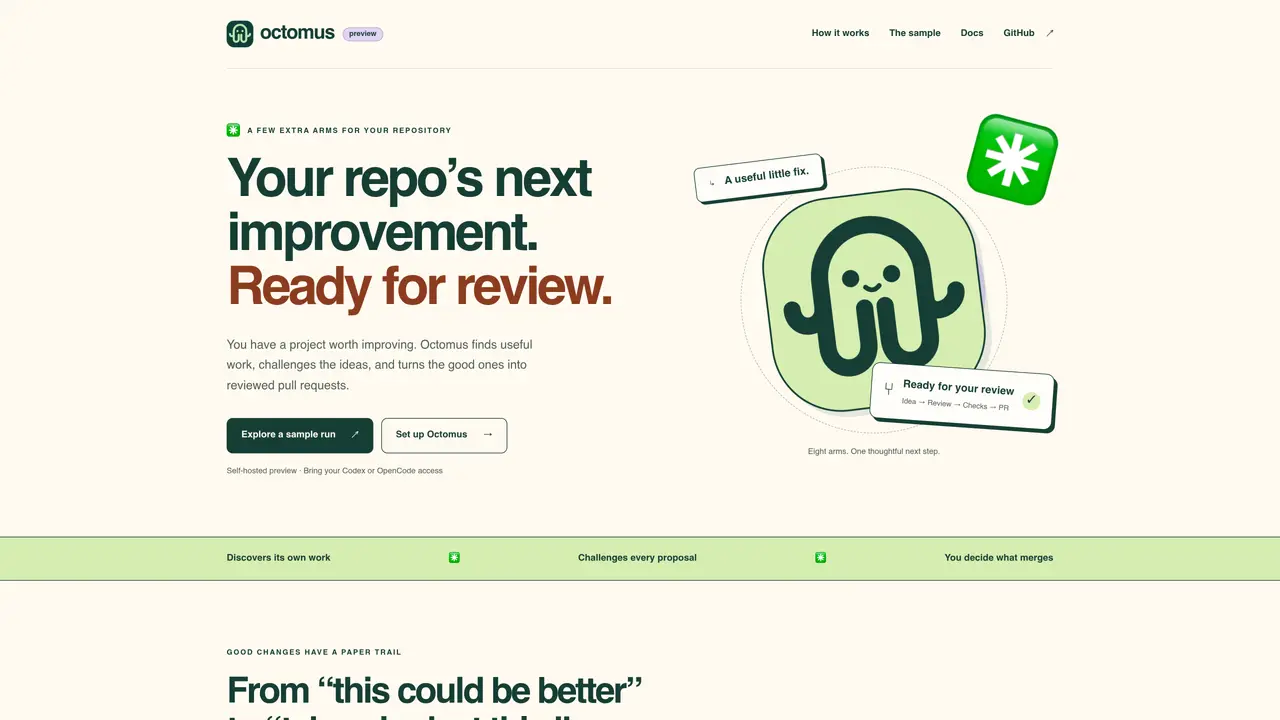
Octomus is a self-hosted software agent that operates on a dedicated Ubuntu 24.04 VM to improve a single GitHub repository. It discovers potential improvements by analyzing code, project instructions, history and existing pull-request context. Each proposal is independently reviewed by two agents before acceptance, deferral or rejection. Accepted work is built, re-reviewed and verified against configured checks before a pull request is published with supporting evidence. The operator retains full control over merging and deployment. A dashboard shows proposed, delivered and deferred work, allowing configuration of models, checks, session limits and open-PR caps. The tool supports Codex or OpenCode models and can run audits that recommend improvements without queuing code changes.
Key features
- Discovers improvements from repository context
- Dual independent reviewers per proposal
- Isolated checkout and fresh code review for accepted work
- Configurable verification commands and checks
- Audit mode for non-destructive recommendations
- Dashboard for monitoring and configuration
- Model selection between Codex and OpenCode
- Pause and cancel controls for active tasks
Use cases
- Automated refactoring of small, well-scoped bugs
- Proposing targeted optimizations with benchmark requirements
- Generating pull requests for low-risk documentation improvements
Pros
- Self-hosted deployment on dedicated VM
- Independent dual review of every proposal
- Full control over merging and deployment
- Audit mode for recommendations without code changes
- Transparent decision records and evidence trail
Cons
- Requires dedicated Ubuntu 24.04 VM
- No hosted service available yet
- Public binaries and crates.io installation pending
- Limited to one repository per instance
Frequently asked questions about Octomus
How is Octomus different from giving an AI a task directly?
Octomus discovers potential improvements by analyzing repository context, such as code, project instructions, and history, rather than relying solely on direct instructions. It employs two independent reviewers to challenge proposals before acceptance, ensuring thorough evaluation before any changes are made.
Does Octomus merge or deploy changes automatically?
No. Octomus delivers GitHub pull requests with supporting evidence, but the operator retains full control over merging and deployment. The tool can pause new work while allowing active tasks to complete and publish.
What does it cost to use Octomus?
Users provide a dedicated Ubuntu 24.04 VM and access to Codex or OpenCode models, whose costs depend on the provider and usage. Octomus itself does not impose a dollar cap but uses a session-admission budget as an operating limit.
Can I run Octomus on my laptop?
The supported model requires a dedicated Ubuntu 24.04 VM with no unrelated credentials. While it can be configured on a laptop for testing, the production setup is designed for a dedicated VM to maintain security boundaries.
Is the demo on the website a real run?
No. The public walkthrough and screenshots use synthetic data to illustrate the interface and decision process, including failures. They do not represent real delivery, reliability, speed, or savings.
Where can I ask questions or report bugs?
Use GitHub issues to provide feedback or report reproducible bugs. For security vulnerabilities, follow the project's security policy. Avoid including tokens or private repository data in reports.