
OpenAI builds and deploys advanced AI models like GPT-4o for autonomous agents and workflows.

Prelint
$1Starting price
1.2KMonthly visits
1Popularity
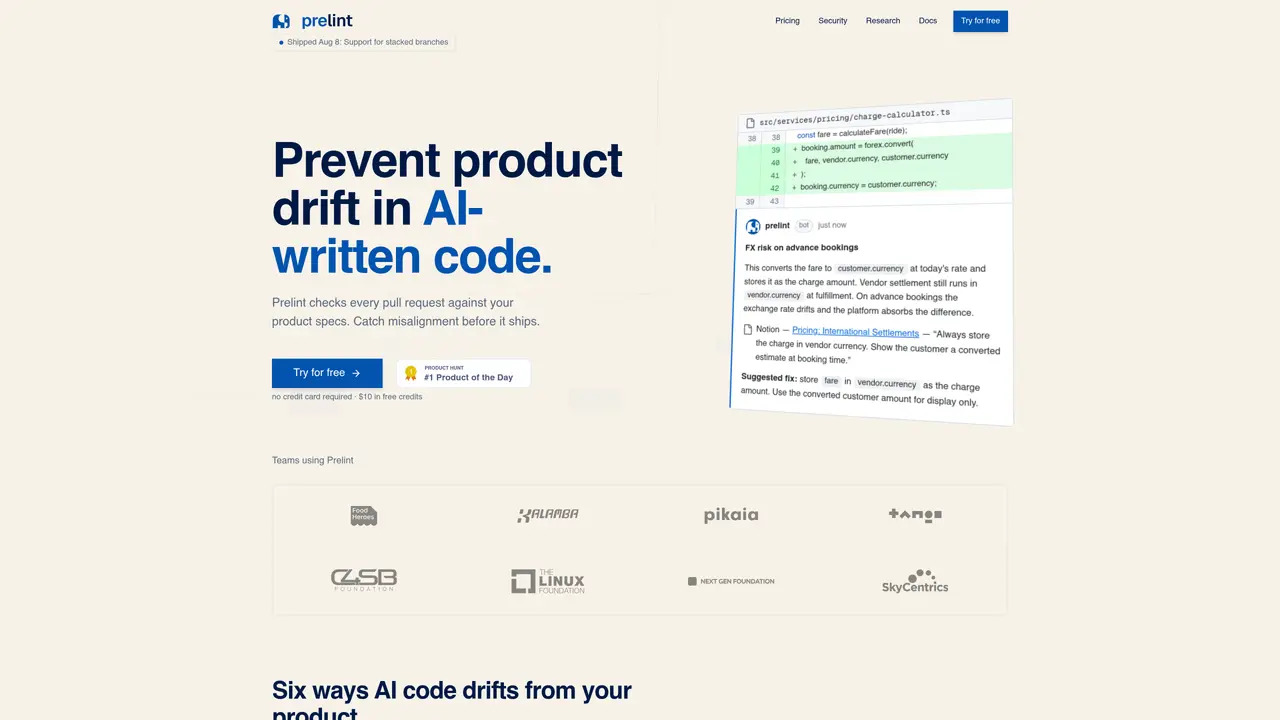
About Prelint
Prelint reviews pull requests against product specifications to prevent AI-generated code from drifting from intended business logic, compliance rules, tooling standards, domain language, and scope. It enforces consistency by checking for contradictions, conflicting technology choices, and duplicated effort before code ships. The tool integrates with GitHub and runs automatically on every pull request, providing machine-readable constraints and inline findings without requiring human meetings. Engineers remain in flow while stakeholders receive grounded answers to product questions directly from the specs. Prelint also supports teams using AI agents by allowing longer iterations without manual oversight, provided product intent is enforced automatically. Product specifications are stored in GitHub and checked for completeness and alignment with existing decisions.
Key features
- Automated product review for pull requests
- Machine-readable product constraints
- Inline findings and summary comments
- Spec compliance checks for business logic and compliance rules
- Support for re-reviews after new commits
- Real-time balance and burn-down tracking
- Monthly spending limit controls
- Auto recharge with configurable thresholds
Use cases
- Preventing AI code drift in business logic and pricing rules
- Ensuring compliance with regulatory and internal policies
- Maintaining consistent domain language across codebases
Pros
- Checks pull requests against product specifications automatically
- Provides machine-readable constraints and inline findings
- Integrates with GitHub and runs on every pull request
- Answers product questions without interrupting engineers
- Offers pay-per-use pricing with no seats or subscriptions
Cons
- No free tier beyond initial credits
- Requires GitHub integration
- Pricing model may be less predictable for high-volume teams
- Limited to pull request-based review
Frequently asked questions about Prelint
What does Prelint do?
Prelint reviews every pull request against product specifications to prevent AI-generated code from drifting from intended business logic, compliance rules, tooling standards, domain language, and scope. It catches misalignments before code ships and enforces consistency automatically.
Who is Prelint designed for?
Prelint is designed for engineering teams, product managers, and stakeholders who use AI to generate code and need to ensure it adheres to product intent, compliance, and business logic without manual oversight.
How does Prelint integrate with existing workflows?
Prelint integrates with GitHub and runs automatically on every pull request, providing machine-readable constraints and inline findings without requiring human meetings. It stores product specifications in GitHub and checks them for completeness and alignment.
Can Prelint help with compliance and regulatory requirements?
Yes, Prelint checks for compliance risks such as data storage without consent flows or retention policy violations by comparing pull requests against product specifications to ensure adherence to regulatory rules.
Does Prelint support teams using AI agents?
Yes, Prelint supports teams using AI agents by allowing longer iterations without manual oversight, provided product intent is enforced automatically through continuous feedback and product review.
How do stakeholders get answers to product questions using Prelint?
Stakeholders can ask product questions and receive grounded answers directly from the specs, without interrupting engineers. Engineers remain in flow while stakeholders get clear, spec-based responses.
Prelint Website Engagement
Last Update: 9 days ago
Total Monthly Visits
0
Bounce Rate
0%
Visit Duration (avg)
—
Pages Per Visit
0
Country Rank
0
India
Global Rank
0