
OpenAI builds and deploys advanced AI models like GPT-4o for autonomous agents and workflows.

Warren
0Popularity
About Warren
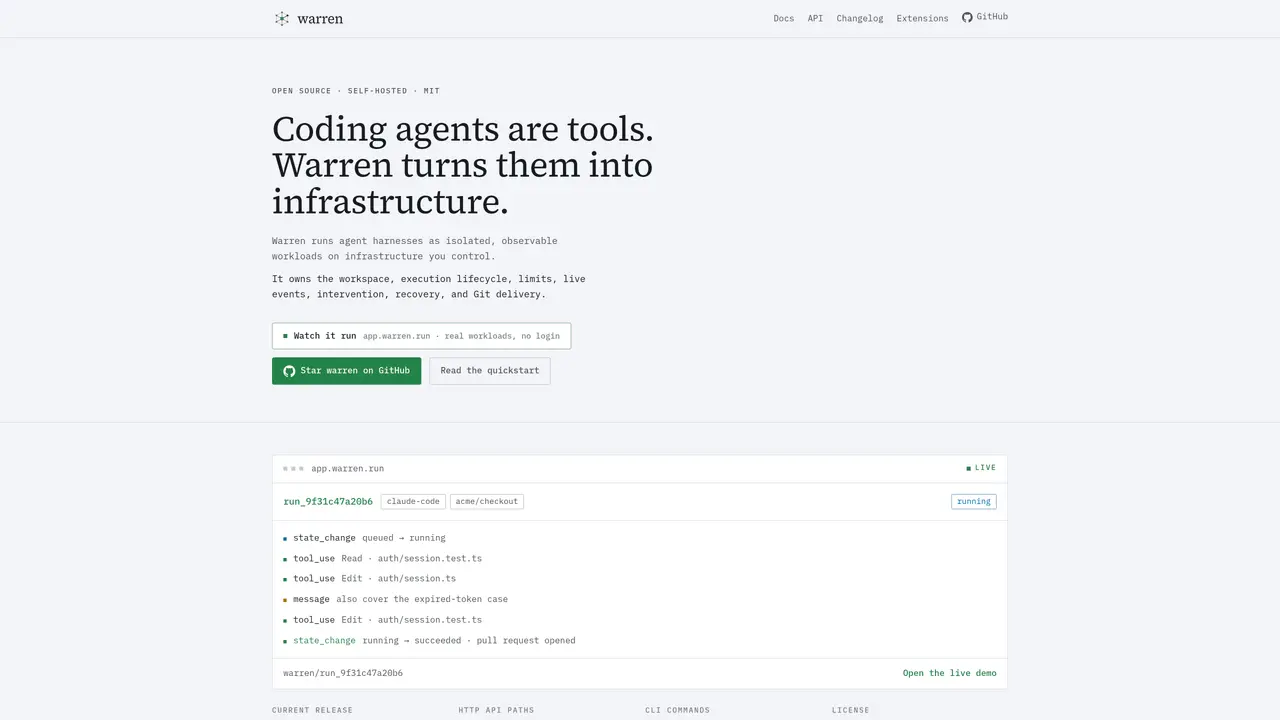
Warren provides infrastructure for executing coding-agent workloads as isolated, observable jobs on infrastructure under user control. It manages the full lifecycle of agent runs from workspace preparation through Git delivery, including sandboxed execution, live event streaming, spend limits, and optional intervention. The system supports multiple execution backends such as local boxes with bwrap, sibling Docker containers, or Kubernetes pods, and includes runtime adapters for agents like Pi and Claude Code. Each run receives a disposable workspace, and Warren persists run records, outcomes, costs, and Git delivery facts for later inspection. Operators can start runs via CLI, schedule, or HTTP API, with concurrency and budget limits enforced during execution. The base service records structured events and outcomes, while optional extensions provide additional capabilities such as append-only audit logs or independent verdicts on finished runs.
Key features
- Isolated sandboxed execution per run
- Live event streaming and structured run records
- Spend and concurrency limits enforcement
- Workspace refresh and disposable run branches
- Git delivery with optional pull request creation
- Multiple execution backends (bwrap, Docker, Kubernetes)
- Runtime adapters for Pi and Claude Code
- Optional audit-log and judge extensions
Use cases
- Running unattended agent workloads that must survive failures
- Scheduling recurring agent tasks with budget enforcement
- Sharing a single deployment among a trusted team for collaborative agent runs
Pros
- Manages full agent-run lifecycle from workspace to Git delivery
- Supports multiple execution backends (local, Docker, Kubernetes)
- Persists structured run records for audit and review
- Enforces concurrency and spend limits during execution
- Includes runtime adapters for multiple coding agents
Cons
- No named user or RBAC support in current release
- Single bearer token guards the deployment
- No per-user attribution in current release
Frequently asked questions about Warren
What is Warren and what does it do?
Warren provides infrastructure for executing coding-agent workloads as isolated, observable jobs on user-controlled infrastructure. It manages the full lifecycle of agent runs, including workspace preparation, sandboxed execution, live event streaming, spend limits, and Git delivery.
Who should use Warren?
Warren is useful when an agent run transitions from a terminal session to a workload that may need to continue unattended, repeat on a schedule, survive failure, or be visible to others. It suits teams or individuals who require durable evidence and infrastructure control.
How does Warren work?
Warren operates the run lifecycle from workspace preparation to Git delivery. It isolates each run in a disposable workspace, enforces limits, streams live events, and delivers changes via Git. Operators can start runs via CLI, schedule, or HTTP API.
What execution backends does Warren support?
Warren supports multiple execution backends, including local boxes with bwrap, sibling Docker containers, or Kubernetes pods. The backend is selected via the WARREN_RUNTIME environment variable.
Can Warren integrate with existing coding agents?
Yes, Warren includes runtime adapters for agents like Pi and Claude Code. Any harness with a Warren runtime adapter can use its run model and API.
How do I get started with Warren?
Start by setting up Warren on your infrastructure, selecting an execution backend, and configuring a runtime adapter for your agent. Use the CLI, schedule, or HTTP API to dispatch runs, then inspect the persisted run records for outcomes and events.