
OpenAI builds and deploys advanced AI models like GPT-4o for autonomous agents and workflows.

Muster
$39Starting price
0Popularity
About Muster
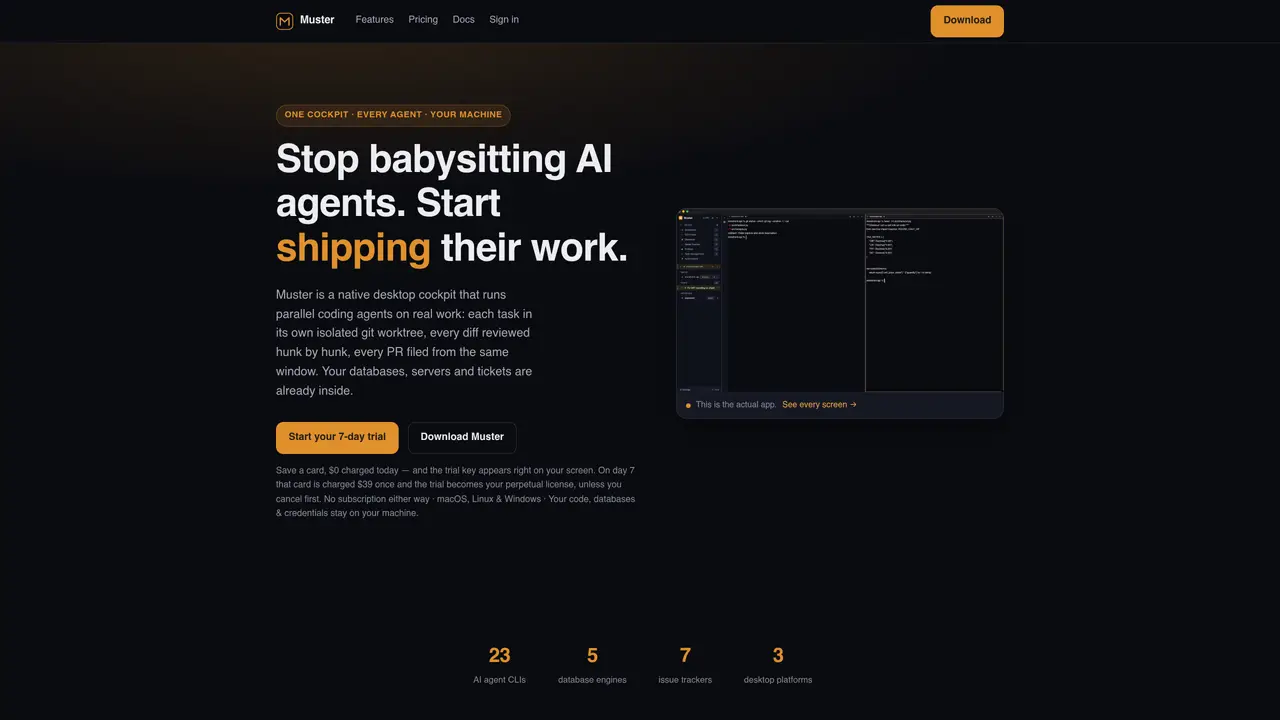
Muster is a native desktop application for macOS, Linux and Windows that orchestrates parallel AI coding agents on a user’s local machine. It provides a single control surface where tasks, agents, databases, servers and tickets are consolidated into one window. Each task can run in its own isolated git worktree and branch, preventing conflicts between agents and keeping the main branch untouched. Users can select from 23 built-in agent CLIs or configure custom adapters via TOML files, with live status indicators for each agent’s progress. The tool enforces granular permissions through its MCP server, allowing read-only access by default and requiring explicit approval for write operations. Diffs are reviewed hunk by hunk before changes are staged and pushed as pull requests, with linked issues automatically tracked. Profiles isolate identities, credentials and environments so users can run personal and work agents simultaneously without switching accounts or risking quota misuse.
Key features
- Isolated git worktrees per task
- Built-in support for 23 AI agent CLIs
- Custom agent adapters via TOML configuration
- Granular MCP permissions for databases and services
- Live agent status indicators
- Hunk-by-hunk diff review
- Automatic pull request creation with linked issues
- Profiles for identity and credential isolation
Use cases
- Coordinating multiple AI agents on a single codebase without conflicts
- Reviewing and shipping agent-generated code changes safely
- Running personal and work agents simultaneously with separate identities
Pros
- Runs parallel AI coding agents in isolated git worktrees
- Single desktop cockpit consolidates terminals, databases, servers and tickets
- Granular MCP permissions with explicit write approvals
- Profiles isolate identities and credentials for multi-agent workflows
- Supports 23 built-in agent CLIs and custom TOML adapters
Cons
- No free tier or open-source option
- Requires a local installation on macOS, Linux or Windows
- Pricing model is a one-time $39 license after a 7-day trial
Frequently asked questions about Muster
What is Muster and what does it do?
Muster is a native desktop application for macOS, Linux, and Windows that orchestrates parallel AI coding agents on a user’s local machine. It consolidates tasks, agents, databases, servers, and tickets into a single control surface, allowing users to manage multiple agents without conflicts.
Who should use Muster?
Muster is designed for developers and teams who want to leverage AI coding agents for parallel task execution while maintaining control over permissions, code quality, and identity management. It suits users who need to run personal and work agents simultaneously without switching accounts.
How does Muster handle permissions and security?
Muster enforces granular permissions through its MCP server, granting read-only access by default and requiring explicit approval for write operations. Agents access databases, tasks, and other resources through a gate, with permissions scoped to specific databases, hosts, projects, or worktrees.
Can Muster integrate with existing tools like databases and issue trackers?
Yes, Muster supports integration with 5 database engines, 7 issue trackers, and 23 built-in AI agent CLIs. It also allows configuration of custom adapters via TOML files, enabling compatibility with a wide range of tools and workflows.
How does Muster manage git workflows and code reviews?
Muster runs each task in its own isolated git worktree and branch, preventing conflicts between agents. Users can review changes hunk by hunk before staging and pushing them as pull requests, with linked issues automatically tracked.
What are profiles in Muster and how do they work?
Profiles in Muster are isolated identities that separate work and personal environments on a single machine. Each profile has its own credentials, SSH keys, git identity, and AI-CLI logins, allowing users to run multiple agents under different identities without switching accounts.