
OpenAI builds and deploys advanced AI models like GPT-4o for autonomous agents and workflows.

Clears
$89/mStarting price
1.7KMonthly visits
4Popularity
About Clears
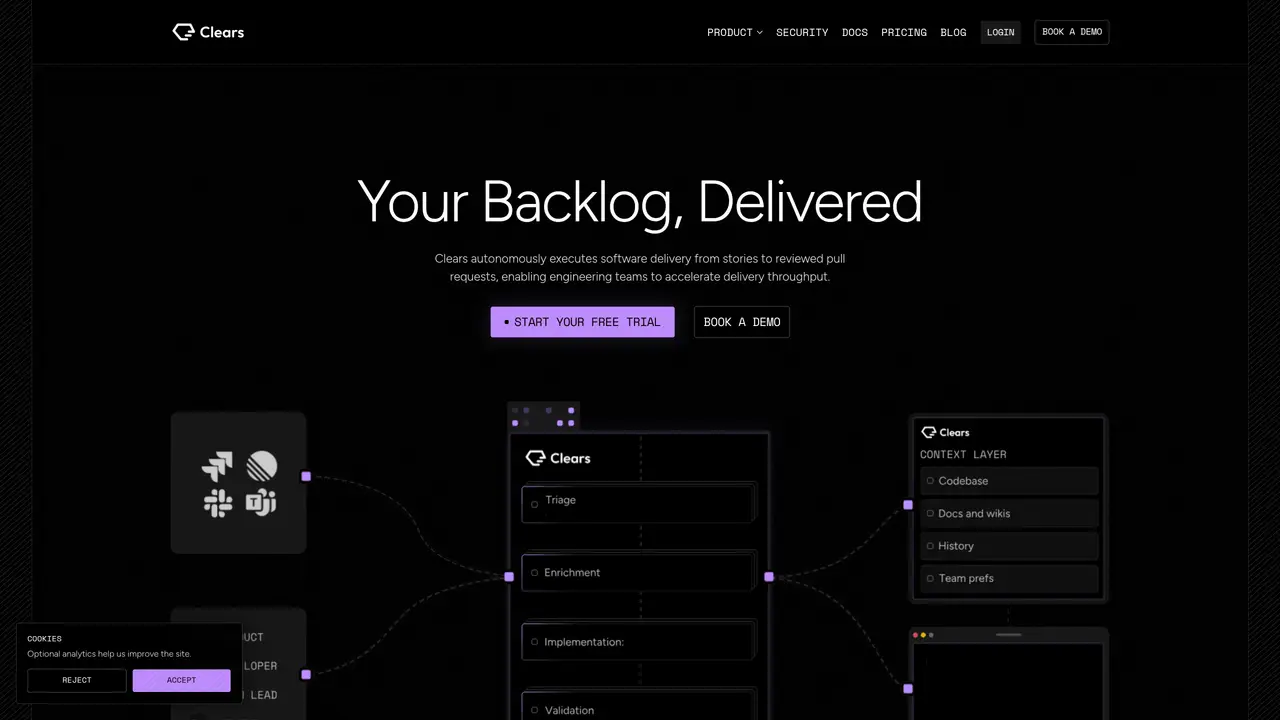
Clears provides an execution layer that carries engineering teams from requirement to shipped code autonomously across the software development lifecycle. It uses agentic workflows to coordinate fleets of agents across systems, ensuring orchestration, observability, and reliability. A context layer maintains shared memory across agents to prevent cold starts and enable consistent decision-making. Background flows continuously analyze tickets, root-cause issues, scope work, assess risk and feasibility, and escalate when necessary. The task board displays each ticket’s live agent session, showing progress from requirement to merged pull request in one place, allowing teams to steer when work drifts and parallelize the entire backlog. Through MCP, users can run and control all processes from the terminal, drawing on Clears for context, shaping requirements, and firing off tasks that document themselves in the background.
Key features
- Autonomous task orchestration
- Continuous background analysis and risk assessment
- Live agent session tracking per ticket
- Terminal control via MCP
- Jira and Git platform integrations
- Shared workspace and context layer
- Slack integration and support
- Parallel backlog processing
Use cases
- Accelerating software delivery throughput for engineering teams
- Automating ticket analysis and risk assessment in large backlogs
- Orchestrating multi-agent workflows across development tools
Pros
- Autonomous execution from ticket to merged pull request
- Agentic workflows with shared context layer for reliability
- Continuous background analysis and risk assessment
- Integration with Jira, GitHub, Bitbucket, GitLab, and Slack
- Terminal control via MCP for orchestration and oversight
Cons
- No free tier beyond trial
- Requires integration with supported development tools
- Enterprise plan needed for large-scale codebase analysis
- Deployment options limited to cloud or VPC
Frequently asked questions about Clears
What does Clears do?
Clears autonomously executes software delivery from user stories to reviewed pull requests, coordinating fleets of agents across the software development lifecycle. It uses agentic workflows, a shared context layer, and background flows to analyze tickets, scope work, assess risk, and escalate issues as needed.
Who is Clears designed for?
Clears is designed for engineering teams looking to accelerate software delivery throughput while maintaining control and observability. It is trusted by leading engineering teams and supports workflows from requirement to shipped code.
How does Clears integrate with existing tools?
Clears operates through MCP, allowing users to run and control all processes from the terminal. It draws on Clears for context, shapes requirements, and executes tasks that document themselves in the background, integrating with ticketing and version control systems.
Can Clears handle parallel work across a backlog?
Yes, Clears provides a task board where each ticket is linked to its live agent session, enabling teams to parallelize the entire backlog and monitor progress from requirement to merged pull request in one place.
How does Clears ensure reliability in autonomous workflows?
Clears uses a context layer that maintains shared memory across agents, preventing cold starts and enabling consistent decision-making. Background flows continuously analyze tickets, root-cause issues, and assess risk to ensure reliable execution.
How can I get started with Clears?
Users can start a free trial or book a demo directly from the Clears website. The platform is designed to be accessible via MCP, allowing teams to begin orchestrating their software delivery processes from the terminal.
Clears Website Engagement
Last Update: 9 days ago
Total Monthly Visits
0
Bounce Rate
0%
Visit Duration (avg)
—
Pages Per Visit
0
Country Rank
0
India
Global Rank
0