AI-powered website builder that generates a professional site in under a minute and includes tools for content, SEO, and analytics.
52M visits/mo+0.7%#4 Coding & Development

Open-source AI code review platform that analyzes pull requests with custom rules and Git provider integrations for engineering teams.
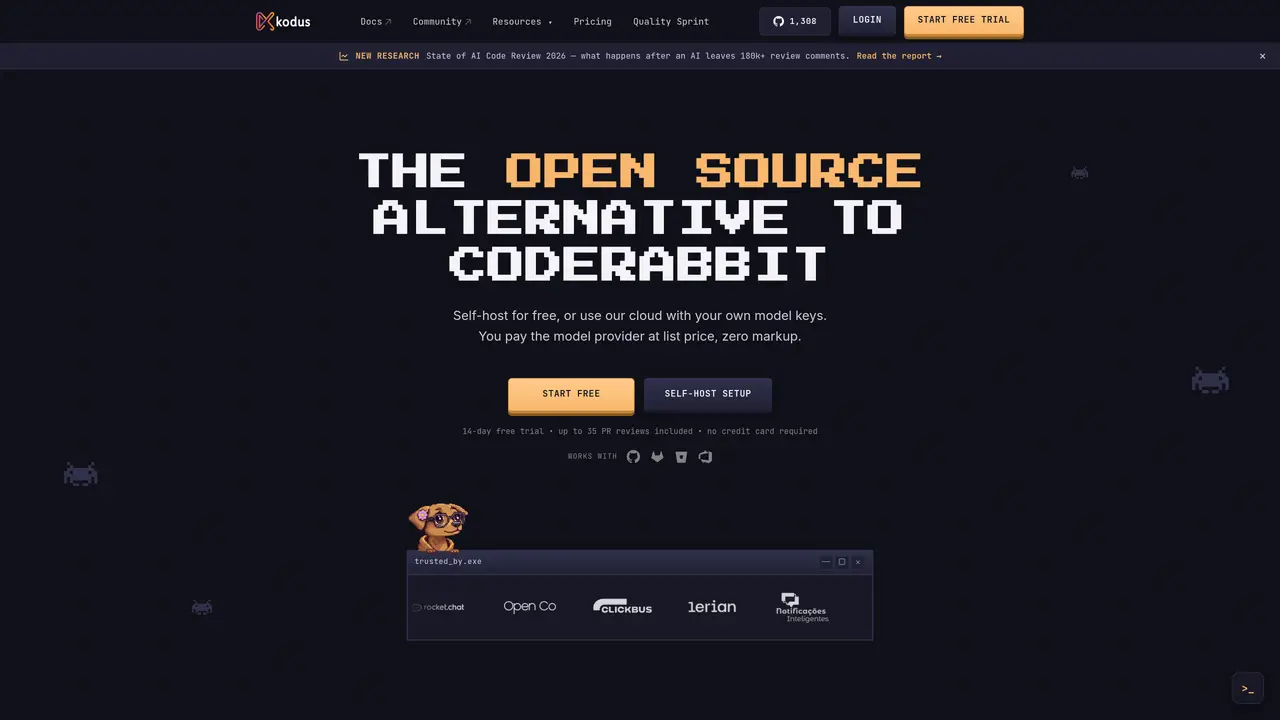
Kodus is an open-source AI-powered code review platform designed for engineering teams seeking automated, context-aware feedback directly within pull requests across Git-based workflows. It evaluates code diffs while considering the broader codebase, architecture, workflows, coding standards, and business rules to deliver targeted feedback on quality, security, performance, and style. The platform supports custom review rules written in natural language, along with a rules library, and can sync existing rule files from tools such as Cursor, Copilot, Claude, and Windsurf. Kodus operates in a model-agnostic manner, allowing teams to use their own API keys with providers like OpenAI, Claude, Gemini, Llama, or any OpenAI-compatible endpoint without additional markup on LLM usage. It integrates with Git providers including GitHub, GitLab, Bitbucket, and Azure DevOps, as well as business context tools like Jira, Notion, and Linear, enabling the conversion of suggestions into tracked issues and support for technical debt monitoring. The tool offers a freemium pricing model with a free open-source Community plan, paid Team plans starting at approximately $10 per developer per month (BYOK) or $30 per developer per month (managed mode), a 14-day free trial, and a self-hosted open-source option where users bring their own API keys and pay model providers directly. Kodus combines a hybrid AST + LLM approach with real-time processing, ensuring source code is not stored while supporting broad language coverage (30+ languages), unlimited pull requests (subject to Git provider APIs), and flexible deployment options in the cloud or self-hosted environments.
Kodus is an open-source AI-powered code review platform that provides automated, context-aware feedback directly within pull requests across Git-based workflows. It evaluates code diffs while considering the broader codebase, architecture, workflows, coding standards, and business rules to deliver targeted feedback on quality, security, performance, and style.
Kodus is designed for engineering teams seeking to automate and standardize code reviews while maintaining control over their review standards and workflows. It suits teams of all sizes, from small startups to large enterprises, particularly those using Git-based workflows.
Kodus integrates with Git providers such as GitHub, GitLab, Bitbucket, and Azure DevOps, as well as business context tools like Jira, Notion, and Linear. It supports custom review rules written in natural language and can sync existing rule files from tools like Cursor, Copilot, and Claude.
No, Kodus does not store source code. It processes code diffs in real-time and ensures source code remains within the user's infrastructure or Git provider.
Kodus offers flexible deployment options, including a cloud-based solution and a self-hosted open-source option. Users can deploy it using Docker Compose or Helm, with no seat minimums required.
Kodus operates in a model-agnostic manner, allowing teams to use their own API keys with providers like OpenAI, Claude, or Gemini. Users pay the model provider at list price, with zero markup added by Kodus.
kodus.io · third-party estimates from Similarweb
Last 4 months · grows by one month every month
Share of visits · estimated visits
Other countries: 44.8%
Coding & Development · Sep 2026
Traffic figures are third-party estimates, good for scale and trends; they can differ from a company's own numbers. Updated monthly.
We use essential cookies to run aitoolnavio™, and optional cookies to analyze traffic and measure our marketing. You choose what we use — optional cookies stay off unless you turn them on. See our Privacy Policy.
One short email a week: fresh tools worth trying, honest takes and the updates that actually matter. No spam, unsubscribe any time.
AI-powered website builder that generates a professional site in under a minute and includes tools for content, SEO, and analytics.
AI-powered coding platform that uses agents to plan, write, and test software with real-time feedback and verifiable artifacts.
Automate code, research, and documents using agents.
AI-powered code assistant that generates, reviews, optimizes, and debugs code with natural language prompts and editor integrations.
AI assistant for safe, reliable productivity with code, collaboration, and integrations.
AI-powered IDE for autonomous coding tasks and agentic development workflows
Privacy-focused AI chatbot that generates uncensored text, code, images, and translations without storing conversations or requiring an account.
A free web-based AI chatbot and agent for writing, coding, research, and content creation with multilingual support.
Write & run code in 50+ languages, auto-complete with AI, and code faster with an intuitive interface.
An IDE that automates legacy-to-modern code migration using autonomous coding agents.
AI models that return typed decisions with calibrated confidence for software automation
Practice coding challenges, improve technical skills, get detailed explanations, compare performance with peers.
Matched on what this tool does — grouped by the job you would be replacing.
matches Context-aware PR analysis with broader codebase awareness · Custom review rules in natural language and rules library · Git provider integrations (GitHub, GitLab, Bitbucket, Azure DevOps)
An AI-powered code review tool that automates GitHub and GitLab pull request reviews with inline comments, PR summaries, and custom rules for software teams.
AI-powered code review tool that fixes issues and validates against CI pipelines
AI-powered code review that analyzes GitHub pull requests with full context to surface high-confidence bugs and security issues while reducing false positives.
AI-powered code review platform that analyzes PRs, suggests fixes, and detects vulnerabilities to speed up development workflows.
matches Security scanning including SAST, secret detection, SCA, and IaC scanning · Multi-agent AI system for coordinated code analysis · Continuous security scanning with vulnerability detection
matches Auto-apply fixes to pull requests · CI failure analysis and deduplication · Pull request summaries and context linking
AI-powered code health platform combining code review, security scanning, quality analysis, and developer metrics for engineering teams.
AI-powered code review and security scanning platform that automates pull request feedback and IDE reviews with one-click fixes.
AI security scanning platform that detects exploitable vulnerabilities in code, logic, and infrastructure and delivers fixes via PRs and CI/CD pipelines.
Autonomous software delivery agent that turns tickets into reviewed pull requests
Cloud-based AI agent for planning and executing cross-repository features