
OpenAI builds and deploys advanced AI models like GPT-4o for autonomous agents and workflows.

hob
$30/moStarting price
0Popularity
About hob
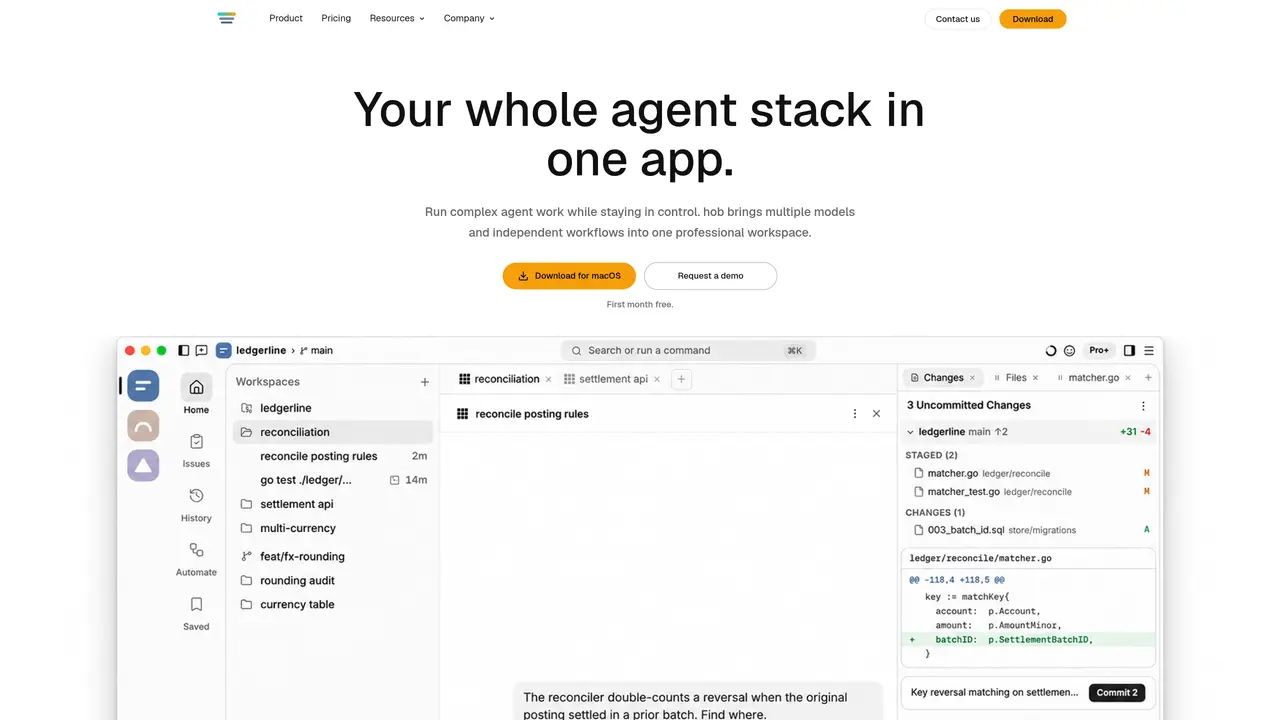
hob is a desktop application designed as a centralized workspace for developers who use agent command-line interfaces such as Claude Code, Codex, and OpenCode. It consolidates multiple agent workflows, terminals, and development tools into a single interface, allowing users to run, review, and coordinate complex agent tasks without switching between separate tools. The workspace operates locally on the user’s machine with end-to-end encryption for remote access, ensuring data remains under the user’s control. Agents themselves function as users within the workspace, opening files, diffs, and panes, coordinating tasks, and handing off work to one another while the developer maintains oversight. The application supports automation of recurring tasks, pull request management, issue tracking across platforms like GitHub, Gitea, and Forgejo, and the use of isolated worktrees for parallel or sensitive tasks. Secrets and sensitive data are managed within hob and never exposed to agents or external providers.
Key features
- Parallel agent panes and terminals
- Durable local conversation history
- Encrypted remote access from any device
- Automations for recurring tasks
- Pull request management
- Issue tracking across GitHub, Gitea, and Forgejo
- Isolated worktrees for task isolation
- Agent-to-agent handoffs within the workspace
Use cases
- Managing multiple agent CLIs for complex development tasks
- Automating recurring workflows like user feedback review
- Coordinating parallel agent tasks with isolated worktrees
Pros
- Centralizes multiple agent CLIs and workflows in one interface
- Local operation with end-to-end encryption for remote access
- Supports automation, pull requests, and issue tracking
- Isolated worktrees for parallel or sensitive tasks
- Encrypted remote access without exposing public ports
Cons
- macOS-only download available
- No free tier after the initial month
- Limited to supported agent backends (Claude Code, Codex, OpenCode)
- Team billing and admin controls still in development
Frequently asked questions about hob
Is hob another coding agent?
No. hob does not perform the thinking or execution itself. It serves as a centralized workspace where existing agent CLIs like Claude Code, Codex, and OpenCode operate alongside development tools such as terminals, worktrees, issues, diffs, and pull requests.
What does 'a workspace your agents can operate' mean?
In hob, agents function as users of the workspace, similar to a human developer. They can open files, arrange panes, coordinate tasks, hand off work to other agents, file issues, and open pull requests, all within the same interface.
How does hob handle remote access and security?
The workspace runs locally on the user’s machine with end-to-end encryption for remote access. No public ports are exposed, and the workspace state is continuously saved, ensuring data remains under the user’s control.
Can hob integrate with version control platforms like GitHub?
Yes. hob supports managing issues and pull requests across platforms such as GitHub, Gitea, and Forgejo directly within the workspace, allowing agents to interact with these systems seamlessly.
Does hob support automation of recurring tasks?
Yes. hob allows users to automate recurring workflows, such as reviewing user feedback, with consistent steps. Secrets and sensitive data are managed within hob and never exposed to agents or external providers.
How do worktrees function in hob?
Worktrees in hob provide isolated environments for agents to perform tasks that require separation. This keeps the main worktree clean, prevents parallel edits from interfering, and allows worktrees to be discarded or retained based on the task outcome.