
OpenAI builds and deploys advanced AI models like GPT-4o for autonomous agents and workflows.

Pydantic AI
FreeStarting price
454KMonthly visits
44Popularity
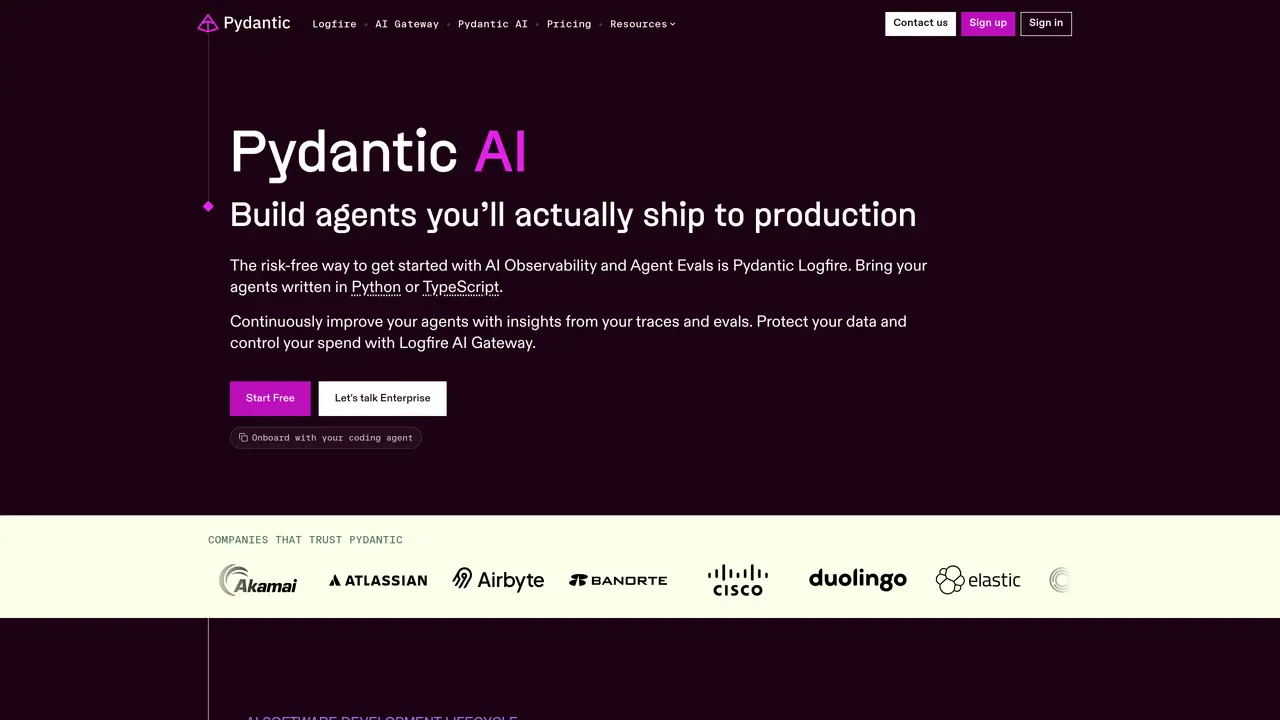
About Pydantic AI
Pydantic AI is a Python framework designed for developers, AI researchers, and machine learning engineers who need to build and manage AI agents efficiently. It ensures that AI responses are accurate and well-structured by validating data and enforcing type safety, which helps prevent errors and messy outputs. The framework simplifies the creation of AI tools while tracking performance, allowing users to obtain clear and usable results quickly. It supports model-agnostic AI, meaning it can work with various AI models without being tied to a specific one. Pydantic AI is particularly useful for validating user input data, generating structured API responses, and tracing model calls for debugging purposes. It also enables the management of concurrent tool executions, making it suitable for complex agent-based systems. By providing a robust structure for AI interactions, it reduces the risk of inconsistencies and improves the reliability of AI-driven applications.
Key features
- Validates data with speed
- Ensures type-safe interactions
- Supports model-agnostic AI
- Tracks performance of AI agents
- Manages concurrent tool executions
- Generates structured API responses
- Traces model calls for debugging
- Simplifies building and managing AI tools
Use cases
- Validate user input data
- Create type-safe chat agents
- Generate structured API responses
Pros
- Provides a Python framework specifically designed for building and managing AI agents with type safety and data validation
- Supports model-agnostic AI, enabling compatibility with various AI models without vendor lock-in
- Includes observability and evaluation tools (Logfire and Evals) for monitoring, securing, and optimizing agent performance
- Facilitates structured and reliable AI interactions through type hints, assertions, and code-first development
- Enables concurrent tool executions and debugging for complex agent-based systems
Cons
- Primarily focused on Python and TypeScript, limiting direct applicability to other programming languages
- Requires integration with multiple Pydantic products (AI, Logfire, Evals) for full end-to-end functionality, which may increase complexity
- Learning curve associated with adopting a comprehensive AI engineering stack rather than standalone tools
Frequently asked questions about Pydantic AI
What is Pydantic AI and what does it do?
Pydantic AI is a Python framework designed for building and managing AI agents with type safety and data validation. It ensures accurate and structured AI responses while supporting model-agnostic interactions.
Who should use Pydantic AI?
Developers, AI researchers, and machine learning engineers who need to build reliable AI agents in Python will benefit from Pydantic AI. It is particularly useful for teams focused on production-ready AI systems.
How does Pydantic AI ensure reliability in AI agents?
Pydantic AI enforces type safety and validates data to prevent errors and inconsistencies in AI responses. It also provides observability through tracing and evaluations to continuously improve agent performance.
Does Pydantic AI work with different AI models?
Yes, Pydantic AI is model-agnostic, meaning it can integrate with various AI models without being tied to a specific provider.
What integrations or tools does Pydantic AI support?
Pydantic AI is part of the broader Pydantic stack, which includes Pydantic Logfire for observability and Pydantic Evals for agent evaluations. It also supports OpenTelemetry for tracing and monitoring.
How can I get started with Pydantic AI?
You can start by exploring the open-source Pydantic AI framework on GitHub or visiting the official Pydantic website for documentation and resources. The framework is designed to be developer-friendly and integrates seamlessly with Python-based AI workflows.
Pydantic AI Website Engagement
Last Update: 9 days ago
Total Monthly Visits
0
Bounce Rate
0%
Visit Duration (avg)
0.00s
Pages Per Visit
0
Country Rank
0
United States
Global Rank
0
Category Rank
#0
Programming & Developer Software
Monthly Traffic
Traffic Sources
Traffic Share By Country
- United States21.3%
- India8.6%
- United Kingdom6.6%
- Germany6.5%
- China5.5%