
OpenAI builds and deploys advanced AI models like GPT-4o for autonomous agents and workflows.

Pydantic
FreeStarting price
0Popularity
About Pydantic
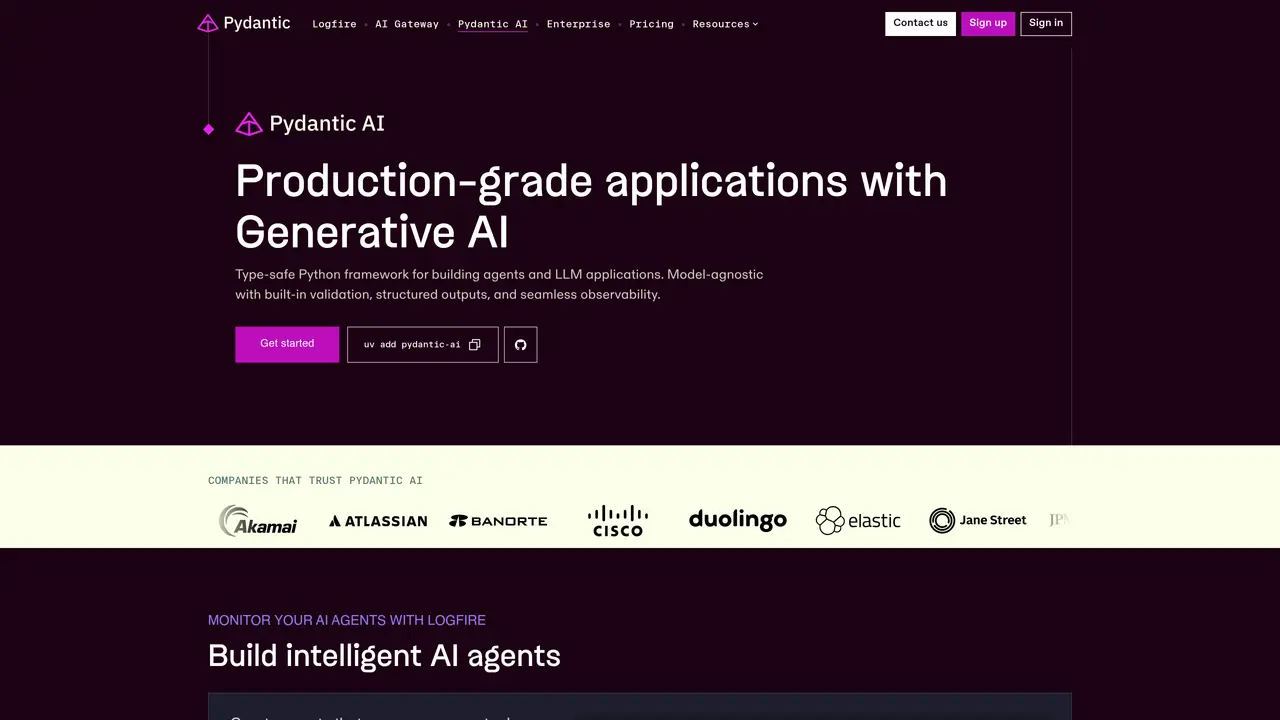
Pydantic AI is a Python framework for constructing LLM-powered agents with strong typing, validated outputs, and first-class observability. It enables developers to define output schemas using Pydantic models, ensuring predictable and type-safe responses across different model providers. The framework supports streaming of tokens, tool calls, and reasoning events in real time, allowing frontends to display live updates. It integrates with Logfire for tracing, cost tracking, latency analysis, and production debugging, providing detailed observability into agent operations. Pydantic AI also supports durable execution through integrations with Temporal, Prefect, DBOS, or Restate, enabling fault-tolerant, resumable workflows for long-running tasks. The tool is designed for platform teams, application engineers, and data/ML practitioners who require structured, evaluable outputs and operational governance. It is particularly suited for teams already using Pydantic in microservices or seeking open-source foundations with clear paths to production systems.
Key features
- Type-safe agent outputs with Pydantic model validation
- Real-time streaming of tokens, tool calls, and reasoning events
- Integration with Logfire for observability, tracing, and cost analysis
- Support for durable execution via Temporal, Prefect, DBOS, or Restate
- Connection to external tools and data via Model Context Protocol (MCP)
- Multi-agent workflows with streaming event visibility
- Model-agnostic design for flexibility across providers
- Typed function tools for reliable automation calls
- Production-ready integrations and governance features
- Optional gateway-driven model routing and cost control
Use cases
- Building production-grade AI agents with structured, validated outputs
- Orchestrating complex multi-agent workflows with durable execution
- Enabling real-time streaming and observability for agent interactions
Pros
- Built-in Pydantic validation ensures type-safe structured outputs for predictable AI agent behavior
- Seamless integration with Pydantic Logfire for real-time tracing, cost tracking, and debugging of AI workloads
- Native support for durable execution frameworks like Temporal, Prefect, DBOS, and Restate for fault-tolerant agent workflows
- Model-agnostic design with built-in routing and cost control via Pydantic AI Gateway
- Modular architecture supports streaming, MCP server connections, and multi-agent workflows for scalable AI applications
Cons
- Requires familiarity with Python and Pydantic for optimal implementation
- Durable execution integrations add complexity to agent deployment and maintenance
- Observability features depend on Pydantic Logfire, which may introduce additional setup overhead
Frequently asked questions about Pydantic
What is Pydantic AI used for?
Pydantic AI is a Python framework for building production-grade AI agents and LLM applications with type-safe outputs, real-time streaming, and integrated observability.
Who should use Pydantic AI?
It is designed for platform teams, application engineers, and data/ML practitioners who need structured, evaluable outputs and operational governance for AI systems.
Does Pydantic AI support real-time streaming?
Yes, it supports streaming of tokens, tool calls, and reasoning events in real time, enabling live updates in frontends.
Can Pydantic AI connect to external tools and data sources?
Yes, it has built-in support for the Model Context Protocol (MCP), allowing agents to interact with file systems, databases, APIs, and other external systems.
Does Pydantic AI offer durable execution for long-running tasks?
Yes, it supports durable execution through integrations with Temporal, Prefect, DBOS, and Restate, enabling fault-tolerant and resumable workflows.
How do I get started with Pydantic AI?
Install the framework using Python package managers like uv or pip, define your agent with output schemas, and integrate with Logfire for observability.