
OpenAI builds and deploys advanced AI models like GPT-4o for autonomous agents and workflows.

Flo AI
0Popularity
About Flo AI
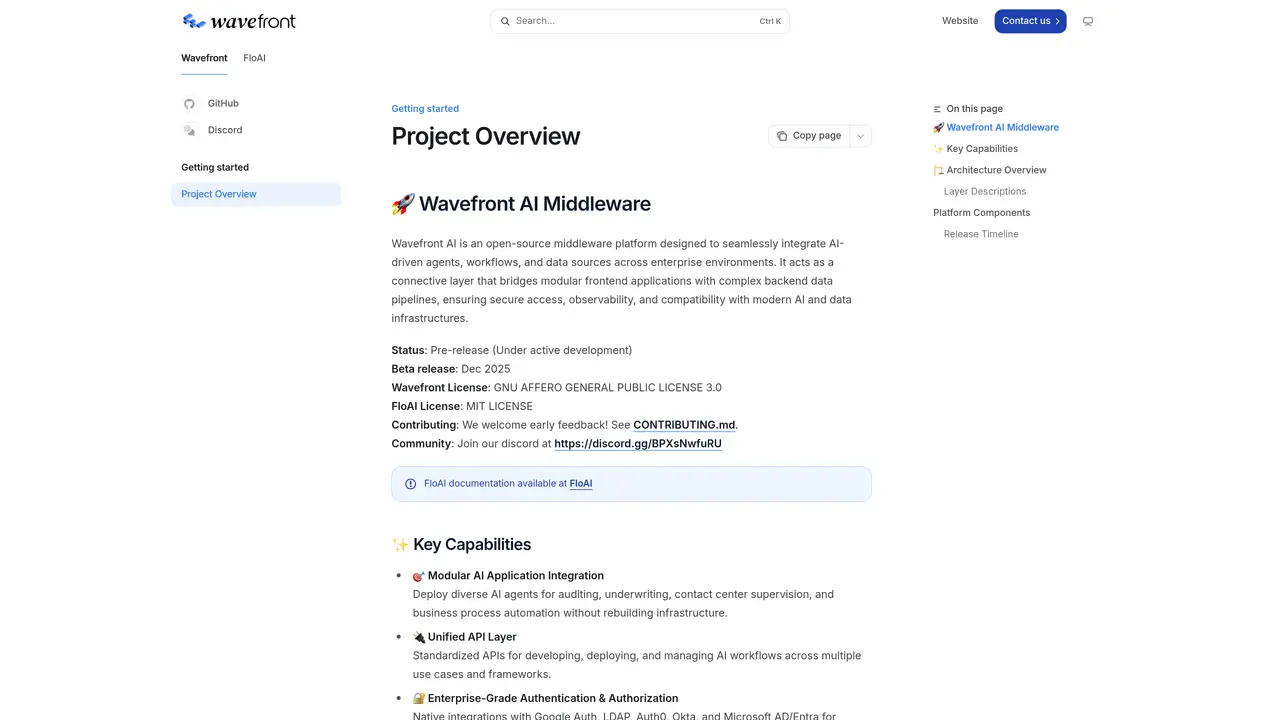
Flo AI is a Python framework designed for developers and enterprises building production-ready AI agents and multi-agent teams. It uses YAML-based configuration to define agents, teams, and orchestration without hard-coding architecture, enabling flexible and scalable agent systems. The framework includes pre-built components alongside support for custom extensions, allowing teams to compose complex agent systems while accommodating bespoke requirements. Flo AI integrates with Wavefront AI’s enterprise middleware stack, providing a connective layer between frontend AI applications and backend data pipelines through a unified API. This integration supports the development, deployment, and management of AI workflows with enterprise-grade controls. Key enterprise features include authentication and authorization integrations such as Google Auth, LDAP, Auth0, Okta, and Microsoft AD/Entra, role-based access control (RBAC), and telemetry support via Grafana and Prometheus. The project is open-source under the MIT License, with the broader Wavefront AI middleware available under AGPL-3.0, and is currently in a pre-release state with a planned beta release in December 2025.
Key features
- YAML-based agent composition for defining agents and workflows
- Pre-built components with support for custom extensions
- Integration with Wavefront AI middleware stack
- Unified API for developing, deploying, and managing AI workflows
- Enterprise authentication and authorization (Google Auth, LDAP, Auth0, Okta, Microsoft AD/Entra)
- Role-based access control (RBAC)
- Telemetry support via Grafana and Prometheus
- Open-source under MIT License
- Compatibility with AGPL-3.0 licensed Wavefront AI middleware
- Pre-release status with planned beta in December 2025
Use cases
- Building production-ready AI agents for enterprise applications
- Developing multi-agent teams with YAML configuration
- Integrating AI workflows with backend data pipelines via unified APIs
Pros
- Open-source framework under MIT License for agent development and orchestration
- YAML-based configuration for flexible, scalable agent systems without hard-coding architecture
- Enterprise-grade authentication and authorization integrations (Google Auth, LDAP, Auth0, Okta, Microsoft AD/Entra)
- Built-in observability and monitoring via Grafana and Prometheus for real-time performance tracking
- Supports modular AI application integration across diverse use cases like auditing, underwriting, and business process automation
Cons
- Pre-release software with a planned beta release in December 2025, indicating potential instability
- Wavefront AI middleware is licensed under AGPL-3.0, which may impose compliance requirements for commercial use
- Limited public documentation and community feedback at current stage of development
- No-code agent and workflow builder capabilities are mentioned but may lack maturity in pre-release state
Frequently asked questions about Flo AI
What is Flo AI and what does it do?
Flo AI is an open-source Python framework for building production-ready AI agents and multi-agent teams using YAML-based configuration. It enables developers to define agents, teams, and orchestration without hard-coding architecture, supporting flexible and scalable agent systems.
Who should use Flo AI?
Flo AI is designed for developers and enterprises building AI-driven applications, particularly those requiring modular agent systems, enterprise-grade authentication, and integration with backend data pipelines. It suits teams needing customizable AI workflows and observability.
How does Flo AI integrate with enterprise systems?
Flo AI integrates with enterprise middleware via a unified API layer, connecting frontend AI applications with backend data sources like databases, cloud storage, and enterprise APIs. It supports authentication providers such as Google Auth, LDAP, Auth0, Okta, and Microsoft AD/Entra.
What enterprise features does Flo AI offer?
Flo AI includes enterprise-grade authentication, role-based access control (RBAC), telemetry support via Grafana and Prometheus, and granular permissions for AI agents and data sources. It also supports observability, monitoring, and evaluation of agent performance.
Is Flo AI open-source?
Yes, Flo AI is open-source under the MIT License. The broader Wavefront AI middleware is available under AGPL-3.0. The project is in a pre-release state with a planned beta release in December 2025.
How can I get started with Flo AI?
To get started, visit the Flo AI documentation or GitHub repository for setup instructions. The framework provides a YAML-based configuration system, pre-built components, and support for custom extensions. Community feedback is welcome via Discord.