Unify customer data, automate workflows, and scale experiences with Einstein AI, Copilot, and Data Cloud in one CRM platform.

Temporal Technologies
FreeStarting price
0Popularity
About Temporal Technologies
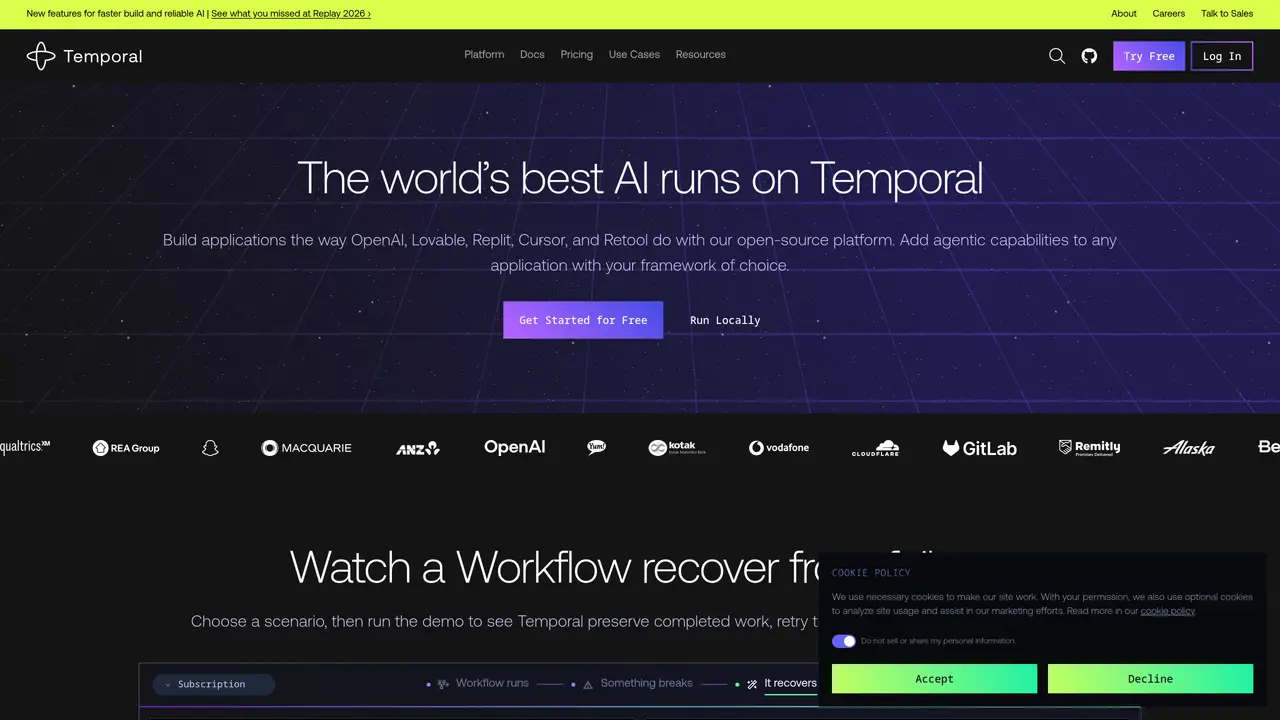
Temporal Technologies revolutionizes the way developers build and manage distributed systems. At its core, Temporal Technologies offers a durable execution platform that ensures applications are resilient against failures, network outages, and other disruptions. Designed for developers and enterprises, it simplifies the development of reliable and scalable systems by abstracting the complexities of infrastructure management. Key Features: Durable Execution: Temporal guarantees the execution of workflows, making applications fault-tolerant by default. Open Source: Built under the MIT license, Temporal is fully open-source, fostering a vibrant community and continuous innovation. Event-Driven Architecture: Simplifies the design and deployment of event-driven applications by managing state, retries, and error handling automatically. Saga & Distributed Transactions: Facilitates safe and consistent state across distributed services by employing the saga pattern, reducing the complexity of compensating transactions.
Key features
- Durable Execution
- Open Source
- Event-Driven Architecture
- Saga & Distributed Transactions
- API Access
- Polyglot Development
- Temporal Cloud
Use cases
- E-commerce Businesses: Utilizing Temporal for reliable order processing and inventory management.
- Financial Institutions: Employing the platform for secure and consistent transaction processing.
- Healthcare Providers: Leveraging Temporal to ensure fault-tolerant patient data management systems.
Pros
- Guarantees durable execution of workflows, ensuring fault tolerance against failures, network issues, and service crashes
- Supports multiple programming languages through native SDKs, allowing integration with existing tech stacks
- Provides full visibility into workflow execution states, reducing debugging and log analysis time
- Offers both self-hosted and managed cloud options, catering to different deployment preferences
- Built on open-source principles with MIT licensing, fostering community collaboration and transparency
Cons
- Requires learning a new paradigm for workflow development, which may involve a learning curve for teams
- Complexity of distributed systems may still require significant design effort despite platform abstractions
- Hosting options may introduce additional operational overhead depending on chosen deployment model
Temporal Technologies videos
Frequently asked questions about Temporal Technologies
What is Temporal Technologies and what does it do?
Temporal Technologies provides a durable execution platform that ensures applications remain resilient against failures, network outages, and other disruptions. It abstracts infrastructure complexities, allowing developers to build reliable and scalable distributed systems without managing state machines or reconciliation logic manually.
Who should use Temporal Technologies?
Temporal is designed for developers and enterprises building distributed systems, AI pipelines, or long-running workflows. It suits platform engineers, startups, and large-scale organizations that require fault-tolerant execution, such as those in AI, financial services, or CI/CD workflows.
How does Temporal handle failures in distributed systems?
Temporal Workflows automatically capture state at every step and resume execution from the point of failure without losing progress. Activities within Workflows retry automatically, and the platform persists state to ensure seamless recovery, eliminating the need for manual intervention.
Can Temporal be used for AI applications?
Yes, Temporal is used to build reliable AI systems by ensuring durable execution of long-running workflows, such as training pipelines or agentic processes. It supports frameworks like MCP and provides the reliability required for complex AI operations.
What hosting options are available for Temporal?
Temporal offers two hosting paths: users can deploy the open-source platform in their own environment or opt for Temporal Cloud, where the service is hosted by Temporal. In both cases, the code remains private and inaccessible to Temporal.
Is Temporal open-source?
Yes, Temporal is fully open-source under the MIT license, developed in the open with a thriving developer community. The platform is battle-tested, with over 20 years of development heritage from projects like AWS SQS and Uber's Cadence.