
OpenAI builds and deploys advanced AI models like GPT-4o for autonomous agents and workflows.

Mastra
FreeStarting price
370KMonthly visits
43Popularity
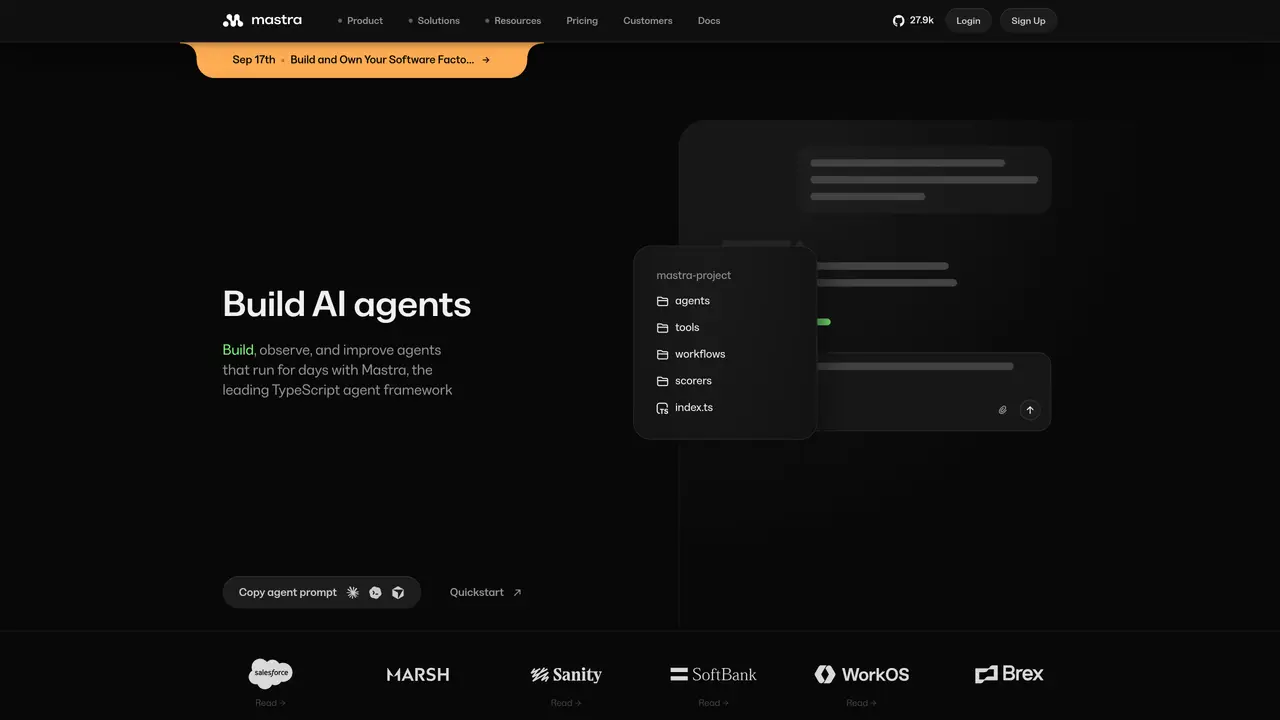
About Mastra
Mastra is a TypeScript-first framework designed for building production AI agents and applications. It provides typed agents, graph-based workflows, memory persistence, and built-in observability including metrics, logs, traces, and evaluations. The framework supports model routing across over 90 providers, MCP servers, and Node-compatible deployments, enabling teams to standardize multi-model access while maintaining deep observability for reliability, performance, and cost control. Developers define typed agents with instructions, tools, and models in a single file, then compose complex workflows using control-flow primitives like then, branch, and parallel. Memory can be persisted and retrieved from APIs, databases, or files to maintain context, while built-in tracing captures tokens, logs, and tool calls for debugging and iteration. Mastra Studio offers a visual interface to inspect workflow graphs, run details, traces, and eval scores, alongside memory snapshots and inputs/outputs, facilitating rapid debugging and regression checks. Deployments are streamlined to Hono servers or cloud providers with minimal configuration changes, supporting integrations into Next.js, React, or Node applications. Teams use Mastra for customer support copilots, internal Slack automation agents, developer SRE monitoring, and onboarding assistants embedded in web apps.
Key features
- Typed agent definitions unifying instructions, models, tools, and runtime behavior
- Graph-based workflow engine with then, branch, and parallel control-flow primitives
- Built-in memory persistence and retrieval from APIs, databases, and files
- Comprehensive observability with metrics, logs, traces, and evaluations
- Model routing across 90+ providers with MCP server support
- Node-compatible deployments to Hono servers or cloud providers
- Mastra Studio for visual debugging, iteration, and regression checks
- Human-in-the-loop approvals and resilient execution state persistence
- TypeScript-native development with straightforward integration into Next.js, React, and Node apps
- Repeatable datasets and scoring for production promotion
Use cases
- Customer support copilot with retrieval and escalation workflows
- Slack automation agents for internal operations and reporting
- Developer SRE agent monitoring logs, traces, and alerts
Pros
- TypeScript-first framework with strong typing for agents and workflows
- Built-in observability with metrics, logs, traces, and evaluations for debugging and iteration
- Supports model routing across over 90 providers and MCP servers
- Visual Studio interface (Mastra Studio) for inspecting workflows, traces, and evaluations
- Streamlined deployments to Hono servers or cloud providers with minimal configuration
Cons
- Requires familiarity with TypeScript and modern JavaScript tooling
- Complexity in defining typed agents and workflows may have a learning curve
- Dependency on external model providers for LLM access
Frequently asked questions about Mastra
What is Mastra and what does it do?
Mastra is a TypeScript-first framework for building production AI agents and applications, offering typed agents, graph-based workflows, memory persistence, and built-in observability.
Who is Mastra designed for?
Mastra is designed for developers and teams building AI agents and applications, particularly those using TypeScript and requiring standardized multi-model access and deep observability.
How does Mastra handle model routing?
Mastra provides a model router that supports access to thousands of models across over 90 providers, enabling teams to standardize multi-model access within their applications.
What kind of observability does Mastra offer?
Mastra includes built-in observability features such as metrics, logs, traces, and evaluations, which help teams debug, iterate, and ensure reliability, performance, and cost control.
Can Mastra be integrated into existing applications?
Yes, Mastra supports integrations into Next.js, React, or Node applications, and deployments can be streamlined to Hono servers or cloud providers with minimal configuration changes.
How do I get started with Mastra?
To get started, run `npm create mastra@latest -- --llm ` to create a new project, then navigate to the project directory and start the dev server with `npx bgproc start -n -w -- npm run dev`.
Mastra Website Engagement
Last Update: 9 days ago
Total Monthly Visits
0
Bounce Rate
0%
Visit Duration (avg)
0.00s
Pages Per Visit
0
Country Rank
0
United States
Global Rank
0
Category Rank
#0
Graphics Multimedia & Web Design
Monthly Traffic
Traffic Sources
Traffic Share By Country
- United States17.2%
- China7.7%
- India6.2%
- Georgia4.7%
- Brazil4.4%