
OpenAI builds and deploys advanced AI models like GPT-4o for autonomous agents and workflows.

QikLM
FreeStarting price
0Popularity
About QikLM
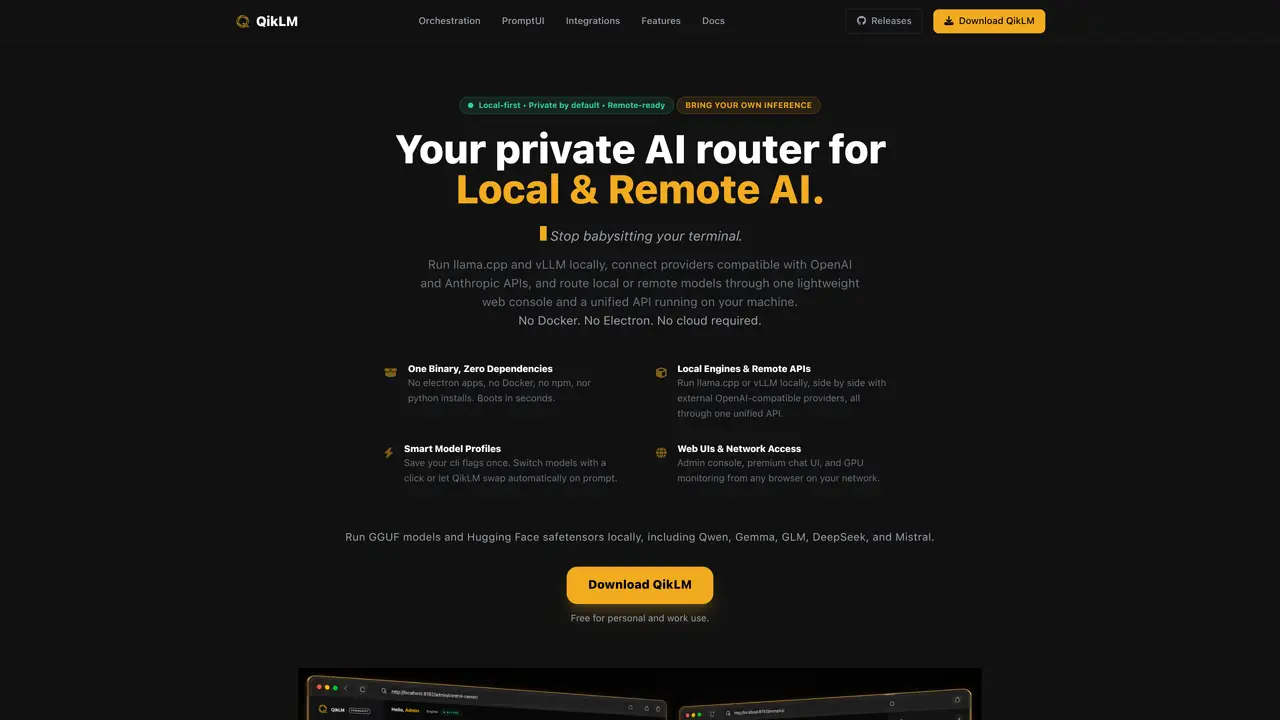
QikLM provides a local-first manager for running and orchestrating large language models using llama.cpp and vLLM. It acts as a unified interface between applications and inference engines, handling model loading, unloading, and swapping automatically. The tool supports running models locally or connecting to remote OpenAI and Anthropic-compatible APIs through a single endpoint. A lightweight web console and API run on the user’s machine without requiring Docker, Electron, or additional dependencies. QikLM includes a built-in chat interface with document and image support, hardware telemetry via lmtop, and integration with popular agentic workflows like Claude Code and Hermes Agent. Model weights can be managed through profiles and templates, with direct access to Hugging Face’s model hub for downloading open-weight models.
Key features
- Local inference with llama.cpp and vLLM
- Unified API for local and remote models
- Hardware telemetry via lmtop
- Built-in chat UI with document OCR
- Hugging Face model hub integration
- Profile-based model configuration
- Agentic workflow integrations
- GPU monitoring and performance tracking
Use cases
- Running local LLMs for offline or privacy-sensitive tasks
- Managing multiple inference engines and models through one interface
- Developing agentic workflows with tools like Claude Code
Pros
- Runs locally without Docker, Electron, or external dependencies
- Unified API for both local and remote models
- Built-in chat UI with document OCR and live code collaboration
- Hardware telemetry and observability via lmtop
- Supports multiple inference engines and model profiles
Cons
- No cloud telemetry or remote hosting options
- Limited to local execution without internet access for some features
- Requires manual setup for advanced CLI flags
Frequently asked questions about QikLM
What is QikLM and what does it do?
QikLM is a local-first manager for running and orchestrating large language models using engines like llama.cpp and vLLM. It provides a unified interface between applications and inference engines, handling model loading, unloading, and swapping automatically.
Who is QikLM designed for?
QikLM is designed for users who want to run local AI models without managing complex terminal commands, as well as professionals who need a lightweight, dependency-free solution for orchestrating local and remote inference engines.
Does QikLM require Docker, Electron, or additional dependencies?
No, QikLM runs as a single binary with zero dependencies, including no requirement for Docker, Electron, npm, or Python installations.
Can QikLM connect to remote AI providers?
Yes, QikLM can connect to remote OpenAI and Anthropic-compatible APIs through a single unified endpoint alongside local models.
What models does QikLM support?
QikLM supports running GGUF models and Hugging Face safetensors locally, including models like Qwen, Gemma, GLM, DeepSeek, Mistral, and others available on Hugging Face.
How do I get started with QikLM?
Download the single binary from the QikLM website, run it on your machine, and use the built-in web console or API to manage models, profiles, and integrations without additional setup.