OpenAI builds and deploys advanced AI models like GPT-4o for autonomous agents and workflows.

SecondOS
$10Starting price
0Popularity
About SecondOS
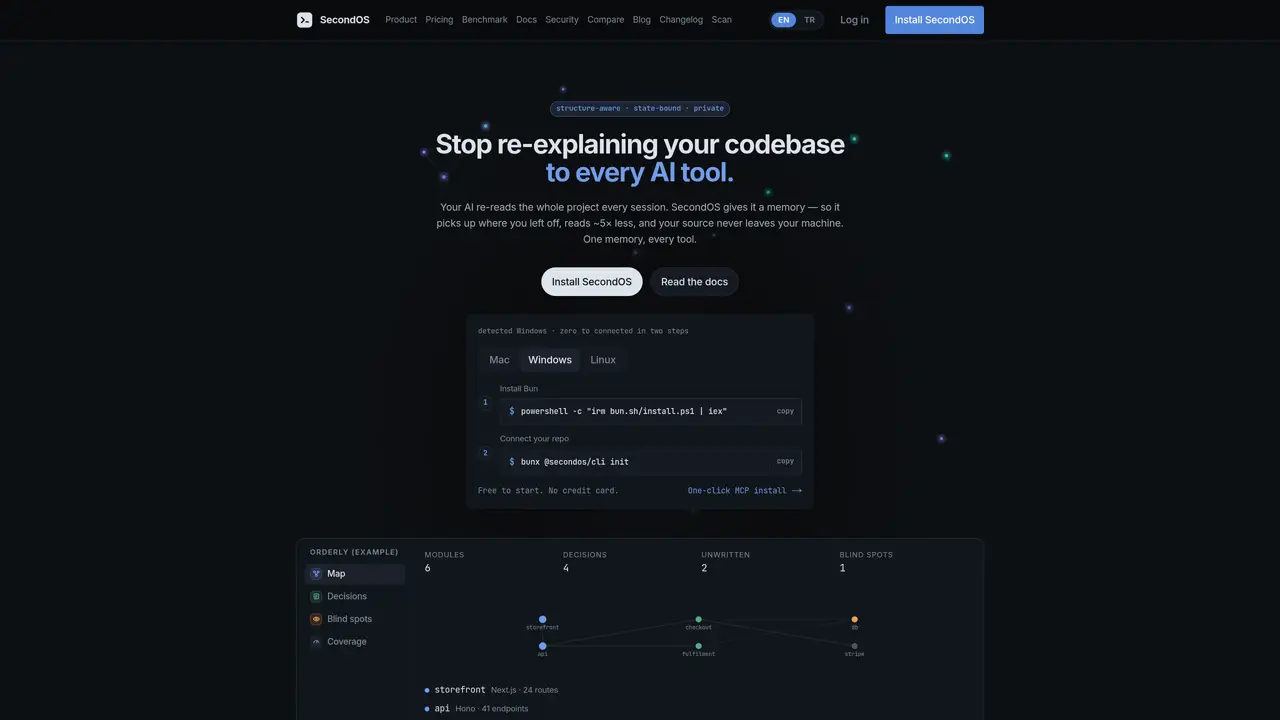
SecondOS creates a structure-aware map of a codebase—including symbols, signatures, routes, and call graphs—on the user’s machine. This map, along with embeddings, is shared with AI tools through the Model Context Protocol (MCP) so they can recall context without re-reading files. The tool supports multiple languages including TypeScript, Go, Python, Rust, and Java, and maintains a call graph that resolves dependencies across repositories. Memory is anchored to specific code symbols, automatically flagging stale notes when code changes, preventing outdated context from being reused. The system measures and scores the validity of each memory, providing confidence levels and version tracking to ensure accuracy. Source code never leaves the machine; only metadata and embeddings are shared, with secrets and file bodies redacted. Users can self-host or export memories stored locally in a .secondos directory, ensuring privacy by default and avoiding vendor lock-in.
Key features
- Structure-aware codebase mapping
- Cross-language call graph resolution
- Symbol-anchored memory with stale detection
- MCP integration for AI tool access
- Local storage with portable .secondos directory
- Value-level redaction of secrets
- Confidence scoring for memories
- Version tracking and rollback
Use cases
- Maintaining consistent context across multiple AI coding assistants
- Onboarding new developers with up-to-date architectural knowledge
- Reducing redundant explanations when switching between AI tools
Pros
- Reduces AI re-reading by up to 5× through persistent, structure-aware memory
- Privacy-first design: source code stays local; only metadata and embeddings are shared
- Supports multiple languages and cross-repository call graphs
- Automatically detects and flags stale memories when code changes
- Works with existing AI tools via MCP (Cursor, Claude Code, GitHub Copilot, etc.)
Cons
- Requires installation and setup on local machine
- No free cloud tier beyond basic workspace; paid plans start at $10/month
- Limited to projects that can be indexed locally
- Credit-based pricing for AI operations may add cost for heavy usage
Frequently asked questions about SecondOS
What does SecondOS do?
SecondOS creates a structure-aware map of a codebase—including symbols, signatures, routes, and call graphs—on the user’s machine. This map, along with embeddings, is shared with AI tools through the Model Context Protocol (MCP) to provide context without re-reading files.
Who is SecondOS for?
SecondOS is designed for developers and teams who use AI tools like Cursor, Claude Code, GitHub Copilot, or similar, and want to avoid repeatedly explaining their codebase. It is particularly useful for those working with multiple AI assistants across different sessions.
How does SecondOS handle privacy and security?
SecondOS ensures privacy by default by keeping the source code on the user’s machine. Only metadata, embeddings, and redacted symbols are shared, with file bodies and secrets never leaving the local environment. Users can also self-host the tool or export memories stored locally.
Does SecondOS support multiple programming languages?
Yes, SecondOS supports multiple languages including TypeScript, Go, Python, Rust, and Java. It builds a call graph that resolves dependencies across repositories and languages.
How does SecondOS handle outdated or stale information?
SecondOS anchors memories to specific code symbols and automatically flags stale notes when code changes. This prevents outdated context from being reused, ensuring that AI tools rely on accurate and current information.
Can I use SecondOS with my existing AI tools?
Yes, SecondOS integrates with AI tools you already use, such as Cursor, Claude Code, GitHub Copilot, Cline, Windsurf, Zed, Continue, Aider, and Aider. It provides a shared, structure-aware map over MCP, so all tools read the same context.