
OpenAI builds and deploys advanced AI models like GPT-4o for autonomous agents and workflows.

coldstart
FreeStarting price
0Popularity
About coldstart
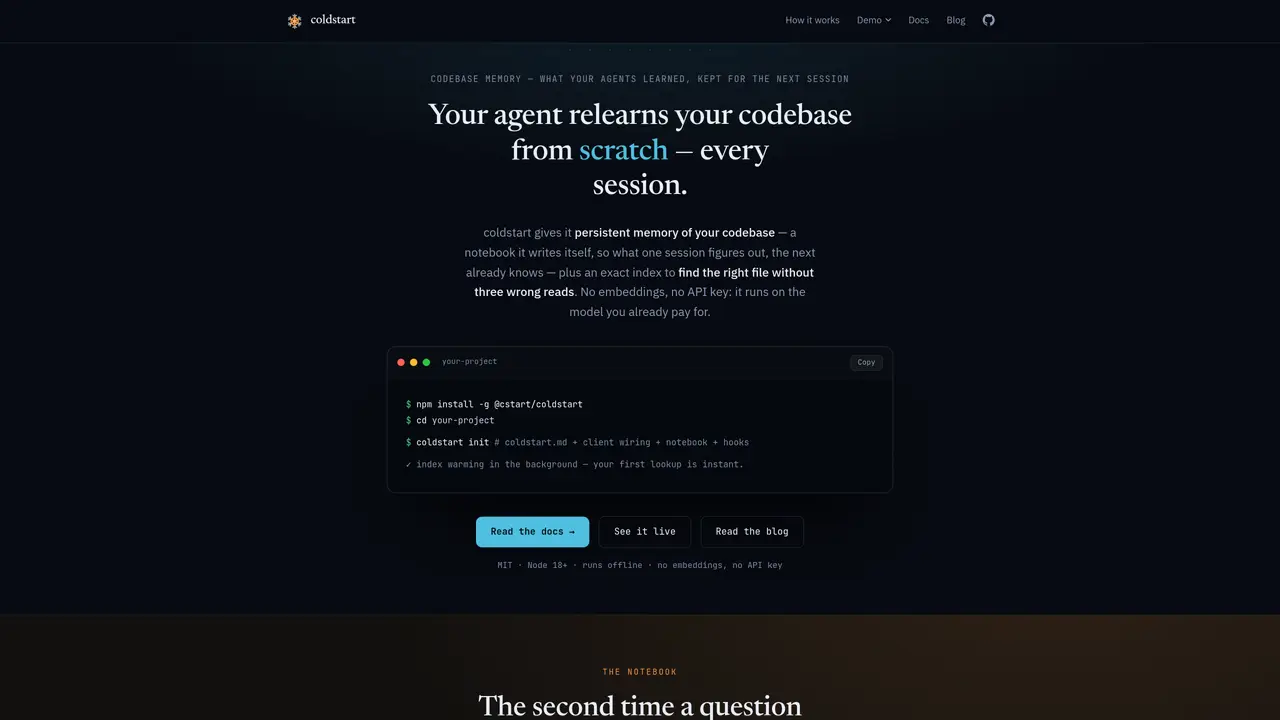
coldstart provides persistent memory and exact navigation for AI coding agents working on codebases. It maintains a notebook written by the agent itself, capturing what one session learns so subsequent sessions can reuse that knowledge without relearning from scratch. The tool builds an exact index of file paths, symbols, and import/call graphs, enabling instant lookups without embeddings or external APIs. Navigation uses two lightweight commands—find for term-based file ranking and gs for file-specific symbol and usage details—replacing slower grep-based searches. The notebook is anchored to real files and symbols, with content hashes ensuring notes remain accurate when code changes. Changes to files trigger automatic re-verification, while renamed or moved files retain their notes if content matches. The index updates in the background as code changes, keeping lookups instant and avoiding stale data. It integrates with popular coding agents like Claude Code, Cursor, and Codex via CLI or MCP tools.
Key features
- Persistent notebook with agent-written notes
- Exact index for file paths, symbols, and import/call graphs
- Two lookup commands: find and gs
- Background index warming for instant first use
- Automatic re-verification of notes on code changes
- Integration with Claude Code, Cursor, and Codex
- Offline operation with no external API calls
- Support for 20+ languages via Tree-sitter grammars
Use cases
- Reducing token usage in repeated AI coding sessions by reusing prior context
- Accelerating onboarding for new developers by providing pre-indexed codebase knowledge
- Improving accuracy of AI agents by anchoring notes to exact file and symbol references
Pros
- Persistent notebook written by the agent, reducing repeated context gathering
- Exact index using file paths, symbols, and import/call graphs for instant lookups
- No embeddings or external APIs required; runs fully offline
- Supports over 20 languages via Tree-sitter grammars
- Automatic notebook updates and re-verification on code changes
Cons
- No free tier or open-source version mentioned
- Requires Node 18+ and npm installation
- Limited to shell-capable or MCP-compatible agents
Frequently asked questions about coldstart
Does coldstart use embeddings?
No. coldstart relies on a fast static index over file paths, symbol names, exports, and the import/call graph, combined with a ripgrep-backed reference scan. It does not use vector embeddings or external APIs.
Do I need an API key or a paid model to use coldstart?
No API key is required. coldstart operates fully offline and integrates with the coding agent you already use, adding navigation and memory without billing additional tokens.
Does coldstart work with Claude Code, Cursor, and Codex?
Yes. coldstart supports these agents via CLI commands (e.g., coldstart find, coldstart gs) or MCP tools for shell-capable and no-shell clients like Claude Desktop.
What languages does coldstart parse?
coldstart parses over 20 languages including TypeScript, JavaScript, Python, Go, Rust, Java, Ruby, PHP, C#, Kotlin, and C++ using Tree-sitter grammars. It also supports Vue, Svelte, Astro, YAML, TOML, XML, and GraphQL.
What is the coldstart notebook?
The notebook is a set of notes written by the agent during its work, capturing what it learns about the codebase. These notes are anchored to real files and symbols and are automatically verified for accuracy when code changes.
What happens to a note when the code changes or a file is renamed?
Each note includes a fingerprint of the files it describes, which is re-checked on every read. If the file changes, the note is flagged for re-verification. If the file is renamed or moved, the note follows as long as the content matches. If the file is deleted, the note becomes inactive and reactivates if the file reappears.