
OpenAI builds and deploys advanced AI models like GPT-4o for autonomous agents and workflows.

CodeGraph
$0.07Starting price
0Popularity
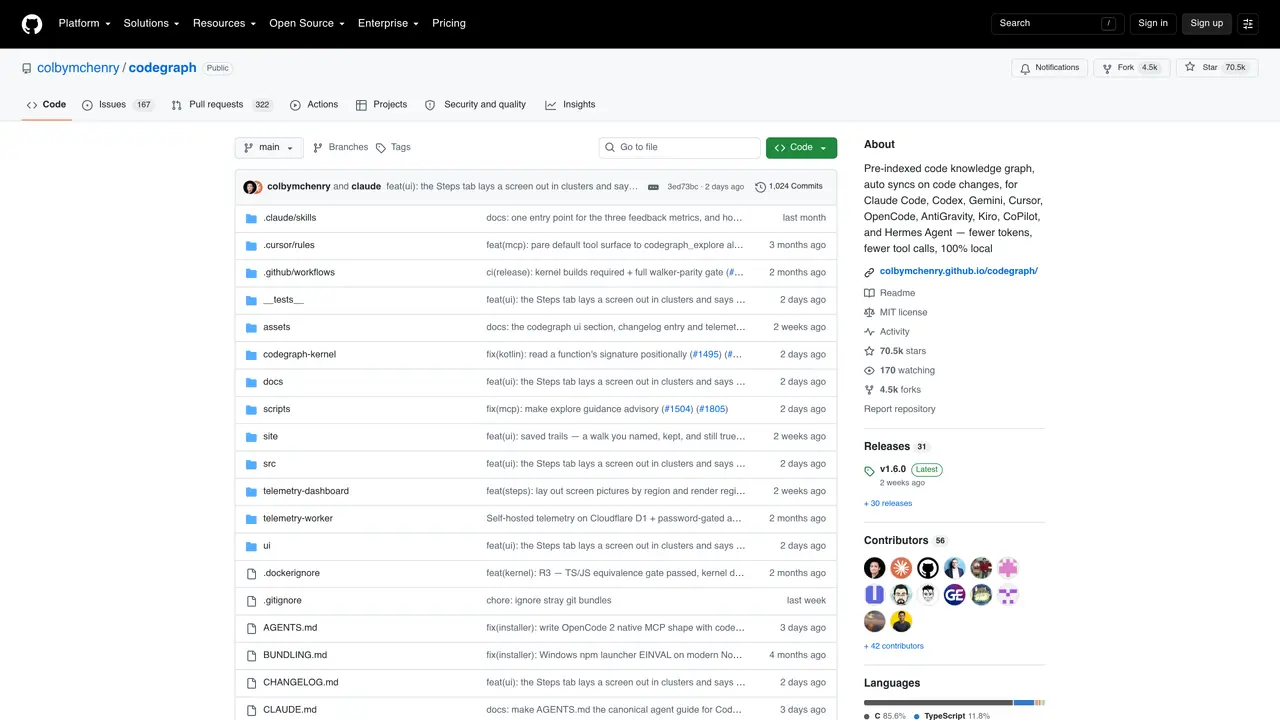
About CodeGraph
CodeGraph is a local-first code intelligence platform designed to enhance AI-powered coding workflows by pre-indexing codebases into a queryable knowledge graph. It uses deterministic tree-sitter parsing to extract symbols, imports, relationships, and call structures from supported files, storing this information locally in SQLite for fast access. The tool exposes this pre-indexed graph through an MCP server, enabling agentic coding tools to retrieve context efficiently without repeated file scanning or LLM-generated summaries. Developers, engineering teams, and AI tool builders leverage CodeGraph to support tasks such as architecture analysis, refactoring, debugging, and repository exploration while maintaining full control over their data. The platform integrates seamlessly with popular AI coding agents like Claude Code, Cursor, Codex CLI, OpenCode, Hermes Agent, and GitHub Copilot, reducing token consumption and tool calls for codebase-related queries. CodeGraph auto-syncs on code changes, ensuring the knowledge graph remains current without manual intervention.
GitHub, Inc.
San Francisco, California, US · Founded 2008
- Founders
- Tom Preston-Werner, Chris Wanstrath, PJ Hyett, Scott Chacon
- Founded
- 2008
- Headquarters
- San Francisco, California, US
- Legal status
- Subsidiary of Microsoft (NASDAQ: MSFT)
Key features
- Local indexing of codebase into a knowledge graph
- Deterministic tree-sitter parsing for accurate symbol extraction
- SQLite-based storage for per-project code intelligence
- MCP server to expose code graph to agentic coding tools
- Reduces token usage and tool calls for codebase queries
- Supports Claude Code, Codex CLI, Cursor, OpenCode, and Gemini CLI
- Exposes symbols, imports, relationships, files, and call structures
- Enables architecture analysis, refactoring, and debugging workflows
Use cases
- Index a repository to provide AI coding agents with faster codebase context through MCP queries
- Support architecture analysis and refactoring by querying pre-indexed code relationships and dependencies
- Debug and explore repositories efficiently by reducing repeated file scans and tool calls
Pros
- Local-first architecture with deterministic tree-sitter parsing for accurate code analysis
- Reduces token usage and tool calls by pre-indexing codebases into a queryable knowledge graph
- Supports multiple popular AI coding agents including Claude Code, Cursor, and GitHub Copilot
- Auto-syncs code changes to maintain an up-to-date knowledge graph without manual intervention
- 100% local execution with no external dependencies or cloud processing required
Cons
- Requires initial setup and configuration to integrate with specific AI coding agents
- Limited to supported programming languages and frameworks as defined by tree-sitter parsers
- May introduce complexity for teams unfamiliar with knowledge graph-based code intelligence tools
Frequently asked questions about CodeGraph
What is CodeGraph and what does it do?
CodeGraph is a local-first code intelligence library, CLI, and MCP server that indexes a codebase into a queryable knowledge graph. It parses supported files to extract symbols, relationships, and call structures, storing them locally for fast retrieval by AI coding agents.
Who should use CodeGraph?
Developers, engineering teams, and AI tool builders who want to enhance AI-powered coding workflows with accurate, local code intelligence. It is particularly useful for tasks like architecture analysis, refactoring, debugging, and repository exploration.
How does CodeGraph integrate with AI coding agents?
CodeGraph connects to AI coding agents such as Claude Code, Cursor, and GitHub Copilot via an MCP server. The CLI tool auto-detects and configures supported agents, wiring the CodeGraph MCP server into each to enable context retrieval without repeated file scanning.
Does CodeGraph require an internet connection to work?
No, CodeGraph operates entirely locally. The pre-indexed knowledge graph is stored on the user's machine, and all processing occurs offline without external dependencies or cloud processing.
What programming languages does CodeGraph support?
CodeGraph supports languages and frameworks that have tree-sitter parsers available. The specific list of supported languages is determined by the tree-sitter ecosystem and may expand over time.
How do I get started with CodeGraph?
Install the CLI using a one-command installer, then run the agent integration step to connect CodeGraph to your preferred AI coding tools. Finally, initialize each project to build its code graph. Detailed instructions are available in the project's README and documentation.