
Meta AI enhances machine learning, NLP, and computer vision capabilities.

Travsr
FreeStarting price
0Popularity
About Travsr
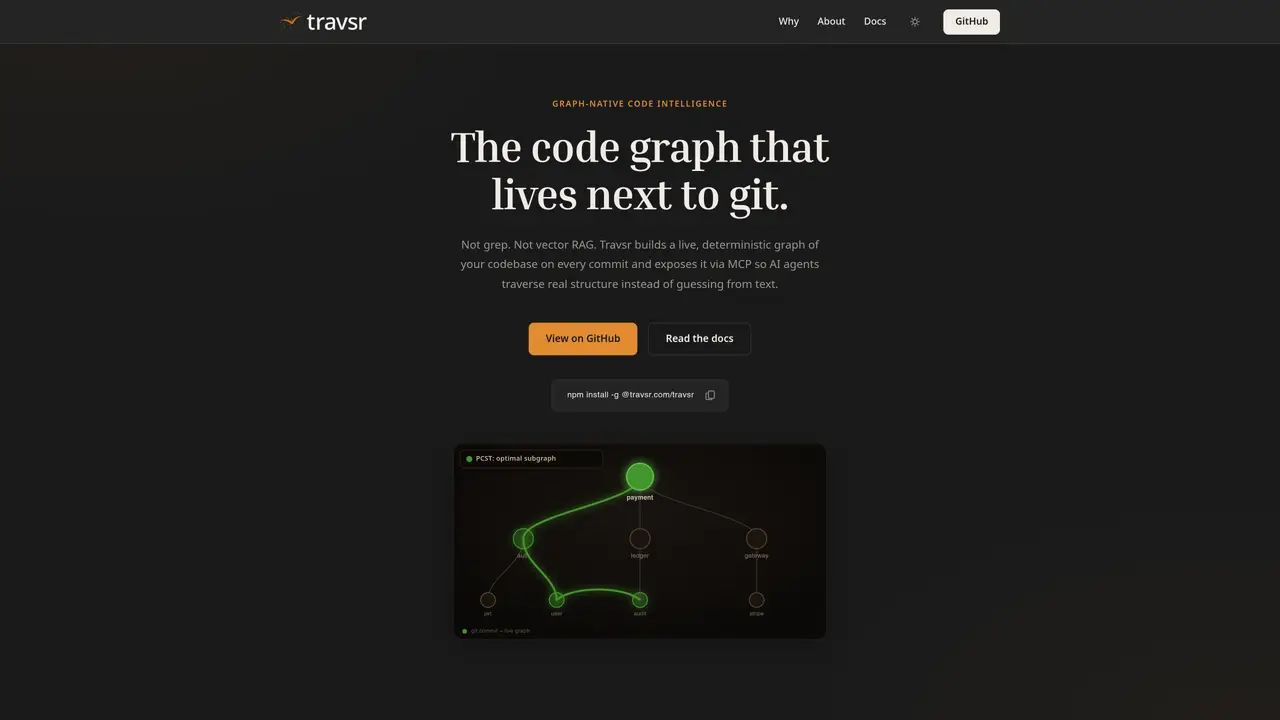
Travsr constructs a precise, graph-based representation of a codebase by parsing files with Tree-sitter and LSIF on each git commit. The resulting graph captures call relationships, type dependencies, and import structures without approximations or embeddings. It exposes this graph via the Model Context Protocol (MCP), allowing AI coding assistants such as Claude, Copilot, or Cursor to traverse the actual code structure instead of inferring from text. The tool integrates automatically with popular editors and AI agents, requiring no manual configuration beyond installation and language setup. Users can query the graph directly or visualize it within VS Code to inspect callers, dependencies, and code metrics in real time. The system maintains freshness by reindexing changed files on every commit, ensuring the graph reflects the latest state of the repository.
Key features
- Live code graph generation on every commit
- MCP server for AI agent integration
- VS Code extension for visual graph exploration
- Tree-sitter parsing for structural code analysis
- Built-in semantic edges for TypeScript, JavaScript, Rust, and Python
- Language-specific analyzers via travsr lang install
- Graph metrics and statistics display
- Cross-editor and cross-agent compatibility
Use cases
- Enabling AI agents to traverse real code structure instead of text chunks
- Visualizing call graphs and dependencies in VS Code
- Answering precise codebase questions with confidence scores
Pros
- Deterministic graph built from Tree-sitter and LSIF without approximations
- Real-time updates via git post-commit hooks
- MCP-native integration with multiple AI coding tools
- Zero-config setup for supported editors and agents
- Visual graph exploration within VS Code
Cons
- Requires installation of language analyzers for full semantic indexing
- Objective-C semantic indexing is macOS-only
- No explicit support for languages beyond those listed
Frequently asked questions about Travsr
What is Travsr and how does it work?
Travsr builds a live, deterministic graph of a codebase on every git commit using Tree-sitter and LSIF, capturing call relationships, type dependencies, and import structures without approximations. It exposes this graph via the Model Context Protocol (MCP) for AI agents to traverse the actual code structure.
Who is Travsr designed for?
Travsr is designed for developers and AI coding assistants like Claude, Copilot, or Cursor that need precise, real-time code structure insights. It suits teams working with large or complex codebases where accurate dependency and call relationship tracking is critical.
How does Travsr stay updated with code changes?
Travsr maintains freshness by reindexing changed files on every git commit via a post-commit hook, ensuring the graph reflects the latest state of the repository without manual intervention.
What integrations does Travsr support?
Travsr integrates automatically with popular AI coding tools such as Claude Code, Cursor, Copilot, Windsurf, and Zed through the Model Context Protocol. It also offers a VS Code extension for visualizing the graph directly within the editor.
How do I get started with Travsr?
Install the Travsr binary, index your repository, and add the languages you need. The tool detects installed AI coding tools and wires them to the MCP server with zero manual configuration. You can then query the graph or visualize it in VS Code.
Does Travsr support multiple programming languages?
Yes, Travsr supports a wide range of languages through Tree-sitter parsers. Semantic edges for TypeScript, JavaScript, Rust, and Python are built-in, while other languages require installing their respective analyzers using the `travsr lang install` command.