
OpenAI builds and deploys advanced AI models like GPT-4o for autonomous agents and workflows.

TestMyVibe
0Popularity
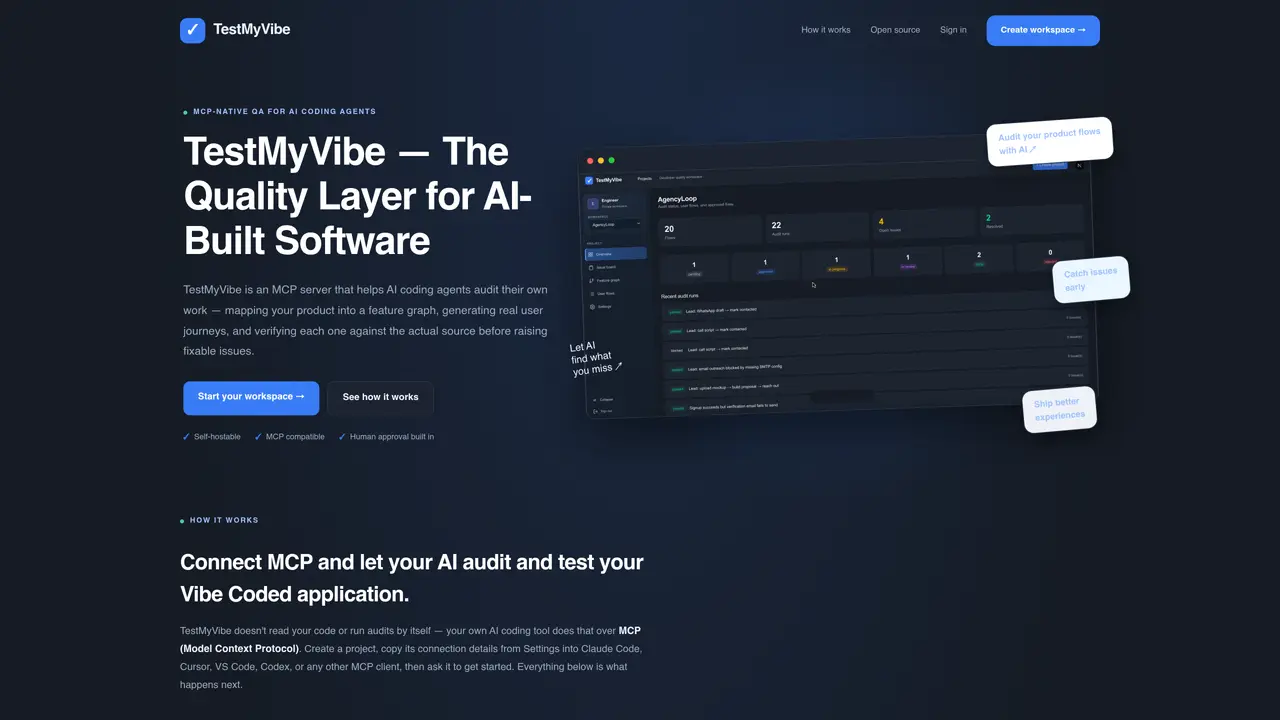
About TestMyVibe
TestMyVibe functions as a quality layer for software built by AI coding agents. It operates as an MCP server that enables AI tools to audit their own work by mapping product features into a graph, generating realistic user journeys, and verifying each flow against the actual source code. The system does not perform audits directly but relies on the connected AI coding tool to execute checks via the Model Context Protocol. Users create a project, obtain a connection token, and integrate TestMyVibe with their preferred MCP-compatible client such as Claude Code, Cursor, VS Code, or Codex. The AI agent then constructs a feature graph from the source, derives testable user flows, and evaluates each step against the real codebase. Issues are reported with file references and suggested fixes, which can be reviewed and approved on a kanban-style board. Human oversight remains central, as findings require explicit approval before the AI agent can claim and implement fixes.
Key features
- MCP server integration
- Feature graph generation
- User journey creation
- Source-based verification
- Issue tracking with file references
- Fix prompt generation
- Kanban-style approval board
- Bearer token authentication
Use cases
- Auditing AI-generated code for correctness
- Validating user flows in AI-built applications
- Catching edge cases missed by automated testing
Pros
- MCP-native integration with popular AI coding tools
- Self-hostable deployment option
- Human approval required for issue resolution
- Open source implementation
- Feature graph and user journey generation
Cons
- Requires MCP-compatible client for operation
- No cloud-hosted option mentioned
- Limited to source-based audits
- Human approval step adds manual overhead
Frequently asked questions about TestMyVibe
What does TestMyVibe do?
TestMyVibe acts as a quality assurance layer for AI-generated software by enabling AI coding agents to audit their own work. It maps product features into a graph, generates realistic user journeys, and verifies each flow against the actual source code using the Model Context Protocol.
Who is TestMyVibe designed for?
TestMyVibe is designed for developers and teams using AI coding agents who want to ensure the reliability and correctness of their AI-generated code. It is particularly useful for those who rely on AI tools like Claude Code, Cursor, VS Code, or Codex.
How do I get started with TestMyVibe?
Users begin by creating a project on TestMyVibe and obtaining a connection token. They then integrate TestMyVibe with their preferred MCP-compatible client, such as an AI coding tool, to start the auditing process.
Does TestMyVibe perform audits directly?
No, TestMyVibe does not perform audits directly. Instead, it relies on the connected AI coding tool to execute checks via the Model Context Protocol. The AI agent constructs a feature graph, derives testable user flows, and evaluates each step against the real codebase.
How are issues reported and handled?
Issues are reported with file references and suggested fixes, which can be reviewed and approved on a kanban-style board. Human oversight is central, as findings require explicit approval before the AI agent can claim and implement fixes.
What MCP-compatible clients does TestMyVibe support?
TestMyVibe supports integration with MCP-compatible clients such as Claude Code, Cursor, VS Code, and Codex. Users can connect their preferred AI coding tool to TestMyVibe for auditing purposes.