
OpenAI builds and deploys advanced AI models like GPT-4o for autonomous agents and workflows.

Yoetz
0Popularity
About Yoetz
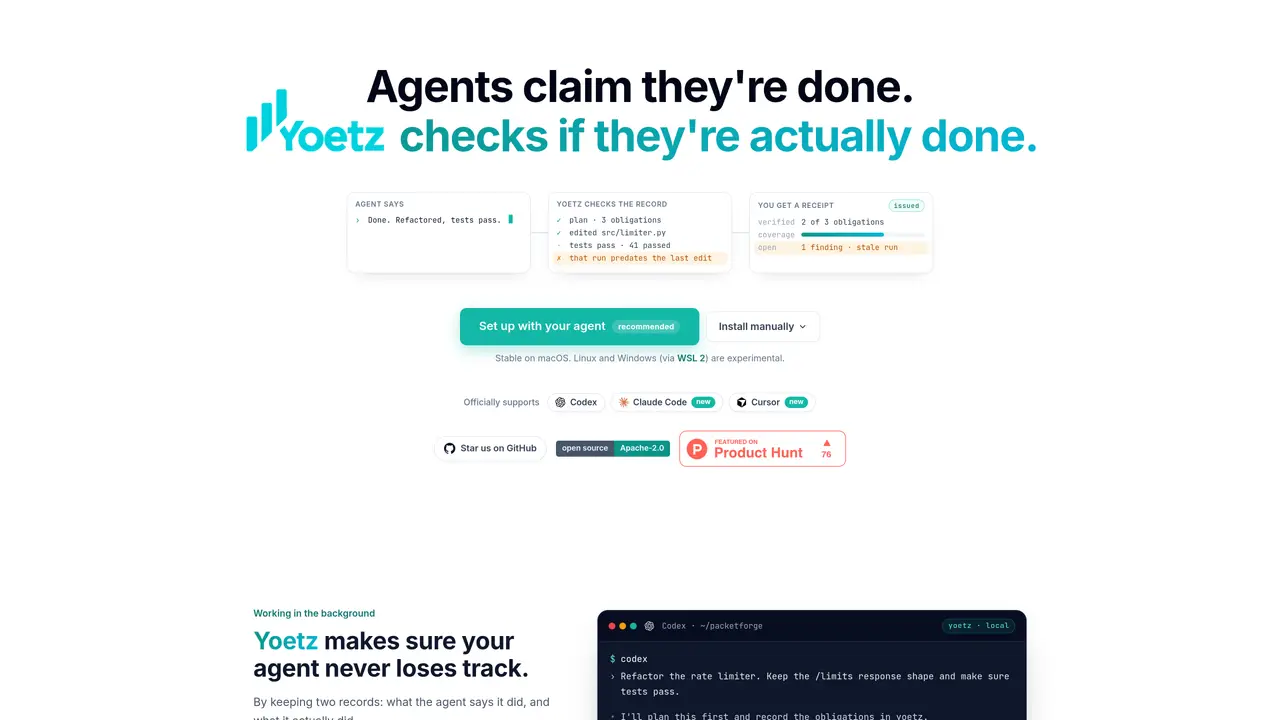
Yoetz validates whether AI coding agents have truly completed assigned tasks by comparing their stated claims against verifiable evidence. It maintains two parallel records: one for what the agent claims to have done and another for what actually occurred during execution. Discrepancies between these records are flagged as findings, prompting the agent to correct its work before issuing a final receipt. The tool operates locally on a user’s machine, requiring no account or network access, and generates deterministic receipts that document exactly which obligations were verified and which remain open. Yoetz integrates with popular coding agents like Codex, Claude Code, and Cursor through MCP and hooks, capturing structural facts such as edits, test runs, and tool calls without inspecting file contents. It supports task delegation, lineage tracking, and project coordination, allowing multiple agents to work on related tasks while maintaining separate verification records. The system uses an append-only ledger to store records and applies local rules to compare them, producing receipts that clearly state the extent of verification achieved.
Key features
- Honest completion verification for AI coding agents
- Receipt generation with verified and open obligations
- Task delegation and lineage tracking
- Project coordination with consent-based overlap detection
- Append-only ledger for record storage
- MCP and hooks-based integration
- Deterministic receipts with coverage details
- Local service with no external dependencies
Use cases
- Validating AI agent refactoring tasks before claiming completion
- Coordinating multiple agents working on related tasks in a repository
- Tracking task lineage and roll-up verification across parent-child relationships
Pros
- Local-first operation with no account or network required
- Compares agent claims against verifiable evidence
- Supports multiple agents and task delegation
- Generates deterministic receipts for auditability
- Open-source under Apache-2.0 license
Cons
- Experimental support for Linux and Windows (WSL 2)
- Limited to agent-supported environments (Codex, Claude Code, Cursor)
- No official mobile or cloud-based deployment
Frequently asked questions about Yoetz
What does Yoetz do?
Yoetz validates whether AI coding agents have truly completed assigned tasks by comparing their stated claims against verifiable evidence. It generates deterministic receipts that document which obligations were verified and which remain open.
Who is Yoetz designed for?
Yoetz is designed for developers and teams using AI coding agents like Codex, Claude Code, or Cursor. It helps ensure task completion is honest and verifiable, especially in collaborative or automated workflows.
How does Yoetz work with AI coding agents?
Yoetz integrates with agents via MCP and hooks, capturing structural facts such as edits, test runs, and tool calls without inspecting file contents. It maintains two parallel records—what the agent claims and what actually occurred—and flags discrepancies as findings.
Does Yoetz require an internet connection or account?
No, Yoetz operates locally on a user’s machine and requires no account or network access. All verification and receipt generation happen offline.
What kind of receipts does Yoetz produce?
Yoetz produces deterministic receipts that clearly state the extent of verification achieved, including coverage-bounded findings and unresolved obligations. These receipts document exactly which claims were verified and which remain open.
Can Yoetz coordinate multiple agents working on the same project?
Yes, Yoetz supports task delegation, lineage tracking, and project coordination. It allows multiple agents to work on related tasks while maintaining separate verification records and rolling up findings to parent tasks.