
Frontier-grade Claude models with agentic workflows, strong coding, and enterprise guardrails delivered via developer console, web app, and cloud partners.

Proof Engine
FreeStarting price
0Popularity
About Proof Engine
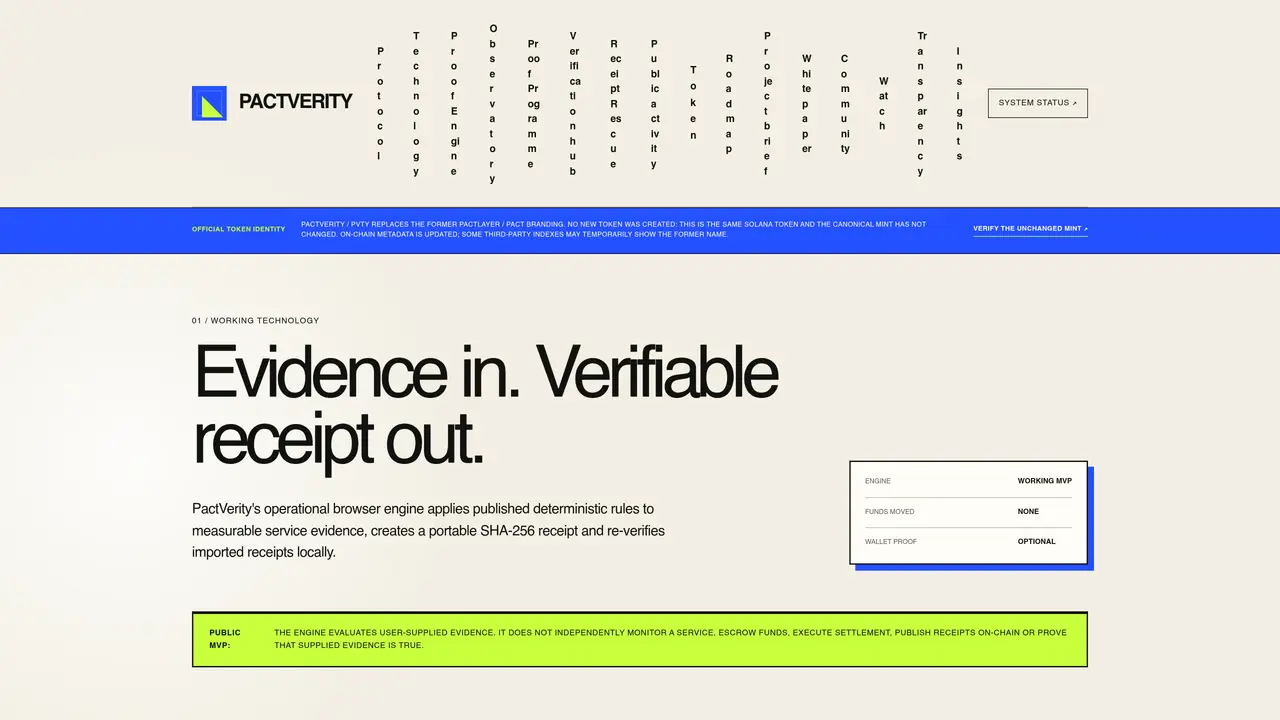
The Proof Engine is a deterministic verification tool that processes measurable service evidence to generate verifiable SHA-256 receipts. It applies published rules to normalize inputs, evaluate conditions, and produce a portable record of outcomes. The engine separates agreement terms, observations, and decisions into distinct stages, allowing independent re-verification. It supports explicit criteria such as maximum latency, minimum uptime, and evidence age, using fixed units for clarity. The tool does not independently monitor services, collect evidence, or execute settlements, relying instead on user-supplied measurements. Receipts can be locally re-verified to detect alterations, and optional wallet key control adds cryptographic proof of receipt authenticity. The system is designed for measurable digital work where service terms can be objectively defined, such as API calls, data products, or automated workflows.
Key features
- Normalizes service terms into measurable conditions
- Validates evidence structure and limits
- Applies deterministic checks to produce explainable outcomes
- Generates SHA-256 receipts for portable verification
- Supports optional Ed25519 wallet key control
- Separates terms, evidence, and decisions into distinct stages
- Enables local re-verification of receipts
- Designed for API and AI agent service-level agreements
Use cases
- Verifying API call outcomes against predefined SLA terms
- Auditing automated workflows or data product deliveries
- Providing machine-readable evidence for incident reviews
Pros
- Generates portable, machine-readable receipts for verifiable outcomes
- Separates terms, evidence, and checks for transparent auditing
- Supports deterministic re-verification of receipts via SHA-256 hashing
- Optional wallet key control for cryptographic proof of receipt authenticity
- Designed for measurable service conditions with fixed-unit criteria
Cons
- Does not independently monitor services or collect evidence
- No on-chain settlement or dispute resolution capabilities
- Limited to user-supplied evidence without independent verification
- Requires explicit, measurable terms to function effectively
Frequently asked questions about Proof Engine
What does the Proof Engine actually verify?
The Proof Engine applies published deterministic rules to user-supplied service evidence to produce a portable SHA-256 receipt that can be locally re-verified. It evaluates measurable conditions such as maximum latency, minimum uptime, and evidence age, but does not independently collect evidence or confirm service delivery.
Who should use the Proof Engine?
The tool is designed for API builders, AI agent operators, and platform operators who need to retain verifiable records of measurable digital work. It is most useful when service terms can be represented as objective conditions and the evidence source is disclosed.
Does the Proof Engine replace monitoring or dispute resolution systems?
No, the Proof Engine does not replace monitoring, identity, authorization, contracts, or dispute procedures. It provides a deterministic verification layer that strengthens the evidence boundary but remains separate from these systems.
Can the Proof Engine prove the truth of the supplied evidence?
No, the Proof Engine does not prove the truth of the evidence. It verifies that the normalized inputs reproduce the listed checks and outcome under the engine version, but evidence collection and truth confirmation remain external responsibilities.
How does wallet key control work in the Proof Engine?
Wallet key control adds an optional Ed25519 signature to the receipt digest, proving that the corresponding Solana key signed the exact receipt. This does not establish real-world identity, role, or evidence source, but adds cryptographic proof of receipt authenticity.
What is the four-stage verification process in the Proof Engine?
The engine separates verification into four stages: Terms (defining measurable conditions), Evidence (supplying bounded observations), Checks (evaluating every rule), and Receipt (canonicalizing and committing the record). This structure allows independent re-verification and detectability of alterations.