Frontier-grade Claude models with agentic workflows, strong coding, and enterprise guardrails delivered via developer console, web app, and cloud partners.

RunLLM
$20/mStarting price
1.9KMonthly visits
5Popularity
About RunLLM
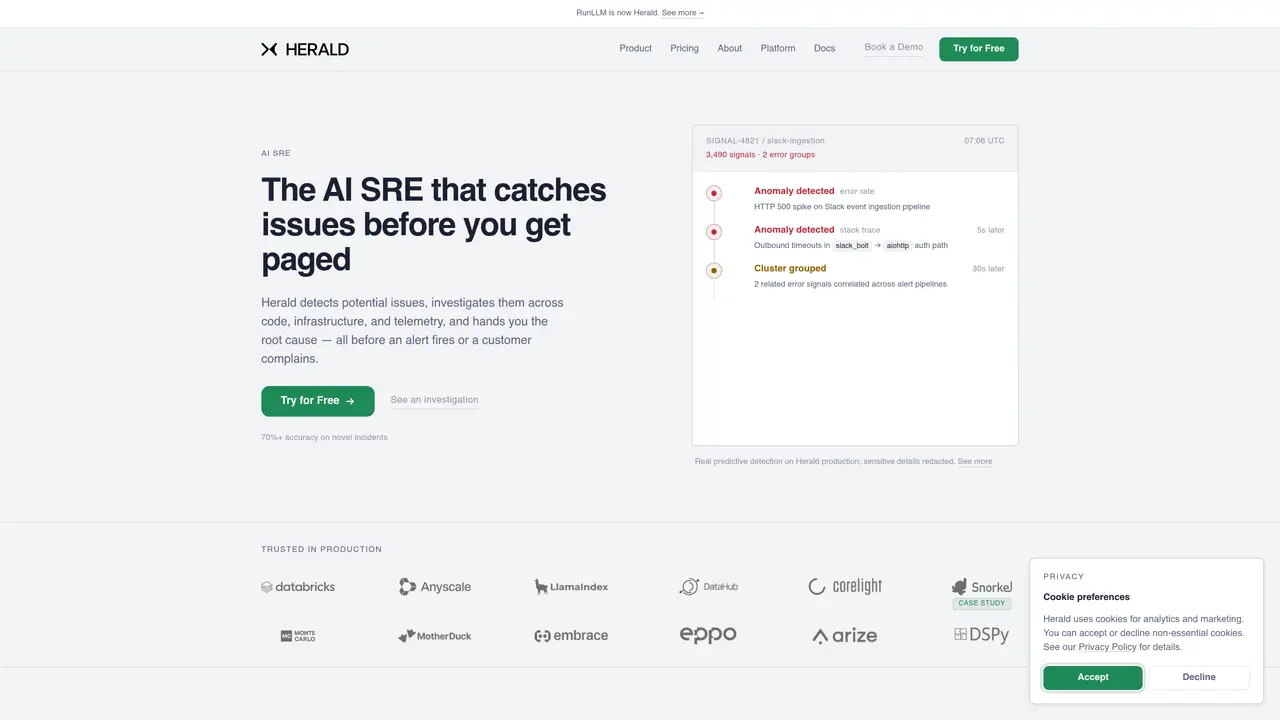
RunLLM is a web-based AI Site Reliability Engineering (SRE) platform designed for SREs, support engineers, and technical teams that need to accelerate incident investigation across complex observability stacks. It connects to telemetry and operational context—such as logs, metrics, traces, tickets, code, and documentation—to automatically investigate alerts and produce actionable outputs. The tool delivers rapid root cause analysis (RCA) and mitigation guidance by correlating alerts with relevant data sources, then returning prioritized next steps with verification checks. RunLLM supports self-teaching investigations, learning from incidents and user corrections to reuse proven investigation steps over time. It offers agentic workflows and customization through a UI for managing suites of agents and a Python SDK for building custom triage, escalation, and support workflows. The platform includes connectors for tools like Datadog, Splunk, GCP Logging, Grafana, Slack, and Zendesk, with read-only access by default and full action logging. It is SOC 2 Type II compliant and emphasizes secure, validated code execution and real-time reasoning capabilities. RunLLM is notably used by vLLM to deflect a significant volume of technical questions, demonstrating its effectiveness in high-volume incident environments.
Key features
- Automated alert investigation and root cause analysis (RCA)
- Self-teaching investigations that learn from incidents and user feedback
- Agentic workflows with UI and Python SDK for custom triage workflows
- Integrations with Datadog, Splunk, GCP Logging, Grafana, Slack, and Zendesk
- Read-only access by default with full action logging
- SOC 2 Type II compliance for security and privacy
- Prioritized next steps with verification checks for actionable outputs
- Multi-agent collaboration and validated code execution
- Real-time reasoning capabilities for faster incident response
Use cases
- Automating incident investigation and root cause analysis for SRE teams
- Supporting technical teams in resolving complex observability alerts
- Building custom triage and escalation workflows for enterprise environments
Pros
- Automates root cause analysis (RCA) for incidents before alerts fire or customers are impacted
- Builds a context graph from observability data, code, CI/CD, and documentation to understand normal system behavior
- Delivers predictive anomaly detection tailored to each data stream without requiring manual threshold tuning
- Achieves over 70% accuracy on novel incidents by evaluating multiple hypotheses simultaneously
- Learns from investigations and user corrections to avoid repeating mistakes and improve over time
Cons
- Requires initial setup to scan and integrate with existing observability and codebase tools
- May need adjustments to fully align with unique or highly customized infrastructure workflows
- Dependent on the quality and completeness of the integrated telemetry and operational context sources
Frequently asked questions about RunLLM
What does RunLLM (formerly Herald) do?
RunLLM is an AI-powered Site Reliability Engineering (SRE) platform that proactively detects, investigates, and resolves incidents across observability stacks before alerts fire or customers are impacted. It correlates telemetry, code, and operational context to deliver root cause analysis (RCA) and actionable mitigation steps.
Who is RunLLM designed for?
The tool is designed for SREs, support engineers, and technical teams managing complex infrastructure who need to accelerate incident investigation and reduce mean time to resolution (MTTR). It is particularly useful for teams handling high-volume or novel incidents.
How does RunLLM investigate incidents?
RunLLM builds a context graph of your stack—including observability data, codebase, CI/CD, and documentation—then uses custom anomaly detection models to identify issues. It evaluates multiple hypotheses simultaneously against relevant data sources to deliver RCAs in minutes.
Does RunLLM require runbooks or manual configuration?
No. RunLLM does not require predefined runbooks or manual threshold tuning. It learns your stack automatically and adapts to novel incidents without prior documentation, reducing operational overhead.
What integrations does RunLLM support?
RunLLM offers connectors for tools like Datadog, Splunk, GCP Logging, Grafana, Slack, and Zendesk, with read-only access by default. These integrations enable it to correlate alerts and telemetry across your existing observability stack.
How does RunLLM ensure security and compliance?
RunLLM is SOC 2 Type II compliant and emphasizes secure, validated code execution and real-time reasoning. It provides full action logging and operates with read-only access to data sources by default, ensuring minimal risk to your infrastructure.
RunLLM Website Engagement
Last Update: 9 days ago
Total Monthly Visits
0
Bounce Rate
0%
Visit Duration (avg)
—
Pages Per Visit
0
Country Rank
0
United States
Global Rank
0