
OpenAI builds and deploys advanced AI models like GPT-4o for autonomous agents and workflows.

Cleric
$100/mStarting price
0Popularity
About Cleric
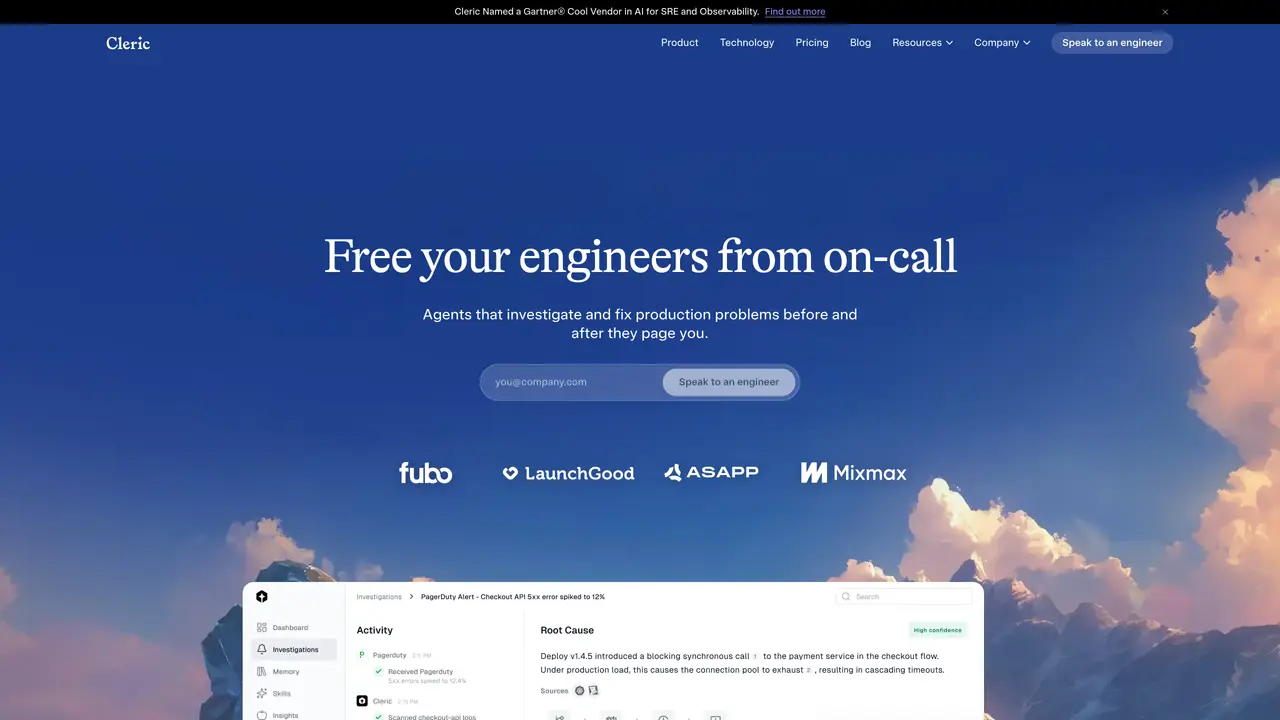
Cleric is an AI-powered tool designed to enhance the operational efficiency of production applications. Its primary function is to autonomously triage and root cause alerts without the need for manual intervention or extensive runbooks. This innovative solution is tailored for IT professionals and teams managing complex infrastructures, particularly those dealing with Kubernetes and cloud environments. Cleric simplifies the daunting task of alert management by automatically investigating issues and prioritizing critical alerts, thereby transforming the landscape of operational troubleshooting. Key Features: Autonomous Alert Investigation: Cleric autonomously investigates alerts, collecting and presenting relevant evidence to justify a root cause proposal, which significantly reduces the time spent on manual investigations. Intelligent Runbook Execution: The tool selects and executes the most appropriate runbook for each alert. If the runbook doesn’t provide sufficient evidence, Cleric employs first-principles reasoning to identify the root cause. Critical Alert Prioritization: Cleric efficiently triages alerts at scale, identifying and prioritizing only those issues that require immediate attention, ensuring that teams focus on high-impact problems. Privacy and Safety Oriented Design: Cleric operates with read-only access to infrastructure and can be deployed entirely within your Virtual Private Cloud (VPC), ensuring data safety and privacy.
Key features
- Autonomous Alert Investigation
- Intelligent Runbook Execution
- Critical Alert Prioritization
- Privacy and Safety Oriented Design
- Time Efficiency
- Cost-Effective
- Scalability
- Enhanced Problem-Solving
Use cases
- IT Administrators managing and maintaining the efficiency of server operations
- DevOps Teams streamlining operations across development and production environments
- Cloud Service Managers overseeing vast cloud infrastructures where quick response to alerts is crucial
Pros
- Autonomously investigates and triages production alerts without manual intervention
- Provides root cause analysis with evidence and proposed fixes for faster resolution
- Integrates with existing stacks via read-only access, ensuring minimal setup disruption
- Operates with security-first design, including SOC 2 Type II compliance and encrypted data handling
- Learns from team actions to improve future investigations and institutionalize knowledge
Cons
- Requires read-only access to infrastructure, which may limit certain troubleshooting capabilities
- Dependent on existing alerting and monitoring systems for optimal performance
- May not fully replace human oversight in highly complex or novel incident scenarios
Frequently asked questions about Cleric
What is Cleric and who is it designed for?
Cleric is an AI-powered Site Reliability Engineering (SRE) tool designed to autonomously investigate, triage, and resolve production incidents. It is built for engineering teams, particularly those managing complex infrastructures like Kubernetes and cloud environments, to reduce manual on-call burdens and accelerate incident resolution.
How does Cleric prioritize and investigate alerts?
Cleric filters noise by triaging alerts at scale, identifying critical issues that require immediate attention. It autonomously investigates alerts, collects relevant evidence, and proposes root causes or fixes, often skipping manual dashboards like Cloudflare or Datadog.
Does Cleric integrate with existing tools and workflows?
Yes, Cleric is designed to plug into existing stacks with read access by default and write access when configured. It supports integrations with tools like Linear, Jira, Notion, GitHub, PagerDuty, and AWS DevOps, among others.
How does Cleric ensure data privacy and security?
Cleric operates with read-only access by default and can be deployed entirely within a Virtual Private Cloud (VPC). It is SOC 2 Type II compliant, performs regular penetration testing, and encrypts data everywhere while never using customer data for training.
Can Cleric learn from past incidents and team knowledge?
Yes, Cleric compounds institutional knowledge over time by learning from every resolution. It maps services, dependencies, and ownership automatically, and institutionalizes fixes so the entire team benefits from past solutions.
How quickly can teams get started with Cleric?
Cleric is designed for quick setup, typically taking minutes to integrate with existing stacks. Teams can start using it with read-only access and expand to write access as needed, enabling rapid deployment and immediate value.