Cloud platform for web scraping, browser automation, and AI data extraction with 20,000+ pre-built tools and scalable cloud runs.

AnyCrawler
FreeStarting price
0Popularity
About AnyCrawler
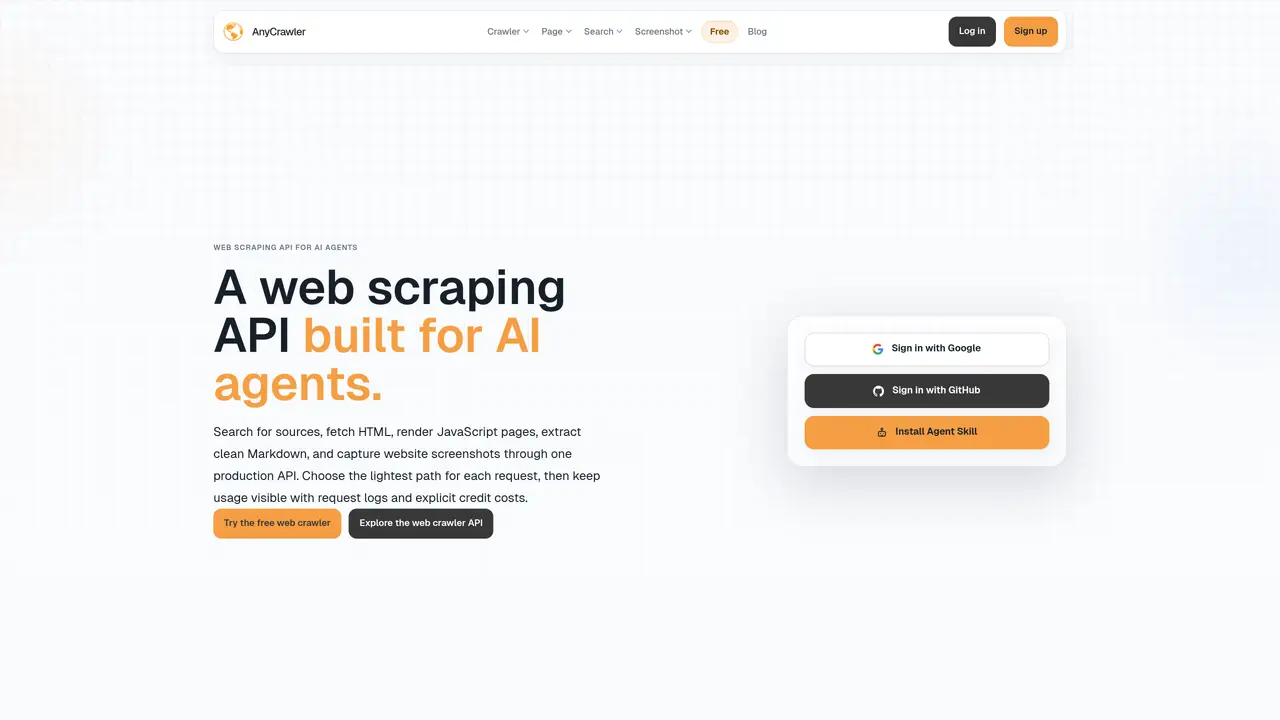
AnyCrawler is a web-access infrastructure API designed to transform live web pages and search results into structured, LLM-ready context for AI systems. It fetches or renders JavaScript-heavy websites, extracts content in Markdown format, captures metadata, links, and screenshots, and provides a reusable “agent skill” for AI agents, RAG pipelines, and automation tools. The tool eliminates the need for developers to build custom browser or crawler stacks by handling the heavy lifting of web access and content extraction. Its outputs are noise-reduced and structured, ensuring reliable context for AI models and pipelines. AnyCrawler also includes features like traceability through credits, usage logs, and canonical URLs, which help maintain transparency and reproducibility in production deployments. Additionally, it manages billing, concurrency, and observability, making it suitable for scalable and production-grade applications. By providing clean, structured data from the live web, AnyCrawler enables AI systems to interact with current information without manual scraping or parsing overhead.
Key features
- Fetches and renders JavaScript-heavy websites
- Extracts content in Markdown, metadata, links, and screenshots
- Provides reusable agent skills for AI systems
- Delivers noise-reduced, structured, and traceable outputs
- Includes credits, usage logs, and canonical URLs for transparency
- Handles billing, concurrency, and observability for production use
- Supports live web pages and search results
- Designed for integration with RAG pipelines and automation tools
Use cases
- Feeding current web context into AI agents for real-time decision-making
- Enabling RAG pipelines to retrieve up-to-date information from live websites
- Automating data extraction for AI-driven workflows without custom crawler development
Pros
- Provides a unified API for fetching, rendering, searching, and capturing screenshots of web content
- Supports both lightweight HTML fetching and full browser rendering for JavaScript-heavy pages
- Delivers structured Markdown output with metadata, links, and canonical URLs for reliable AI context
- Offers multiple search channels including web, image, news, video, and scholar results
- Includes usage logs, credit-based billing, and observability features for production deployments
Cons
- Requires understanding of credit-based billing and API workflows for optimal use
- Browser rendering may introduce latency compared to simple HTML fetching
Frequently asked questions about AnyCrawler
What does AnyCrawler do?
AnyCrawler provides a web access infrastructure API that transforms live web pages and search results into structured, LLM-ready context for AI systems. It handles fetching, rendering, searching, and screenshot capture through a single production API.
Who is AnyCrawler suitable for?
AnyCrawler is designed for AI developers, agents, and automation tools that need reliable live web context. It suits teams building RAG pipelines, AI agents, or production-grade applications requiring clean, structured data from the web.
How does AnyCrawler handle JavaScript-heavy websites?
AnyCrawler offers a render API that uses browser execution to capture content from JavaScript-heavy pages, ensuring accurate extraction where simple HTML fetching would fail.
Does AnyCrawler provide search capabilities?
Yes, AnyCrawler includes search APIs for web, image, news, video, and scholar results, allowing users to discover candidate pages before crawling or extracting content.
How does AnyCrawler manage billing and usage?
AnyCrawler uses a credit-based billing system with usage logs and request tracking, providing transparency and control over costs for different AI workloads.
How do I get started with AnyCrawler?
Users can sign up via the AnyCrawler Console, obtain API keys, and follow the documented API flows for search, fetch, render, or screenshot workflows. The platform provides concise API documentation and examples for quick integration.