

Cloud platform for web scraping, browser automation, and AI data extraction with 20,000+ pre-built tools and scalable cloud runs.
4M visits/mo-5%#13 Automation & Agents
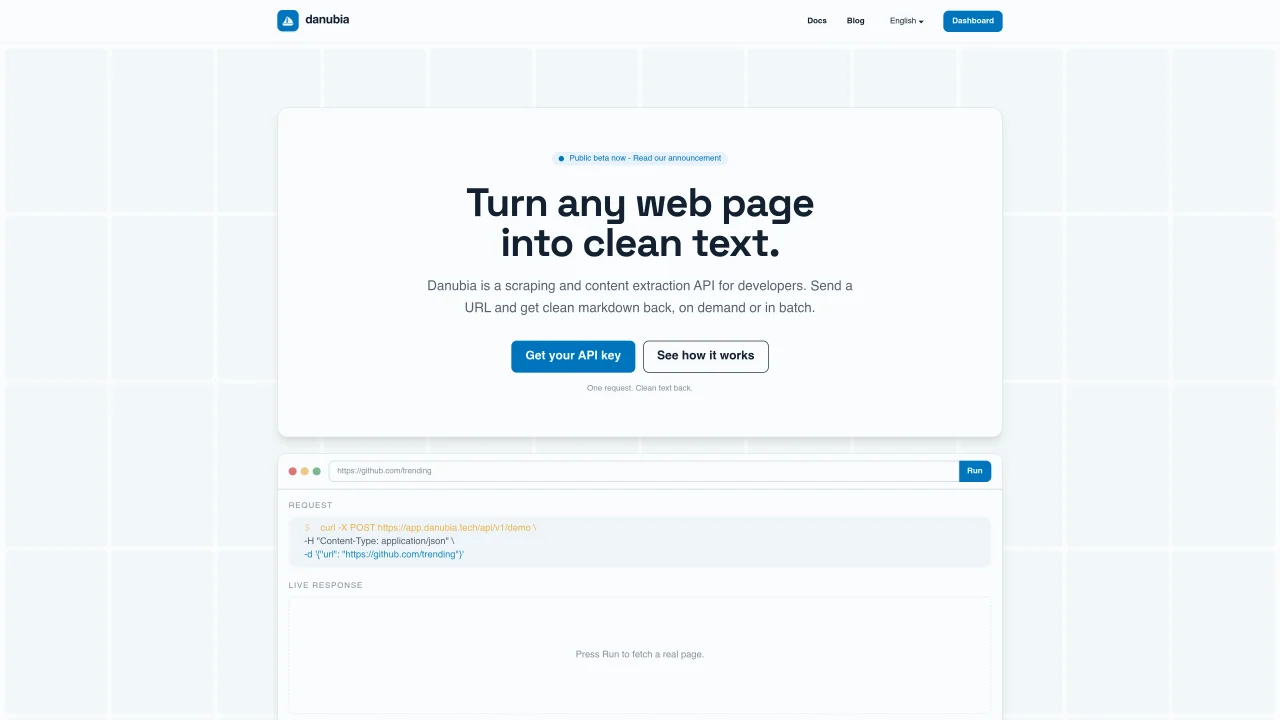
Danubia is a scraping and content extraction API designed for developers. It accepts URLs and returns the main content of web pages as clean markdown, HTML, or plain text, with navigation, ads, and boilerplate removed. The service also provides structured metadata such as title, description, and language, along with fetch metadata like the final URL and response time. Danubia operates on a prepaid credit system where users can make individual requests or batch process thousands of URLs at a reduced cost. The API respects robots.txt rules and enforces per-domain concurrency limits to ensure polite crawling. Servers are hosted in the European Union with GDPR compliance by default, and user data is never used for model training or shared with third parties. JavaScript rendering is supported but incurs higher credit costs.
Danubia is a scraping and content extraction API for developers that converts web pages into clean markdown, HTML, or plain text. It removes navigation, ads, and boilerplate while providing structured metadata such as title, description, and language.
Danubia is designed for developers and teams who need to extract clean, structured content from web pages for applications like RAG pipelines, content aggregation, or dataset creation without building custom scrapers.
Yes, Danubia strictly respects robots.txt rules, including crawl delays and blocks, and enforces per-domain concurrency limits to ensure polite crawling. Redirect targets are also checked against robots.txt.
Yes, Danubia supports JavaScript rendering through a real browser, but this feature incurs higher credit costs compared to standard HTML fetching.
Danubia allows users to submit thousands of URLs for batch processing at a reduced cost per request. Batch jobs share the same prepaid credit system as on-the-fly requests, with batch fetches costing half the credits of individual requests.
No, Danubia stores user data only to serve requests and does not use it for model training or share it with third parties. All data is processed and stored in the European Union with GDPR compliance.
We use essential cookies to run aitoolnavio™, and optional cookies to analyze traffic and measure our marketing. You choose what we use — optional cookies stay off unless you turn them on. See our Privacy Policy.
One short email a week: fresh tools worth trying, honest takes and the updates that actually matter. No spam, unsubscribe any time.
Cloud platform for web scraping, browser automation, and AI data extraction with 20,000+ pre-built tools and scalable cloud runs.
AI web crawler that extracts clean web data into JSON or markdown for developers and marketers.
Enterprise-grade proxy networks, web scrapers, and ready-to-use datasets for reliable web data collection.
Fast, secure web browser with U3 technology, extensions, and intuitive shortcuts for efficient browsing.
Automate lead generation and data enrichment with AI-powered web scraping and outreach tools.
Web scraping and data extraction API that simplifies gathering data from websites with features like JavaScript rendering and geotargeting.
Create automated web crawlers and automate web scraping tasks without coding.
Automate data entry, extract structured data from websites, and create images using OpenAI's Dall-E.
No-code web scraping tool to extract structured data from websites, automate runs, and export to sheets or databases without coding.
Web scraping API that automates data extraction from websites, including those that block scraping, designed for developers.
REST API that converts any URL into clean, LLM-ready markdown or structured data for AI agents and pipelines.
An AI-powered web scraping toolkit offering APIs, cloud browsers, CAPTCHA solving, and proxy rotation for reliable public data extraction.
Matched on what this tool does — grouped by the job you would be replacing.
matches URL-to-markdown conversion · Clean text output with boilerplate removal
AI web crawler that extracts clean web data into JSON or markdown for developers and marketers.
REST API that converts any URL into clean, LLM-ready markdown or structured data for AI agents and pipelines.
A web crawling API that converts websites and docs into clean Markdown for AI agents, handling JS rendering, CAPTCHAs, and proxies automatically.
API that returns clean, normalized web page content for AI agents