
AI chatbot for conversation, work, research, coding, and content creation.

Lyrenth
$19/moStarting price
0Popularity
About Lyrenth
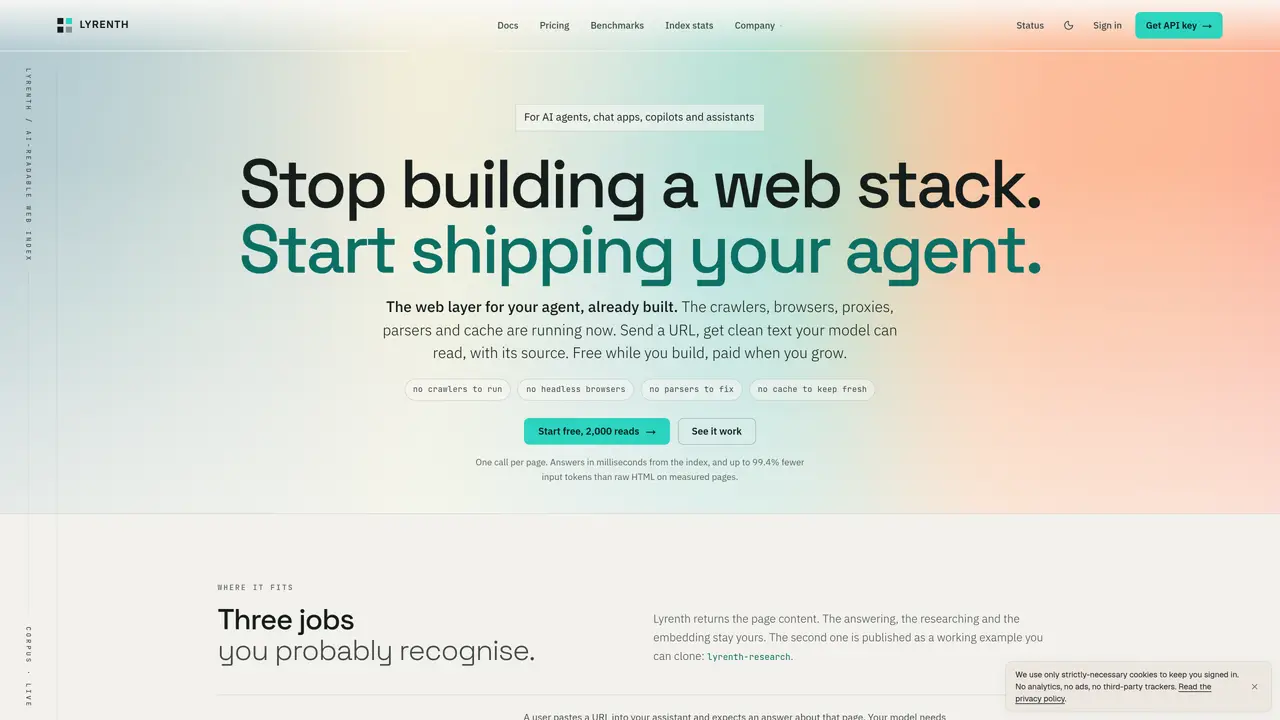
Lyrenth provides an indexed corpus of AI-readable web documents accessible via a single API call. It handles crawling, rendering, parsing, and caching of public web pages so that applications can retrieve clean, normalized content without maintaining their own infrastructure. The service returns a standardized JSON envelope called an AIDocument, which includes markdown, metadata, links, and source information. Users send a URL and receive the processed document in milliseconds, with optional freshness controls to force re-indexing when needed. The platform supports batch operations for multiple URLs and offers tiered pricing based on read volume and freshness requirements. It is designed for AI agents, chat applications, copilots, and research systems that need reliable access to web content without the overhead of web scraping pipelines.
Key features
- Single API call per URL
- Standardized AIDocument JSON output
- Batch processing up to 20 URLs per call
- Headless browser rendering for dynamic pages
- Cache-first or force-refresh freshness control
- Per-key analytics and cost reporting
- Domain verification for verified sources
- Public JSON schema validation
Use cases
- Answering questions about a specific URL in an AI assistant
- Reading and normalizing sources for research agents
- Integrating public web content into knowledge bases
Pros
- Returns standardized JSON documents with markdown and metadata
- Handles crawling, rendering, and parsing automatically
- Offers batch processing for multiple URLs per request
- Provides freshness controls with cache-first or force-refresh options
- Includes analytics and cost reporting per API key
Cons
- No free tier beyond initial 2,000 reads
- Requires API key for access
- Freshness windows vary by plan (90 days to 24 hours)
- Limited to public web pages
Frequently asked questions about Lyrenth
What is Lyrenth?
Lyrenth is an AI-readable web index that provides a pre-built infrastructure for retrieving clean, normalized web content via a single API call. It handles crawling, rendering, parsing, and caching of public web pages, returning standardized JSON documents called AIDocuments.
Who is Lyrenth designed for?
The tool is designed for AI agents, chat applications, copilots, research systems, and enterprise pipelines that require reliable access to web content without managing their own scraping infrastructure.
How does Lyrenth work?
Users send a URL to the API, and Lyrenth returns a canonical AIDocument containing cleaned markdown, metadata, links, and source information. The platform maintains a standing index of pre-processed pages, enabling fast responses and optional freshness controls for re-indexing.
What pricing model does Lyrenth use?
Lyrenth offers tiered pricing based on read volume and freshness requirements, with a free tier available for development and testing. Pricing scales with usage as applications grow.
Does Lyrenth support batch operations?
Yes, Lyrenth supports batch operations, allowing users to process multiple URLs in a single API call, such as retrieving up to 20 documents per request.
How can I get started with Lyrenth?
Users can start by signing up for an API key, testing the service with sample URLs, and integrating the API into their applications. The platform provides documentation, examples, and a public JSON schema for validation.