
Cloud platform for web scraping, browser automation, and AI data extraction with 20,000+ pre-built tools and scalable cloud runs.

Nutrient Data Extraction API
$59Starting price
0Popularity
About Nutrient Data Extraction API
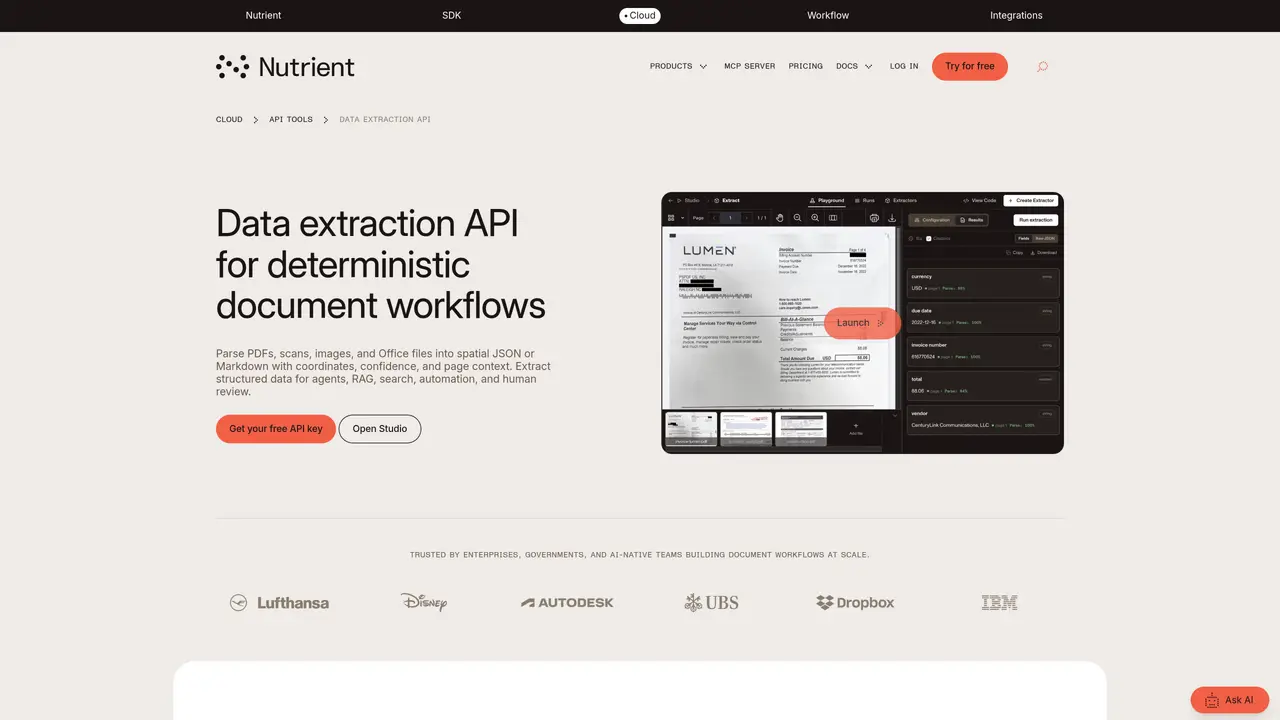
Nutrient Data Extraction API specializes in converting PDFs, scanned images, and Office files into structured formats like spatial JSON or Markdown. The API preserves document context by including bounding boxes, confidence scores, and page references, making it suitable for applications requiring precise data localization. It supports four processing modes, ranging from low-cost text extraction to AI-augmented parsing for handling complex layouts, handwritten content, and formulas. Users can define a custom JSON Schema to map extracted values directly to their internal data models, facilitating smooth integration with databases, enterprise systems, or AI-driven workflows. The API is designed for deterministic document processing, supporting use cases such as retrieval-augmented generation (RAG), search indexing, automation agents, and human review queues. It is used by enterprises and AI-native teams to build scalable document workflows, with a free tier available for development and testing purposes.
Key features
- Parses PDFs, scans, and Office files into structured JSON or Markdown
- Includes bounding boxes, confidence scores, and page context in output
- Supports four processing modes (text extraction to AI-augmented parsing)
- Handles complex layouts, handwriting, and formulas
- Allows JSON Schema mapping for direct integration with data models
- Compatible with databases, ERPs, CRMs, and AI pipelines
- Designed for deterministic document workflows
- Includes a free tier for testing and development
Use cases
- Automating data extraction from invoices, receipts, and forms
- Enhancing search indexing with structured document content
- Building automation agents for document processing pipelines
Pros
- Supports multiple file formats including PDFs, scanned images, and Office files
- Provides spatial JSON or Markdown output with bounding boxes, confidence scores, and page context
- Offers four processing modes to balance cost and accuracy for different document complexities
- Enables seamless integration with databases, ERPs, CRMs, and AI pipelines via custom JSON Schema mapping
- Includes a free tier for testing and development without upfront costs
Cons
- May require technical setup for JSON Schema mapping to align with specific data models
- Complex layouts, handwriting, or formulas may still require higher-cost AI-augmented processing modes
Nutrient Data Extraction API videos
Frequently asked questions about Nutrient Data Extraction API
What types of documents can the Nutrient Data Extraction API process?
The API can process PDFs, scanned images, and Office files such as Word documents and spreadsheets.
Who is the Nutrient Data Extraction API designed for?
It is designed for enterprises, governments, and AI-native teams building document workflows at scale, including use cases like RAG, search indexing, and automation agents.
Does the API support integration with other software systems?
Yes, users can define a JSON Schema to map extracted data directly to their databases, ERPs, CRMs, or AI pipelines for seamless integration.
How does the API handle complex documents like those with handwriting or formulas?
The API offers AI-augmented processing modes specifically for handling complex layouts, handwritten content, and formulas.
Is there a free tier available for testing the API?
Yes, the API provides a free tier for testing and development purposes.
What output formats does the API support?
The API outputs data in spatial JSON or Markdown, including coordinates, confidence scores, and page context.