Summarizes, extracts, and rewrites content from files.

MDifying
FreeStarting price
0Popularity
About MDifying
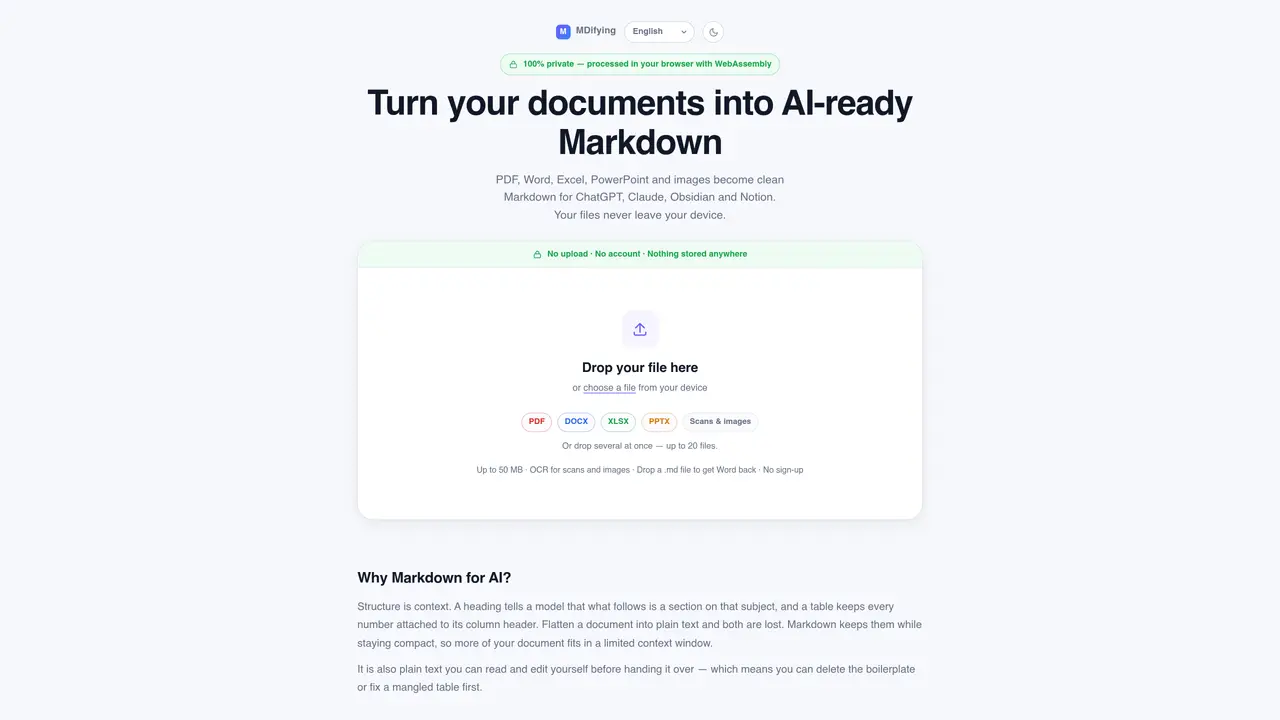
MDifying converts PDF, Word, Excel, PowerPoint and image files into clean Markdown that preserves document structure such as headings and tables. Processing occurs entirely in the user’s browser using WebAssembly, so files never leave the device and no upload step is required. The tool supports scanned PDFs via local OCR, recognizing English and Spanish text from images. Output can be copied directly into AI chat interfaces like ChatGPT or Claude, or into note-taking apps such as Obsidian and Notion. A Chunks tab splits documents into semantically meaningful pieces for vector stores, preserving heading paths and avoiding mid-table splits. The converter is free to use without sign-up and imposes file size limits of 50 MB on desktop and 10 MB on mobile, reflecting browser memory constraints rather than account restrictions.
Key features
- Converts PDF, Word, Excel, PowerPoint and images to Markdown
- Local OCR for scanned PDFs in English and Spanish
- Preserves headings, tables and code blocks in output
- Generates semantically chunked Markdown with heading paths
- Supports direct copy or download of Markdown
- Produces standard Markdown compatible with Obsidian, Notion and AI tools
- No upload step or server-side processing
- Unlimited conversions without sign-up
Use cases
- Preparing documents for AI chat interfaces like ChatGPT or Claude
- Converting research papers or reports into structured Markdown for note-taking apps
- Transforming spreadsheets into Markdown tables for documentation or vector stores
Pros
- Preserves document structure including headings and tables
- Local processing with WebAssembly ensures privacy
- Supports multiple file formats: PDF, Word, Excel, PowerPoint, images
- Free to use with no account required
- Generates structured Markdown chunks for vector stores
Cons
- File size limits due to browser memory constraints
- Mobile file limit is 10 MB
- OCR for scanned PDFs is slower and less accurate than text extraction
Frequently asked questions about MDifying
What file types does MDifying support for conversion to Markdown?
MDifying supports PDF, Word, Excel, PowerPoint, and image files, including scanned PDFs via local OCR.
Does MDifying upload my files to a server during conversion?
No, MDifying processes files entirely in the user’s browser using WebAssembly, so files never leave the device.
Can MDifying handle scanned PDFs or images with text?
Yes, MDifying offers local OCR for scanned PDFs and images, recognizing English and Spanish text.
What is the output format of MDifying, and where can I use it?
The output is clean Markdown that preserves document structure, compatible with AI chat interfaces like ChatGPT or Claude, and note-taking apps such as Obsidian and Notion.
Does MDifying provide a way to split documents for vector stores?
Yes, the Chunks tab splits documents into semantically meaningful pieces for vector stores, preserving heading paths and avoiding mid-table splits.
Are there any file size limits for using MDifying?
Yes, MDifying imposes file size limits of 50 MB on desktop and 10 MB on mobile, reflecting browser memory constraints rather than account restrictions.