Cloud platform for web scraping, browser automation, and AI data extraction with 20,000+ pre-built tools and scalable cloud runs.

Docling
$0.07Starting price
0Popularity
About Docling
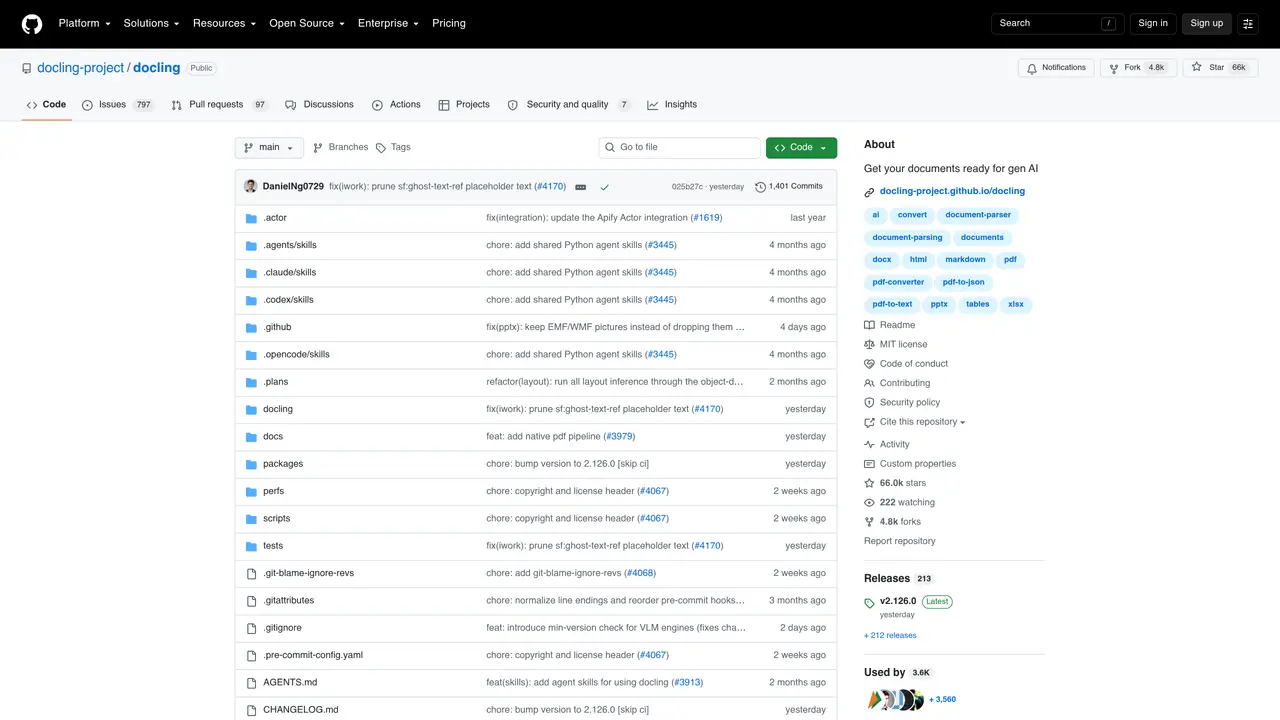
Docling is an open-source document processing library designed to parse a wide variety of file formats—including PDF, DOCX, PPTX, EPUB, HTML, audio, video, and scanned documents—into a unified, structured representation suitable for generative AI applications. It provides advanced capabilities such as layout analysis, table extraction, formula recognition, and OCR for handling image-based documents. The tool integrates seamlessly with popular AI frameworks like LangChain, LlamaIndex, Crew AI, and Haystack, enabling developers to incorporate document parsing directly into their AI pipelines. Docling also supports local execution for environments with strict data privacy or air-gapped requirements, and it can be deployed as a standalone API service for scalable document processing. By standardizing diverse document types into a consistent format, Docling simplifies the ingestion and analysis of documents in generative AI workflows, reducing preprocessing complexity for teams working with unstructured data. Its native integration with agent frameworks via an MCP server further extends its utility in automated document processing systems.
GitHub, Inc.
San Francisco, California, US · Founded 2008
- Founders
- Tom Preston-Werner, Chris Wanstrath, PJ Hyett, Scott Chacon
- Founded
- 2008
- Headquarters
- San Francisco, California, US
- Legal status
- Subsidiary of Microsoft (NASDAQ: MSFT)
Key features
- Parses PDF, DOCX, PPTX, EPUB, HTML, audio, video, and scanned documents
- Advanced PDF understanding with layout analysis and table extraction
- Formula recognition for mathematical content in documents
- OCR support for scanned or image-based documents
- Native integration with LangChain, LlamaIndex, Crew AI, and Haystack
- MCP server for agent-based document processing
- Local execution for sensitive or air-gapped environments
- Standalone API service for scalable document parsing
- Unified representation of diverse document formats
Use cases
- Extracting structured data from invoices, contracts, and reports for AI analysis
- Processing academic papers, books, or research documents into searchable formats
- Automating document ingestion in enterprise workflows for generative AI applications
Pros
- Supports parsing of over 20 document formats, including PDF, DOCX, PPTX, EPUB, HTML, audio, video, and scanned documents
- Provides advanced document understanding features such as layout analysis, table extraction, formula recognition, and OCR
- Offers a unified document representation format for consistent processing in generative AI workflows
- Enables local execution for environments with strict data privacy or air-gapped requirements
- Integrates with popular AI frameworks like LangChain, LlamaIndex, Crew AI, and Haystack
Cons
- Requires Python 3.10 or higher for installation, dropping support for Python 3.9
- Complex setup may be challenging for users unfamiliar with Python-based tools
Frequently asked questions about Docling
What is Docling and what does it do?
Docling is an open-source document processing library that parses diverse file formats into a structured representation suitable for generative AI applications. It handles formats like PDF, DOCX, PPTX, EPUB, HTML, audio, video, and scanned documents, providing advanced features such as layout analysis, table extraction, and OCR.
Who is Docling designed for?
Docling is designed for developers and teams working with unstructured data in generative AI workflows. It suits those who need to process diverse document types into a consistent format for AI pipelines, including environments with strict data privacy requirements.
How does Docling integrate with other tools?
Docling integrates with popular AI frameworks like LangChain, LlamaIndex, Crew AI, and Haystack. It also supports agent frameworks via an MCP server and can be deployed as a standalone API service for scalable document processing.
Can Docling be used in air-gapped or private environments?
Yes, Docling supports local execution, making it suitable for environments with strict data privacy or air-gapped requirements. It can also be deployed as a standalone API service for scalable processing.
What are the system requirements for using Docling?
Docling requires Python 3.10 or higher and works on macOS, Linux, and Windows environments for both x86_64 and arm64 architectures. Detailed installation instructions are available in the project's documentation.
How do I get started with Docling?
To get started, install Docling using pip. Ensure you have Python 3.10 or higher installed. Detailed installation instructions and examples are provided in the project's README and documentation.