
Cloud platform for web scraping, browser automation, and AI data extraction with 20,000+ pre-built tools and scalable cloud runs.

Graphlit
$49Starting price
11KMonthly visits
17Popularity
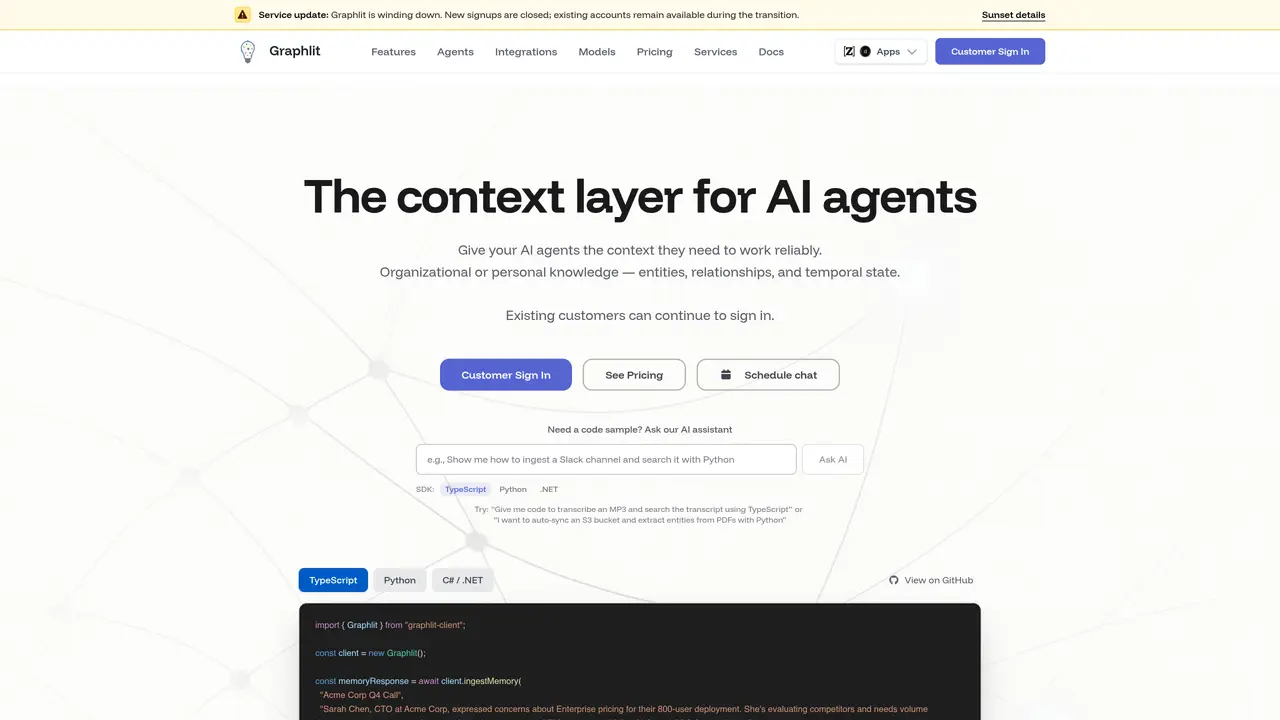
About Graphlit
Graphlit is a RAG-as-a-Service platform designed to streamline the integration of knowledge into AI applications through intelligent data processing and retrieval capabilities. The platform automates text extraction and chunking, generates vector embeddings, and maintains conversation history to support contextual interactions. It offers semantic search functionalities, including metadata filtering, enabling users to retrieve relevant information with precision. Graphlit also provides content creation tools such as automated summarization of text and transcripts, social media post generation, and long-form content creation to enhance productivity and engagement. The platform supports ingestion from a wide range of sources, including websites, cloud storage, SharePoint, podcasts, Jira, Notion, YouTube, email, and Slack, allowing users to extract unstructured data in formats like documents, audio, video, or images. Graphlit is tailored for developers and businesses seeking to build AI applications that require efficient knowledge retrieval and content generation, enabling rapid deployment and integration without extensive manual setup.
Key features
- Intelligent text extraction and chunking
- Built-in vector embeddings and conversation history
- Semantic search with metadata filtering
- Automated text and transcript summarization
- Social media post generation
- Long-form content creation
- Ingest data from various sources
- Extract unstructured data in multiple formats
Use cases
- Offer RAG conversations over user's unstructured data
- Extract JSON from documents, audio transcripts, and web pages
- Publish AI-generated audio summaries of Slack messages or emails
Pros
- Enables intelligent text extraction and chunking for structured data processing
- Provides built-in vector embeddings and conversation history for RAG applications
- Offers semantic search with metadata filtering capabilities
- Supports ingestion from diverse sources including websites, cloud storage, and collaboration tools
- Facilitates automated content creation such as summarization and social media post generation
Cons
- May require technical expertise for advanced integrations
- Limited transparency on pricing and scalability for enterprise use
- Dependence on external data sources could introduce latency or reliability issues
Frequently asked questions about Graphlit
What does Graphlit do?
Graphlit serves as a context layer for AI agents, enabling intelligent text extraction, built-in vector embeddings, and conversation history management.
Who is Graphlit designed for?
Graphlit is designed for developers and businesses seeking to integrate knowledge into their AI applications quickly and efficiently.
How does Graphlit handle data ingestion?
Graphlit allows users to ingest data from various sources, including websites, cloud storage, SharePoint, podcasts, Jira, Notion, YouTube, email, or Slack, and extracts unstructured data in formats such as documents, audio, video, or images.
What content creation features does Graphlit offer?
Graphlit provides automated text and transcript summarization, social media post generation, and long-form content creation capabilities.
Does Graphlit support semantic search?
Yes, Graphlit offers semantic search capabilities, including metadata filtering.
How can I get started with Graphlit?
Users can begin by exploring Graphlit's documentation or contacting the team for integration support.
Graphlit Website Engagement
Last Update: 9 days ago
Total Monthly Visits
0
Bounce Rate
0%
Visit Duration (avg)
0.00s
Pages Per Visit
0
Country Rank
0
United States
Global Rank
0
Category Rank
#0
Programming & Developer Software
Monthly Traffic
Traffic Sources
Traffic Share By Country
- United States39.6%
- India21.7%
- Spain15.7%
- Germany14.6%
- Brazil8.4%