
Meta AI enhances machine learning, NLP, and computer vision capabilities.

Zapinner
$10/moStarting price
0Popularity
About Zapinner
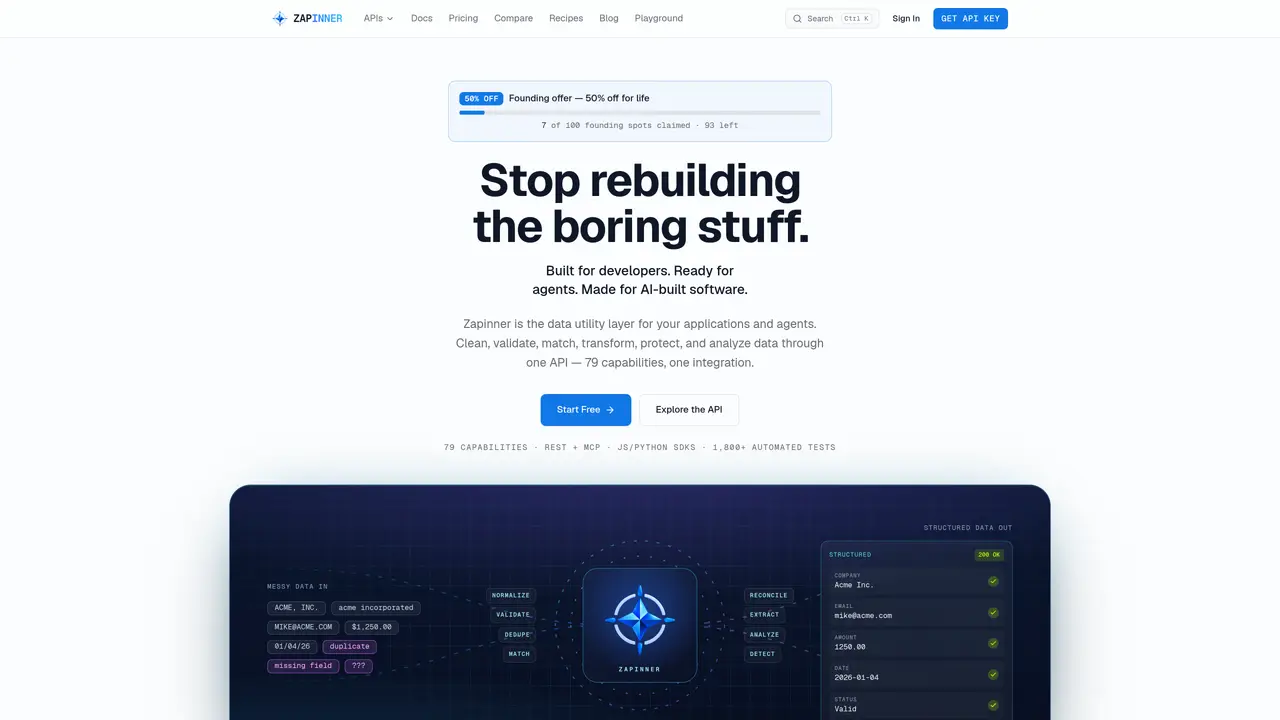
Zapinner provides a data utility layer for applications and agents, offering 79 capabilities through a single API. It handles cleaning, validation, matching, transformation, protection, and analysis of data with one integration. The service includes three flagship workflows—Repair, Map, and Guard—each accessible via a single API call and billed per credit. Repair transforms messy data into production-ready records with an audit trail, Map converts incoming data into required schemas, and Guard validates or rejects data before it enters systems. Individual endpoints such as normalize, dedupe, match, anomalies, and reconcile remain available as developer primitives. The API supports REST, JavaScript and Python SDKs, and MCP, with deterministic engines ensuring consistent results. It is designed for teams that need reliable data processing without rebuilding the same plumbing repeatedly.
Key features
- Repair messy data into production-ready records
- Map data into required schemas
- Guard data before it enters systems
- Normalize inconsistent fields
- Deduplicate records within datasets
- Match records to identify real-world entities
- Detect anomalies in datasets
- Score data with transparent factor breakdown
Use cases
- Cleaning and standardizing customer data from multiple sources
- Validating and repairing records before database insertion
- Deduplicating and reconciling datasets for analytics
Pros
- Single API integration for 79 data utilities
- Deterministic engines with consistent input-output behavior
- Supports REST, JavaScript/Python SDKs, and MCP
- Audit trails and structured evidence-backed results
- Flagship workflows for repair, mapping, and guarding data
Cons
- No free tier beyond 1,000 credits per month
- Pricing is credit-based with no flat-rate option
- Limited to API-only access; no desktop application
Frequently asked questions about Zapinner
What does Zapinner do?
Zapinner provides a data utility layer that cleans, validates, matches, transforms, protects, and analyzes data through a single API with 79 capabilities. It offers three flagship workflows—Repair, Map, and Guard—each accessible via one API call and billed per credit.
Who is Zapinner designed for?
Zapinner is built for developers and teams building AI-driven software or applications that require reliable data processing without repeatedly rebuilding the same data plumbing. It suits teams handling messy, inconsistent, or untrustworthy data.
How does Zapinner's pricing model work?
Zapinner operates on a per-credit billing model, where each API call—whether using flagship workflows or individual endpoints—consumes one credit. The pricing is consistent across all capabilities and workflows.
What integrations does Zapinner support?
Zapinner supports REST, JavaScript and Python SDKs, and MCP. It provides a single API integration for all 79 data utility capabilities, eliminating the need to stitch together multiple point solutions.
Can I use individual endpoints instead of the flagship workflows?
Yes, Zapinner offers individual endpoints such as normalize, dedupe, match, anomalies, and reconcile that can be called directly as developer primitives, in addition to the three flagship workflows.
How do I get started with Zapinner?
To get started, sign up for an API key on the Zapinner website, explore the API documentation, and begin making calls to the available endpoints or flagship workflows. The service provides a playground and automated tests to help with integration.