
Transform ideas into fully functional applications with Lovable, a groundbreaking AI tool.

COG
$0.07Starting price
0Popularity
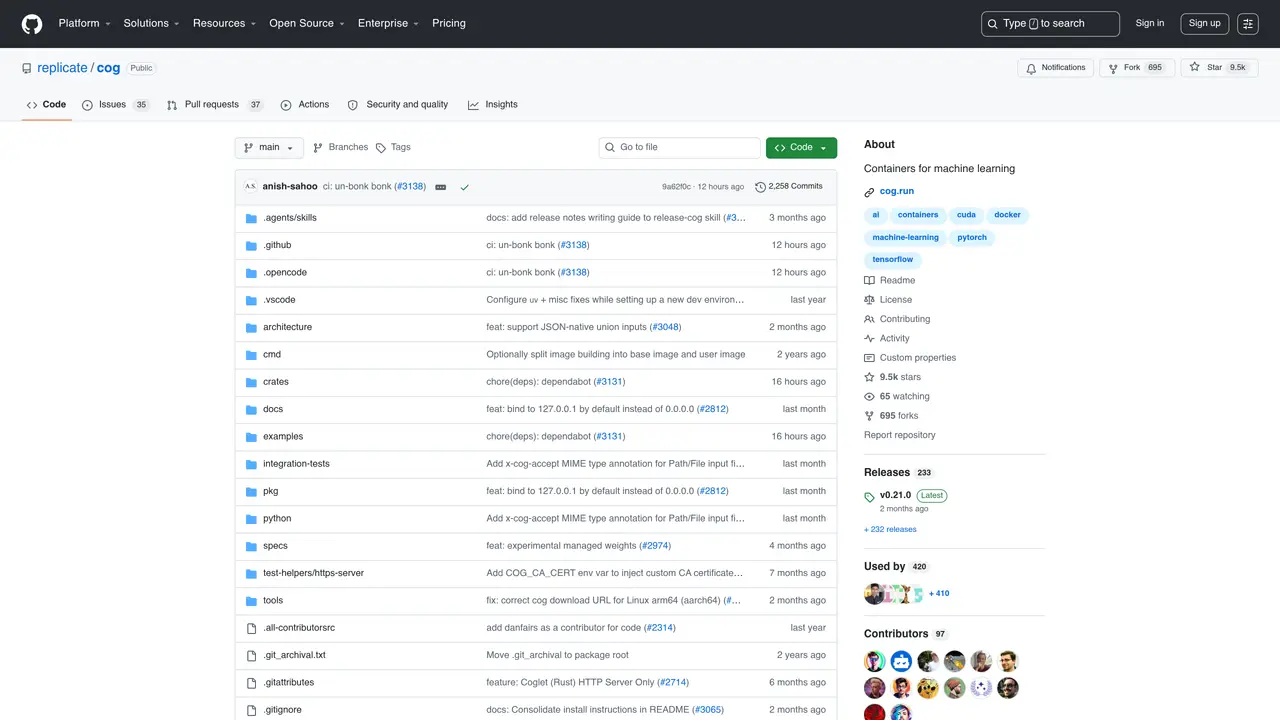
About COG
COG is an open-source, cloud-based platform designed to help developers quickly and easily build and deploy powerful web applications. With COG, developers can create custom applications that are tailored to their exact requirements and integrated with existing systems. The platform allows for fast and easy application development, including the ability to create and deploy applications in minutes. It also offers a wide range of features, including an intuitive user interface, automated deployment, continuous integration and deployment, a wide range of app templates, and powerful APIs. COG is an excellent choice for developers looking to build and deploy applications quickly, efficiently, and securely. With its easy-to-use interface and robust feature set, COG provides the perfect platform for developers to create the applications they need, with minimal hassle and maximum speed.
GitHub, Inc.
San Francisco, California, US · Founded 2008
- Founders
- Tom Preston-Werner, Chris Wanstrath, PJ Hyett, Scott Chacon
- Founded
- 2008
- Headquarters
- San Francisco, California, US
- Legal status
- Subsidiary of Microsoft (NASDAQ: MSFT)
Key features
- Build and deploy web apps
- Create custom applications tailored to needs
- Integrate existing systems with fast deployment
- Automated deployment
- Continuous integration and deployment
- Wide range of app templates
- Powerful APIs
Use cases
- Quickly build and deploy web apps for various projects
- Create custom applications for specific business needs
- Integrate existing systems with fast deployment to improve efficiency
Pros
- Simplifies containerization of machine learning models without requiring deep Docker expertise
- Automatically handles GPU dependencies and compatible software stacks (e.g., CUDA, PyTorch)
- Generates production-ready Docker images with optimized caching and best practices
- Provides an HTTP inference server with OpenAPI schema validation for model inputs/outputs
- Enables deployment flexibility across any Docker-compatible infrastructure or Replicate
Cons
- Requires familiarity with Python and machine learning model development
- Limited to containerized environments, which may not suit all deployment scenarios
- Configuration relies on `cog.yaml` and Python scripts, adding setup complexity for non-developers
Frequently asked questions about COG
What is COG and what does it do?
COG is an open-source tool that packages machine learning models into production-ready Docker containers. It simplifies the process of defining model environments and dependencies, then generates a Docker image with best practices for deployment.
Who is COG designed for?
COG is designed for developers and teams working with machine learning models who need a straightforward way to containerize and deploy their models without managing complex Docker configurations.
How does COG handle dependencies like CUDA or Python versions?
COG automatically selects compatible versions of CUDA, cuDNN, PyTorch, TensorFlow, and Python for the model environment, eliminating the need for manual configuration and reducing errors.
Can COG generate an API for my model?
Yes, COG dynamically generates a RESTful HTTP API based on the model's input and output definitions, allowing for easy integration and inference over HTTP.
Where can I deploy models packaged with COG?
Models packaged with COG can be deployed to any infrastructure that supports Docker images, including your own servers or platforms like Replicate.
How do I get started with COG?
To get started, define your model's environment in a `cog.yaml` file and specify how the model runs in a Python script. Then use COG commands like `cog run` or `cog build` to package and deploy the model.