Transform ideas into fully functional applications with Lovable, a groundbreaking AI tool.

DreamFusion
0Popularity
About DreamFusion
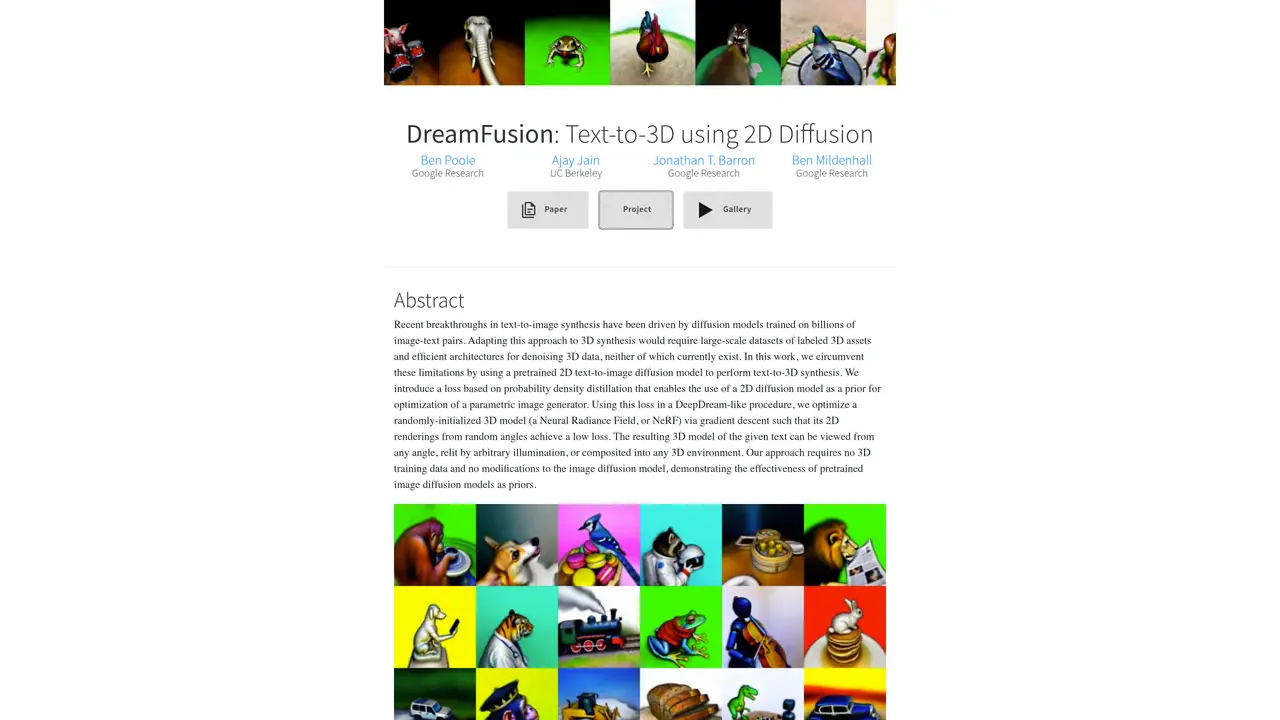
DreamFusion is a research project developed by Google Research that enables text-to-3D generation using a pre-trained text-to-image diffusion model. The platform leverages a technique called Score Distillation Sampling (SDS) to optimize a randomly initialized 3D neural radiance field (NeRF) from the gradients of a diffusion model, allowing users to create detailed 3D models from text prompts without requiring specialized 3D modeling expertise. This approach bridges the gap between 2D image generation and 3D asset creation, making it accessible for researchers, artists, and developers interested in exploring generative 3D content. DreamFusion is primarily designed for experimental and creative applications, such as generating 3D objects, scenes, or prototypes from descriptive text inputs, which can then be further refined or used in various digital workflows. The tool is open-source and intended for academic and non-commercial research purposes, providing a foundation for advancing generative AI in 3D modeling. It is not a commercial product or a platform for building digital products like software or websites, as its core functionality revolves around 3D content generation from text.
Key features
- Create complex software without coding knowledge
- Launch new products quickly and easily
- Customize and maintain products with powerful content management
Use cases
- Creating and managing digital products for businesses
- Developing complex software applications without coding experience
- Launching new products with minimal effort and maintaining them over time
Pros
- Enables text-to-3D generation without requiring 3D training data or labeled 3D assets
- Uses pretrained 2D text-to-image diffusion models (e.g., Imagen) as priors for optimization
- Produces relightable 3D objects with high-fidelity appearance, depth, and normals
- Allows export of generated 3D models (NeRFs) to meshes for integration with 3D renderers or software
- Supports diverse text prompts for generating varied 3D objects and scenes
Cons
- Requires differentiable mapping back to images, limiting parameter space flexibility
- Relies on the quality and biases of the underlying 2D diffusion model (e.g., Imagen)
- Optimization process may be computationally intensive due to gradient descent-based training
Frequently asked questions about DreamFusion
What does DreamFusion do?
DreamFusion converts text prompts into 3D objects and scenes using a pretrained 2D text-to-image diffusion model. It generates relightable 3D models represented as Neural Radiance Fields (NeRFs) without requiring 3D training data.
Who is DreamFusion designed for?
DreamFusion is designed for users interested in 3D content creation, including artists, designers, and developers who want to generate 3D assets from text descriptions without prior 3D modeling experience.
How does DreamFusion work?
DreamFusion uses a technique called Score Distillation Sampling (SDS) to optimize a 3D scene by leveraging a pretrained 2D diffusion model. It maps text prompts to 3D representations through gradient descent, refining geometry and appearance iteratively.
Can I export the 3D models created with DreamFusion?
Yes, DreamFusion allows exporting generated NeRF models to meshes using the marching cubes algorithm, making them compatible with standard 3D renderers and modeling software.
Does DreamFusion require 3D training data?
No, DreamFusion does not require 3D training data. It relies on a pretrained 2D text-to-image diffusion model to guide the optimization of 3D scenes.
What types of 3D outputs can DreamFusion generate?
DreamFusion can generate diverse 3D objects and scenes from text prompts, including high-fidelity models with detailed appearance, depth, and normals that can be viewed from any angle or relit with arbitrary illumination.