Open-source platform combining product analytics, session replay, A/B testing, and feature flags in one toolkit for product engineers.

DriftDetector
0Popularity
About DriftDetector
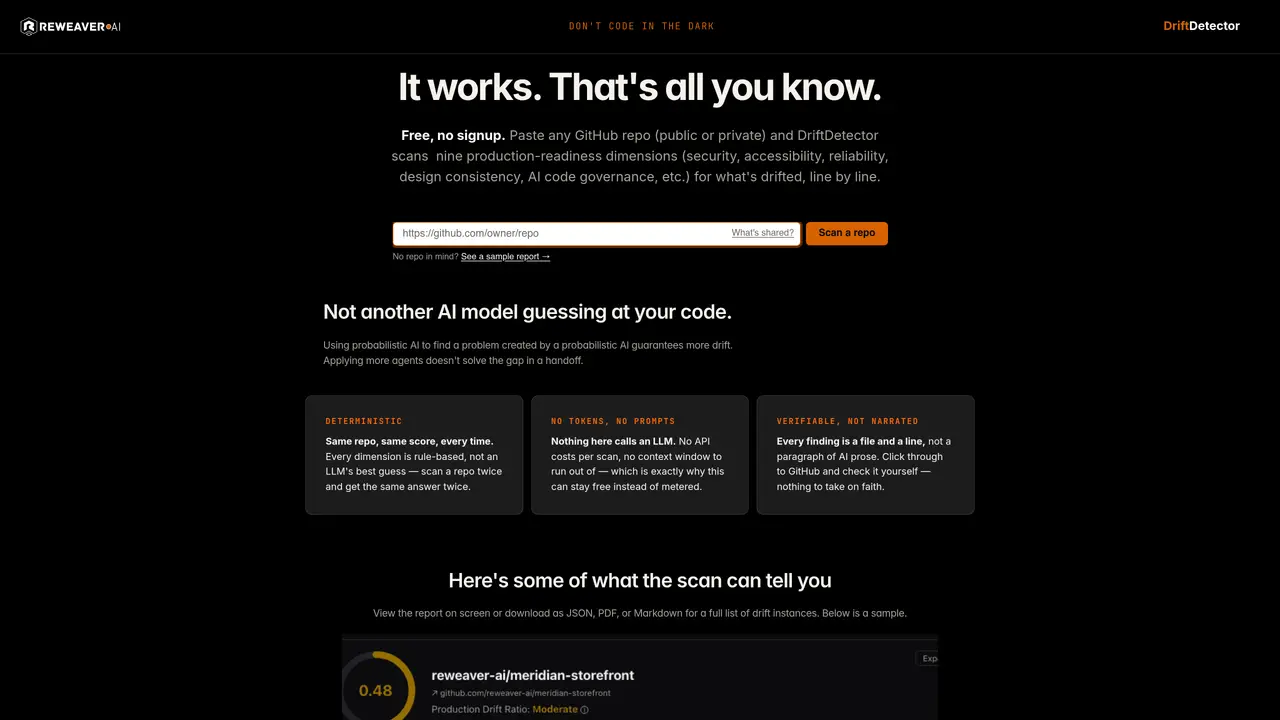
DriftDetector is a free, no-signup tool that analyzes GitHub repositories to detect production-readiness drift across nine dimensions, including security, accessibility, reliability, design consistency, and AI code governance. It provides a standardized Production Drift Ratio score (0–1) weighted by estimated fix hours, enabling comparison of repositories or historical versions to track whether drift is closing or widening over time. The scan pinpoints exact file and line locations where code has deviated from intent or standards, ensuring verifiable, deterministic results without using tokens, prompts, or LLMs. Reports can be viewed on screen or downloaded in JSON, PDF, or Markdown formats. DriftDetector operates without storing repository contents, using temporary memory and GitHub tokens only for access control, and does not retain scans or scores after completion. It is designed to help teams identify and address code drift efficiently, saving time and avoiding the pitfalls of probabilistic AI-generated assessments. The tool is particularly suited for developers, engineering teams, and organizations seeking to maintain code quality and consistency in rapidly evolving codebases. By focusing on rule-based analysis rather than AI-generated narratives, DriftDetector provides actionable, line-level insights that can be cross-referenced directly in GitHub. It supports both public and private repositories and emphasizes privacy by ensuring code never passes through the browser and is not stored after scanning.
Key features
- Scans nine production-readiness dimensions
- Deterministic scoring system
- Line-by-line drift detection
- Standardized Production Drift Ratio (0–1)
- Historical drift tracking across commits
- Multiple export formats (JSON, PDF, Markdown)
- GitHub token-based access control
- No LLM usage or API costs
Use cases
- Detecting code drift in production repositories
- Comparing code quality between repository versions
- Identifying security or accessibility regressions
Pros
- Deterministic, rule-based scoring without LLM guesswork
- Free to use with no signup required
- Supports both public and private GitHub repositories
- Provides verifiable findings with exact file and line references
- Preserves code privacy by streaming directly to scanner without storage
Cons
- No free tier beyond the current offering
- Limited to GitHub repositories only
- No API or integration options mentioned
Frequently asked questions about DriftDetector
What does DriftDetector do?
DriftDetector scans GitHub repositories to detect production-readiness drift across nine dimensions, such as security, accessibility, and reliability. It provides a standardized score and pinpoints exact file and line locations where code has deviated from intent or standards.
Who is DriftDetector for?
The tool is designed for developers, engineering teams, and organizations looking to maintain code quality and consistency in their repositories. It helps identify drift early to prevent technical debt and maintain production-readiness.
Does DriftDetector use AI models or LLMs?
No, DriftDetector uses rule-based analysis rather than probabilistic AI or LLMs. This ensures deterministic, consistent results every time a repository is scanned.
How does DriftDetector handle private repositories?
Private repository scans are performed without storing code contents. The repository's code streams directly to the scanner in temporary memory, and no file contents are retained after the scan. Only the GitHub token, encrypted, is stored temporarily for access control.
Can I compare drift over time with DriftDetector?
Yes, DriftDetector scores the full history of a repository, allowing you to see which commit introduced drift and whether it is closing or widening over time.
What formats are available for DriftDetector reports?
Reports can be viewed on screen or downloaded in JSON, PDF, or Markdown formats for further analysis or documentation.