Meshy turns text prompts or images into fully textured 3D models in minutes.

Infinigen
$0.07Starting price
0Popularity
About Infinigen
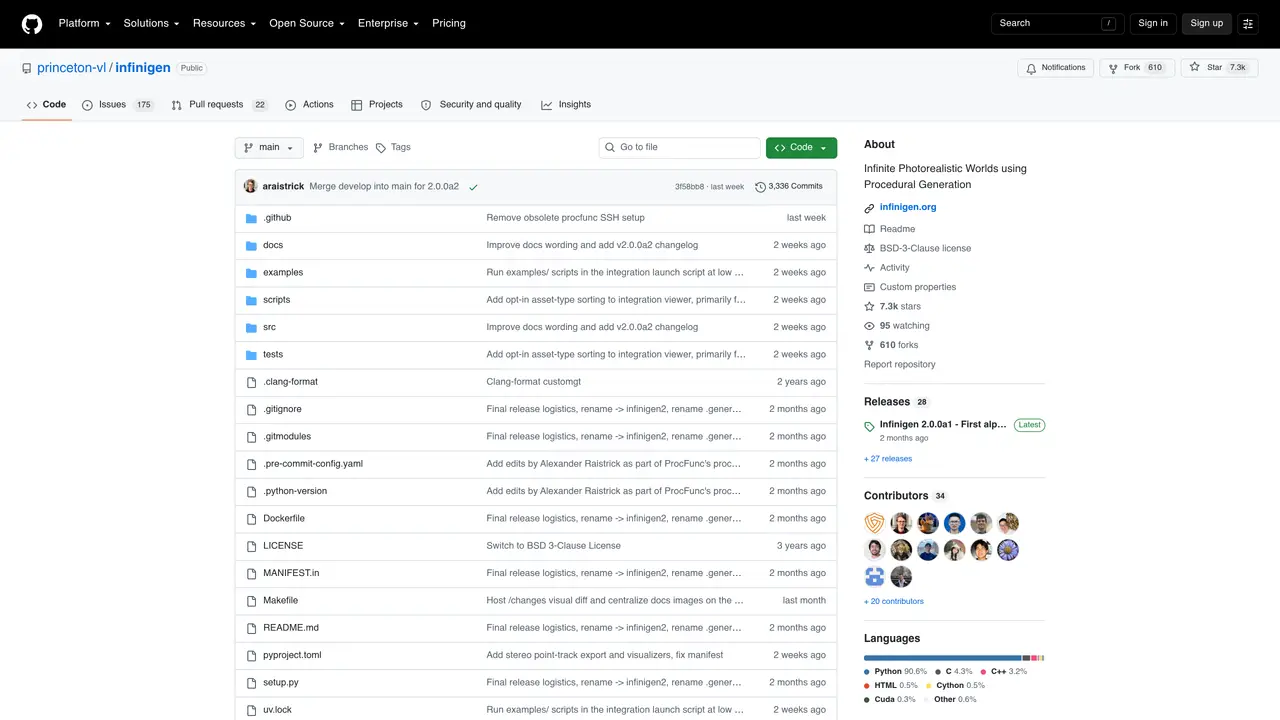
Infinigen is an open-source procedural generator designed to create diverse and high-quality 3D scenes. Developed by Princeton Vision & Learning Lab, it is optimized for computer vision research and generates realistic training data. The tool uses randomized mathematical rules to produce unlimited variations of shapes, materials, and details, ensuring accurate geometry rather than superficial approximations. Infinigen offers a wide range of generators for natural objects and scenes, making it suitable for generating complex environments with minimal manual effort. It also provides automatic annotations for various computer vision tasks, streamlining the process of labeling data for training models. The project encourages community contribution, allowing users to expand its capabilities and adapt it to new use cases. While it requires technical knowledge to set up and run, it serves as a powerful resource for researchers and developers working with 3D data and synthetic environments.
GitHub, Inc.
San Francisco, California, US · Founded 2008
- Founders
- Tom Preston-Werner, Chris Wanstrath, PJ Hyett, Scott Chacon
- Founded
- 2008
- Headquarters
- San Francisco, California, US
- Legal status
- Subsidiary of Microsoft (NASDAQ: MSFT)
Key features
- Procedural generation of 3D scenes with randomized mathematical rules
- Accurate geometry and realistic details for natural objects and scenes
- Wide range of generators for diverse 3D content
- Automatic annotations for computer vision tasks
- Open-source and community-driven development
- Optimized for computer vision research and training data generation
- Unlimited variations of shapes, materials, and details
- Encourages user contributions and expansion of capabilities
Use cases
- Generating synthetic training data for computer vision models
- Creating photorealistic 3D environments for research and development
- Developing diverse 3D assets for games, simulations, or virtual reality
Pros
- Open-source and freely accessible for research and development
- Generates photorealistic 3D scenes and objects procedurally with high geometric accuracy
- Provides automatic annotations for computer vision tasks, reducing manual labeling effort
- Supports multiple scene types including nature, indoor, and articulated objects
- Encourages community contributions to expand capabilities and use cases
Cons
- Requires technical knowledge to set up and run, including familiarity with procedural generation and 3D tools
- Demands significant computational resources for generating complex scenes
- Limited pre-built integrations compared to commercial alternatives
Infinigen videos
Frequently asked questions about Infinigen
What is Infinigen and what does it do?
Infinigen is an open-source procedural generator that creates diverse, photorealistic 3D scenes and objects using mathematical rules. It is designed for computer vision research and provides automatic annotations for training data.
Who is Infinigen suitable for?
Infinigen is suitable for researchers, developers, and practitioners in computer vision, robotics, and simulation who need high-quality synthetic 3D data for training models or testing algorithms.
How does Infinigen generate 3D scenes?
Infinigen uses randomized procedural generation techniques to produce unlimited variations of shapes, materials, and details, ensuring accurate geometry and realistic appearances without manual modeling.
Does Infinigen provide annotations for generated data?
Yes, Infinigen automatically generates annotations for various computer vision tasks, such as segmentation, depth estimation, and object detection, streamlining the data labeling process.
What types of scenes can Infinigen generate?
Infinigen supports generating nature scenes, indoor environments, and articulated objects, with specialized versions available for each domain.
How can I get started with Infinigen?
Users can start by following the getting-started guides available on the project's GitHub repository, which include installation instructions and basic usage examples for different scene types.