Meshy turns text prompts or images into fully textured 3D models in minutes.
nerfstudio
0Popularity
About nerfstudio
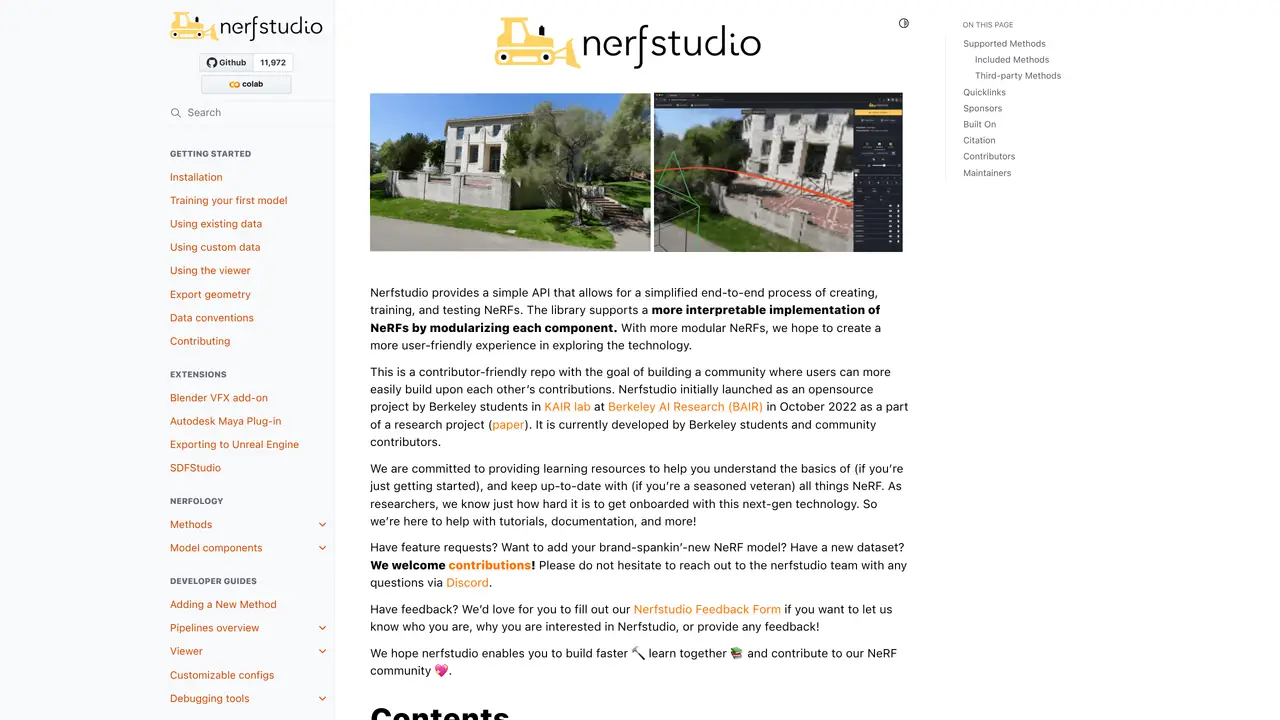
Nerfstudio is a modular framework designed to simplify the creation, training, and testing of Neural Radiance Fields (NeRFs). It enables users to generate photorealistic 3D scenes from collections of 2D images by leveraging neural network-based representations. The tool provides a user-friendly API that supports both beginners and experienced researchers, making NeRF technology more accessible and interpretable. Its modular design allows users to experiment with different NeRF models and configurations without extensive setup overhead. Nerfstudio also includes educational resources to help users learn about NeRFs and their applications. As an open-source project, it encourages community contributions and customization, fostering innovation in 3D scene generation. The framework is suitable for academic research, visual effects in film, and game development, where high-quality 3D representations and renderings are required. By streamlining the NeRF pipeline, Nerfstudio lowers the barrier to entry for advanced 3D scene generation tasks.
Key features
- Modular framework for NeRF creation and testing
- User-friendly API for beginners and researchers
- Supports experimentation with different NeRF models
- Includes educational resources for learning NeRF technology
- Open-source with community-driven contributions
- Photorealistic 3D scene generation from 2D images
- Streamlined training and rendering pipeline
- Interpretable and customizable architecture
Use cases
- Generating 3D scenes for visual effects in film
- Creating immersive environments for game development
- Academic research in neural rendering and 3D reconstruction
Pros
- Modular architecture simplifies experimentation with different NeRF models and configurations
- Open-source framework with active community contributions and support via Discord
- Comprehensive educational resources including tutorials, interactive notebooks, and documentation
- Supports both standard and advanced NeRF methods, including third-party implementations
- Provides a user-friendly API and tools for end-to-end NeRF creation, training, and testing
Cons
- Requires familiarity with NeRF concepts and 3D scene generation workflows
- Training high-quality NeRFs can be computationally intensive and time-consuming
- Setup and configuration may involve technical steps, particularly for custom data pipelines
Frequently asked questions about nerfstudio
What is nerfstudio and what does it do?
Nerfstudio is an open-source framework designed to simplify the creation, training, and testing of Neural Radiance Fields (NeRFs). It enables users to generate photorealistic 3D scenes from 2D images using neural network-based representations.
Who is nerfstudio suitable for?
Nerfstudio is suitable for researchers, developers, and creators interested in 3D scene generation, including applications in visual effects, game development, and academic research. It supports both beginners and experienced users through modular design and educational resources.
How does nerfstudio work?
Nerfstudio modularizes each component of the NeRF pipeline, allowing users to configure and experiment with different methods, data parsers, and rendering tools. It provides a streamlined API for training models and includes a viewer for visualization and debugging.
What NeRF methods does nerfstudio support?
Nerfstudio supports a variety of NeRF methods, including Nerfacto, Instant-NGP, Mip-NeRF, TensoRF, and third-party methods like Instruct-NeRF2NeRF, LERF, and NeRFPlayer. The framework also allows users to add custom methods.
How can I get started with nerfstudio?
Users can get started by following the installation guide and tutorials available in the documentation. The framework provides step-by-step instructions for training models with existing or custom data and using the viewer for visualization.
Does nerfstudio offer integrations with other tools?
Yes, nerfstudio includes extensions for Blender, Autodesk Maya, and Unreal Engine, as well as support for exporting geometry and data in various formats. It also provides data parsers for different datasets and compatibility with Colab for cloud-based training.