Meshy turns text prompts or images into fully textured 3D models in minutes.

Postshot
FreeStarting price
29KMonthly visits
24Popularity
About Postshot
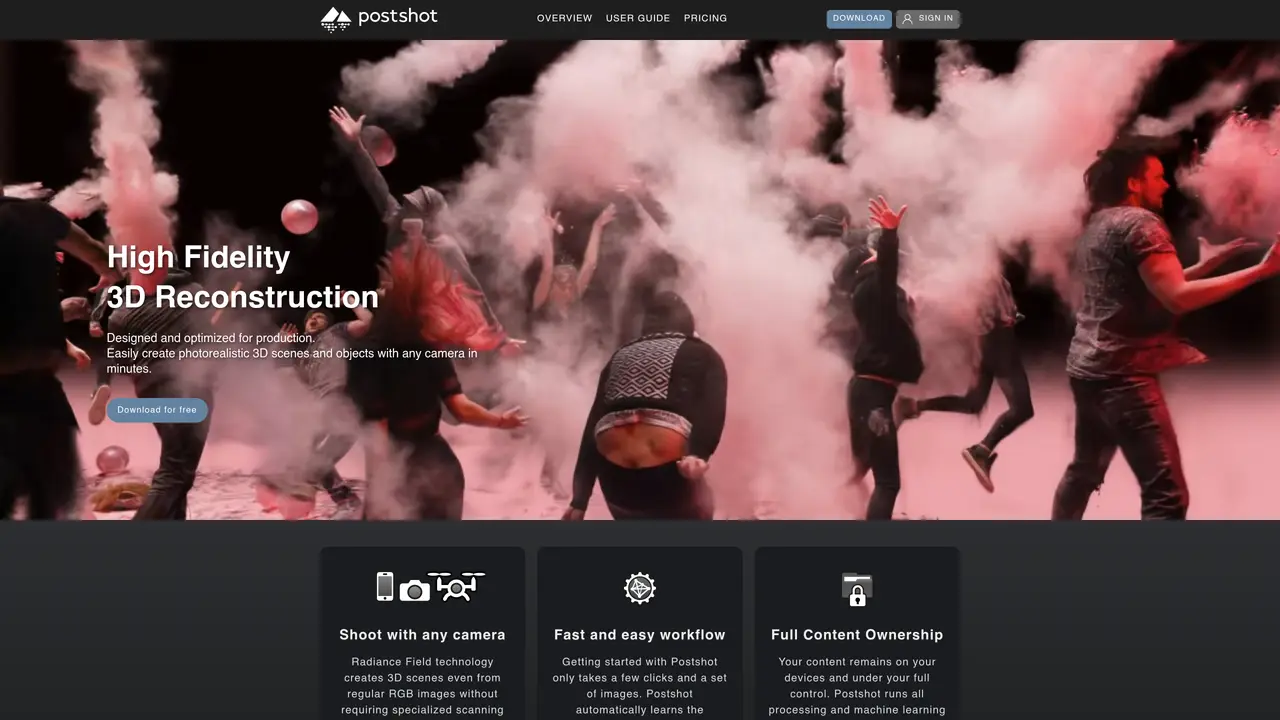
Postshot is an AI-powered 3D scanning tool developed by Jawset that converts video footage or image sequences into detailed, photorealistic 3D models using advanced techniques such as Neural Radiance Fields and Gaussian Splatting. The tool is designed for production environments, enabling users to generate high-fidelity 3D scenes or objects from standard RGB images captured with any camera, including smartphones. Postshot emphasizes ease of use with a streamlined workflow that requires only a few clicks to import images, after which the software automatically learns and reconstructs the 3D scene. It supports a wide range of image formats, including RAW and EXR, and handles color spaces like ACES for professional-grade results. The tool prioritizes user control by processing all data locally on the user’s device, ensuring content remains private and secure. Postshot is particularly suited for designers, engineers, researchers, and 3D modeling enthusiasts seeking an accessible yet powerful solution for creating accurate 3D models without the need for specialized scanning equipment. Its integration with popular software like Unreal Engine and After Effects further extends its utility in creative and technical workflows.
Key features
- AI-powered 3D scanning from smartphone video
- Uses Neural Radiance Fields and Gaussian Splatting
- Desktop app for processing and model generation
- No specialized hardware required
- Free beta access available
- Supports designers, engineers, and researchers
- Creates detailed and comprehensive 3D models
- Easy-to-use workflow for capturing and importing footage
Use cases
- Creating 3D models of objects for design and prototyping
- Documenting and archiving physical objects in 3D
- Enhancing visual content with accurate 3D representations
Pros
- Creates photorealistic 3D models from standard smartphone footage or images without specialized hardware
- Supports high-resolution inputs including 4K, 8K, and HDR formats
- Offers full content ownership with local processing and no cloud dependency
- Integrates with industry-standard tools like Unreal Engine and After Effects
- Provides flexible workflows including command-line interfaces and region-of-interest training
Cons
- Requires an Nvidia GPU with Compute Capability 7.5 or higher for processing
- Limited to Windows 10 or later operating systems
- Free plan restricts saved files to non-commercial use only
Frequently asked questions about Postshot
What is Postshot and what does it do?
Postshot is an AI-powered 3D scanning tool that converts video footage or image sequences into detailed 3D models using advanced techniques like Neural Radiance Fields and Gaussian Splatting. It processes standard RGB images or videos to generate photorealistic 3D scenes or objects.
Who is Postshot designed for?
Postshot is designed for designers, engineers, researchers, and 3D modeling enthusiasts who need an accessible yet powerful solution for creating high-quality 3D models without specialized hardware.
What are the system requirements for Postshot?
Postshot requires Windows 10 or later and an Nvidia GPU with Compute Capability 7.5 or higher, such as a GeForce RTX 2060 or Quadro RTX 4000.
Does Postshot offer a free version?
Yes, Postshot offers a free plan that includes unlimited image count, video length, and model size, but saved files are restricted to non-commercial use only.
Can Postshot integrate with other software?
Yes, Postshot integrates with Unreal Engine and After Effects, and supports importing and exporting camera poses and points in formats like COLMAP and RealityScan.
How do I get started with Postshot?
To get started, download the Postshot desktop app for Windows, ensure your system meets the requirements, and follow the simple workflow to import images or videos. The software will automatically process the data to create a 3D model.
Postshot Website Engagement
Last Update: 9 days ago
Total Monthly Visits
0
Bounce Rate
0%
Visit Duration (avg)
0.00s
Pages Per Visit
0
Country Rank
0
United States
Global Rank
0
Category Rank
#0
Graphics Multimedia & Web Design
Monthly Traffic
Traffic Sources
Traffic Share By Country
- United States57.4%
- Germany12.6%
- Japan7.9%
- South Korea3.6%
- India3.4%