Meshy turns text prompts or images into fully textured 3D models in minutes.

RoboForger
FreeStarting price
0Popularity
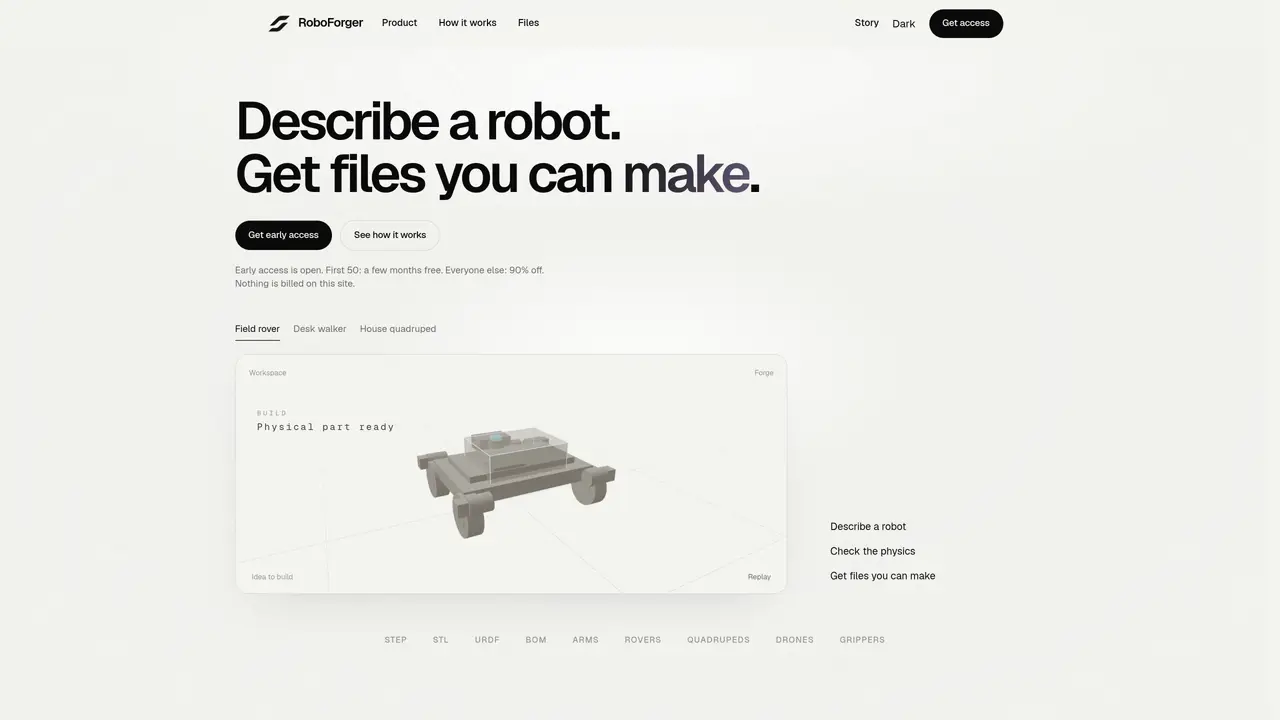
About RoboForger
RoboForger transforms a written description of a robot into structured design files and manufacturing data. It starts with a plain-language brief and generates parts, physics checks, and exportable files such as STEP, STL, URDF, and a bill of materials. The tool validates torque, mass, and runtime to ensure the design can function before fabrication. If a design fails validation, it prompts redesign rather than producing an unworkable model. The process emphasizes engineering intent over visual rendering, aiming to produce machines that can be built rather than just viewed. Users can iterate by adjusting requirements through text and receive feedback on stability and assembly constraints. The output is intended for direct use in 3D printing or machining.
Key features
- Language-to-parts conversion
- Physics validation (torque, mass, runtime)
- STEP, STL, URDF, and BOM file generation
- Iterative redesign loop
- Constraint graph for stability analysis
- Assembly and drivetrain failure detection
- Early access pricing tiers
- Text-based optimization of designs
Use cases
- Prototyping robot concepts from written descriptions
- Generating manufacturing-ready files for small robots
- Validating robot designs before physical assembly
Pros
- Converts natural language descriptions into engineering-ready files
- Includes physics validation for torque, mass, and runtime
- Generates multiple file formats (STEP, STL, URDF, BOM)
- Supports iterative redesign based on failure feedback
- Aims to make robot design accessible without prior CAD experience
Cons
- Early access only, with limited free slots
- No indication of cloud-based collaboration or multi-user support
- Requires plain-language input; custom descriptions may not be supported at launch
- No clear support for non-English languages
Frequently asked questions about RoboForger
What does RoboForger do?
RoboForger converts plain-language descriptions of robots into structured design files and manufacturing data, including STEP, STL, URDF, and a bill of materials. It validates designs for torque, mass, and runtime before generating usable files for fabrication.
Who is RoboForger for?
The tool is designed for users who want to create functional robots without needing deep CAD or engineering expertise. It suits hobbyists, educators, and professionals seeking to iterate quickly from idea to buildable machine.
How does the pricing model work?
Early access is currently open with the first 50 users receiving a few months free at launch. Others on the early access list receive a 90% discount on the later price. No billing occurs during the early access phase.
What integrations or outputs does RoboForger support?
RoboForger generates exportable files such as STEP, STL, URDF, and a bill of materials. These outputs are intended for direct use in 3D printing or machining, ensuring compatibility with standard manufacturing workflows.
What are the main limitations of RoboForger?
The tool focuses on engineering intent and functional validation, so it does not produce purely aesthetic models. Users must describe their requirements clearly, as the system will reject designs that fail physics checks rather than produce unworkable models.
How do I get started with RoboForger?
Users can sign up for early access by providing an email address. Once registered, they can describe their robot in plain language and receive feedback on stability and assembly constraints before generating buildable files.