
AI platform for upscaling images, enhancing photos, and generating high-quality creative assets with contextual detail.

Image to Layers
$19 / moStarting price
0Popularity
About Image to Layers
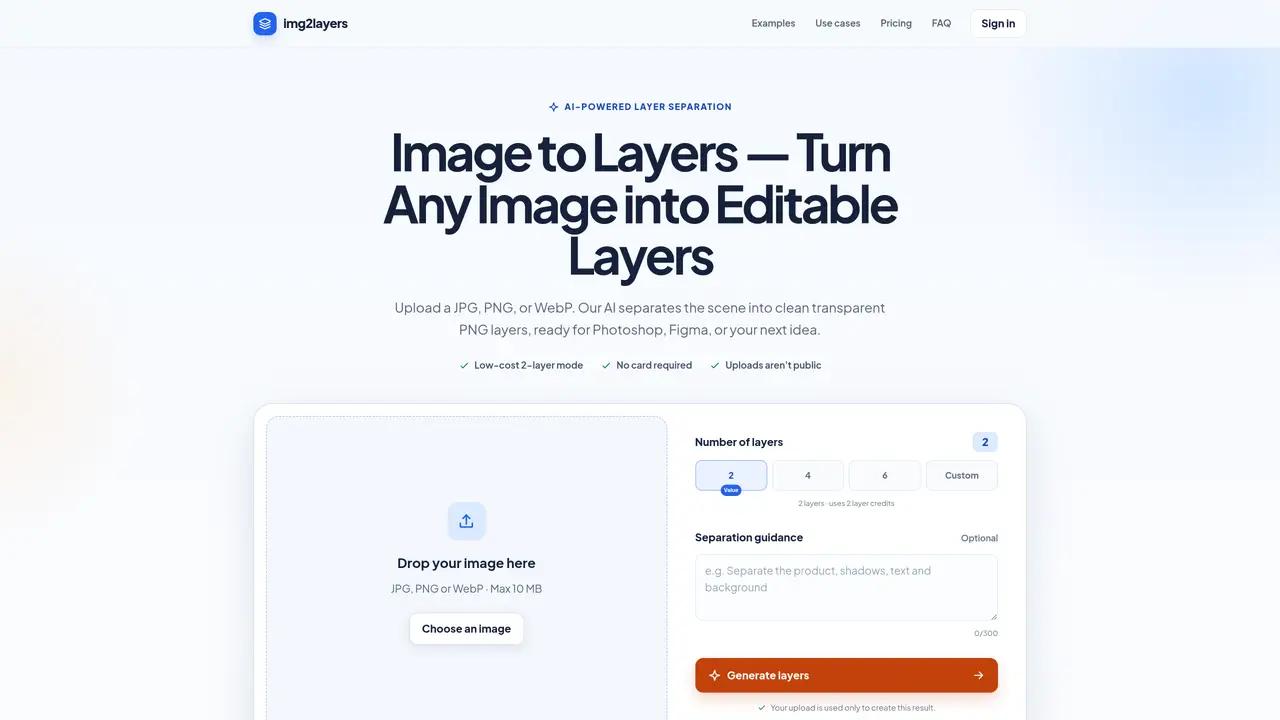
Image to Layers uses artificial intelligence to decompose a single JPG, PNG, or WebP image into multiple transparent PNG layers. The tool targets creative workflows where elements like subjects, backgrounds, shadows, text, or foreground details need independent editing. Users upload an image up to 10 MB, select a layer count (typically 2, 4, or more), and optionally provide guidance to steer the separation. The AI then generates separate layers that can be toggled on or off for review before downloading as individual files or a ZIP archive. Outputs are compatible with Photoshop, Figma, Photopea, Affinity Photo, and similar editors. The service emphasizes privacy by keeping uploads confined to the processing workflow and not storing them in a public gallery. It is positioned for tasks such as product photography retouching, portrait editing, campaign asset remixing, and scene depth adjustments where layered control is required without manual masking.
Key features
- AI-based image decomposition into transparent PNG layers
- Choice of 2, 4, or custom layer counts
- Optional separation guidance for targeted layering
- Layer preview and toggle before download
- Download as individual PNGs or a ZIP archive
- Privacy-focused processing with no public gallery storage
- Compatible with Photoshop, Figma, Photopea, and Affinity Photo
- Credit-based pricing model
Use cases
- Product photography retouching and background replacement
- Portrait editing with separate clothing, hair, and backdrop layers
- Campaign asset remixing for posters and social media
Pros
- AI-powered separation without manual masking
- Supports JPG, PNG, and WebP inputs up to 10 MB
- Outputs transparent PNG layers compatible with major editors
- Uploads remain private and are not added to a public gallery
- Optional separation guidance for custom layer structures
Cons
- No free tier beyond a demo; credits required for downloads
- Maximum input size limited to 10 MB
- Layer count and guidance may still require manual review for complex scenes
Frequently asked questions about Image to Layers
What file formats does Image to Layers support?
The tool supports JPG, PNG, and WebP formats for uploads, and generates transparent PNG layers as output.
How does Image to Layers handle privacy for uploaded images?
Uploads are processed privately and not stored in a public gallery or retained beyond the processing workflow.
Can I specify how the AI separates my image into layers?
Yes, users can select the number of layers (e.g., 2, 4, or custom) and provide optional separation guidance to steer the AI.
What software can I use the generated layers with?
The transparent PNG layers are compatible with Photoshop, Figma, Photopea, Affinity Photo, and similar editing tools.
How are credits used in Image to Layers?
Each generated output layer consumes one credit, with pricing tiers offering different numbers of credits per month.
What types of images work best for layer separation?
Images with clear visual boundaries, such as product photos, portraits, posters, and compositions with distinct elements, typically yield the best results.