
AI platform for upscaling images, enhancing photos, and generating high-quality creative assets with contextual detail.

Paragraphica
0Popularity
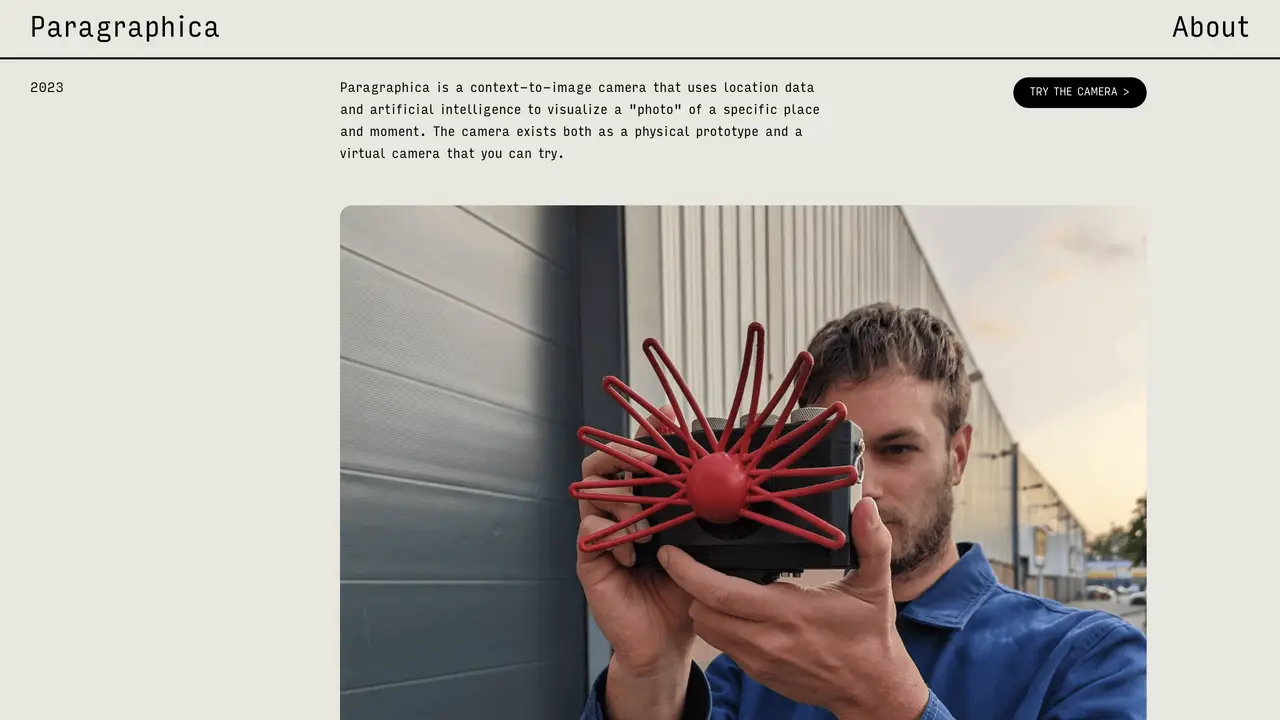
About Paragraphica
Paragraphica is an AI-powered camera that transforms text descriptions into unique photographs. Users input a paragraph describing a scene, emotion, or concept, and the tool generates a corresponding image that reflects the textual input. The system is designed to bridge the gap between language and visual art, enabling users to create custom imagery without traditional photography skills. It is particularly suited for artists, designers, writers, and content creators who need bespoke visuals for projects, social media, or storytelling. Paragraphica emphasizes creativity and personal expression, allowing for iterative refinement of images based on user feedback. The tool is accessible via a web interface, making it easy to use across devices without requiring specialized software. While it does not replace traditional photography, it offers an alternative method for generating conceptually rich images from abstract ideas. The project highlights the intersection of AI and human creativity, providing a novel way to visualize thoughts and narratives.
Key features
- Automatic AI detection for perfect photo moments
- Easy-to-use editing tools for picture enhancement and customization
- Sharing of professional-quality images optimized for social media
- Intuitive user interface for seamless experience
- Powerful AI technology for high-quality image generation
Use cases
- Capturing memories and sharing them on social media
- Enhancing and customizing pictures for personal or professional use
- Creating professional-quality images for marketing or advertising purposes
Pros
- Uses real-time location data (address, weather, time of day, nearby places) to generate contextual descriptions
- Combines multiple data points into a composed paragraph for AI image synthesis
- Offers physical and virtual camera interfaces with adjustable AI parameters via dials
- Provides a unique perspective on locations by visualizing AI interpretations of data
- Inspired by alternative intelligences, offering a metaphorical view of the world
Cons
- Requires internet connectivity to access APIs and AI models
- Output images are AI-generated interpretations, not literal representations
- Physical prototype may have limited portability due to hardware components
Frequently asked questions about Paragraphica
What is Paragraphica?
Paragraphica is a context-to-image camera that uses location data and artificial intelligence to generate a visual representation of a specific place and moment. It combines real-time location details with text-to-image AI to create a unique 'photo' that reflects the essence of the environment.
How does Paragraphica work?
The camera collects data from its location using open APIs, including address, weather, time of day, and nearby places. It composes a descriptive paragraph from these data points and converts it into an AI-generated image using a text-to-image model.
Who is Paragraphica designed for?
Paragraphica is designed for users interested in exploring alternative perspectives of their surroundings through AI-generated visualizations. It appeals to artists, designers, and anyone curious about how AI interprets and represents real-world contexts.
Can I try Paragraphica without a physical camera?
Yes, Paragraphica is available as both a physical prototype and a virtual camera that can be tried online. The virtual version allows users to experience the same functionality without requiring hardware.
What controls does Paragraphica offer?
The camera features three physical dials that allow users to adjust data and AI parameters. These include controlling the search radius for location data, adjusting the noise seed for the AI image diffusion process, and setting the guidance scale to influence the AI's adherence to the generated paragraph.
What kind of data does Paragraphica use to generate images?
Paragraphica uses location-based data such as address, weather conditions, time of day, and nearby places. This data is combined to create a descriptive paragraph that the AI then converts into a visual representation.