
Enhance learning with AI-driven flashcards, tests, and games.

Prodigy
$390Starting price
33KMonthly visits
25Popularity
About Prodigy
Prodigy is a learning platform designed to make education engaging through interactive lessons and activities. It uses adaptive learning technology to tailor lessons to each student’s needs and interests, ensuring they progress at their own pace. The platform emphasizes collaboration and critical thinking, allowing students to work together while exploring new subjects. Lessons are customized to individual strengths and weaknesses, helping learners master skills and build confidence. Prodigy serves both educators and students by providing a structured yet flexible learning experience. It supports personalized learning paths while fostering an environment where students can discover and engage with content meaningfully.
Key features
- Adaptive learning technology for personalized lesson paths
- Interactive lessons and activities
- Customized content based on individual needs
- Encourages collaboration among students
- Focus on critical thinking and skill mastery
- Student-paced learning progression
- Engaging and fun learning experience
- Supports educators in tracking student progress
Use cases
- Personalized math or language learning for K-8 students
- Classroom collaboration and group learning activities
- Homework or supplemental practice for reinforcing classroom lessons
Pros
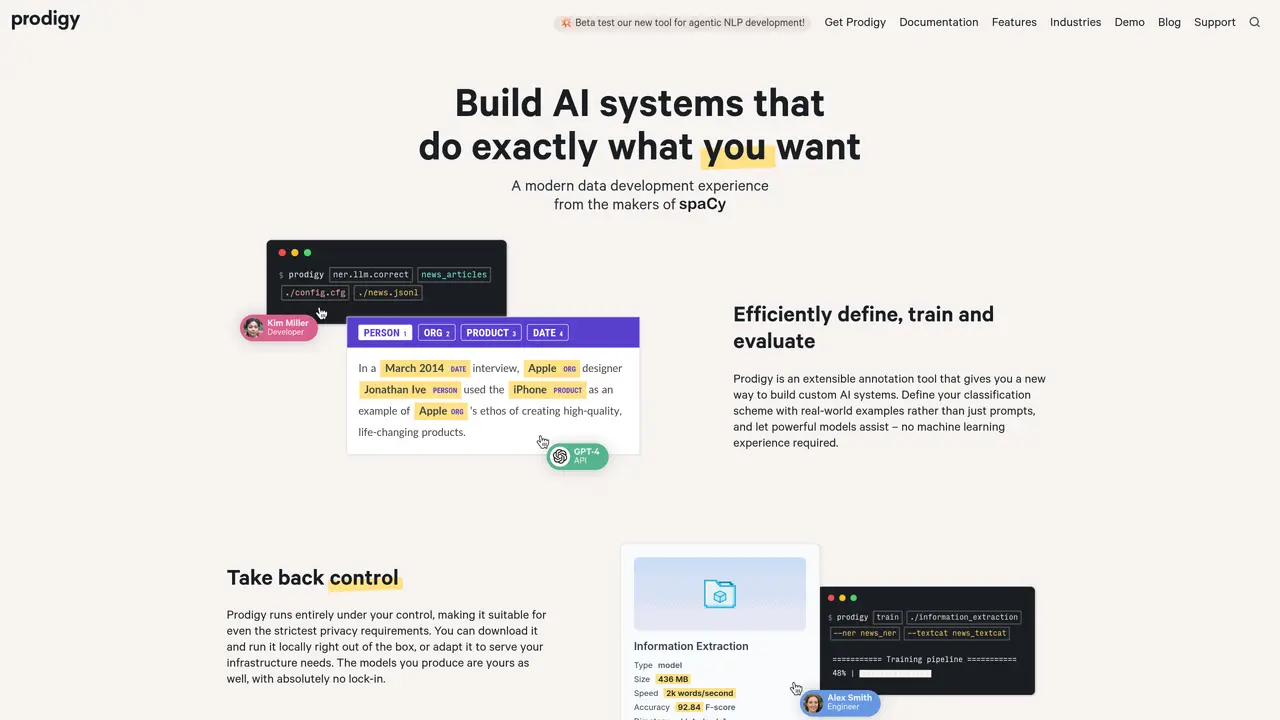
- Runs entirely on local machines, ensuring full data privacy and no external dependencies
- Supports customizable annotation workflows and interfaces tailored to specific project needs
- Enables efficient model training and fine-tuning with real-world examples rather than just prompts
- Offers powerful built-in workflows for information extraction, classification, and segmentation across text, images, audio, and video
- Provides a lifetime license model with no recurring fees or vendor lock-in
Cons
- Requires technical setup and local installation, which may pose challenges for non-technical users
- Limited to users comfortable with Python and command-line interfaces for advanced customization
Frequently asked questions about Prodigy
What is Prodigy and what does it do?
Prodigy is an extensible annotation tool designed for building custom AI systems. It allows users to define classification schemes with real-world examples, train and fine-tune models, and extract structured data from text, images, audio, and video without requiring machine learning expertise.
Who is Prodigy suitable for?
Prodigy suits developers, data scientists, researchers, and teams working in industries such as banking, healthcare, media, legal, and education who need to annotate data, train models, or build AI systems with strict privacy or customization requirements.
What is Prodigy's pricing model?
Prodigy offers a lifetime license model, allowing users to pay once and use the tool indefinitely. It provides flexible options for both individuals and teams, with no recurring fees or data lock-in.
Does Prodigy integrate with other tools or platforms?
Prodigy is designed to run locally and integrate seamlessly with existing workflows. It supports custom data feeds and interfaces, and users can incorporate it into their infrastructure or combine it with other tools like spaCy for enhanced functionality.
What are the main limitations of Prodigy?
Prodigy requires local installation and technical setup, which may not be accessible to non-technical users. Advanced customization and workflows depend on Python and command-line proficiency, potentially limiting ease of use for some teams.
How do I get started with Prodigy?
Users can download and install Prodigy like any other library, then define custom recipes or workflows to annotate data, train models, or extract information. The tool provides documentation and developer resources to guide the setup process.
Prodigy Website Engagement
Last Update: 9 days ago
Total Monthly Visits
0
Bounce Rate
0%
Visit Duration (avg)
0.00s
Pages Per Visit
0
Country Rank
0
India
Global Rank
0
Category Rank
#0
Programming & Developer Software
Monthly Traffic
Traffic Sources
Traffic Share By Country
- United States18.7%
- Russia11%
- Brazil9.5%
- United Kingdom9.2%
- India9.2%