
AI-powered medical search engine that delivers synthesized, cited answers from peer-reviewed research for clinicians.

Lie Predictor
0Popularity
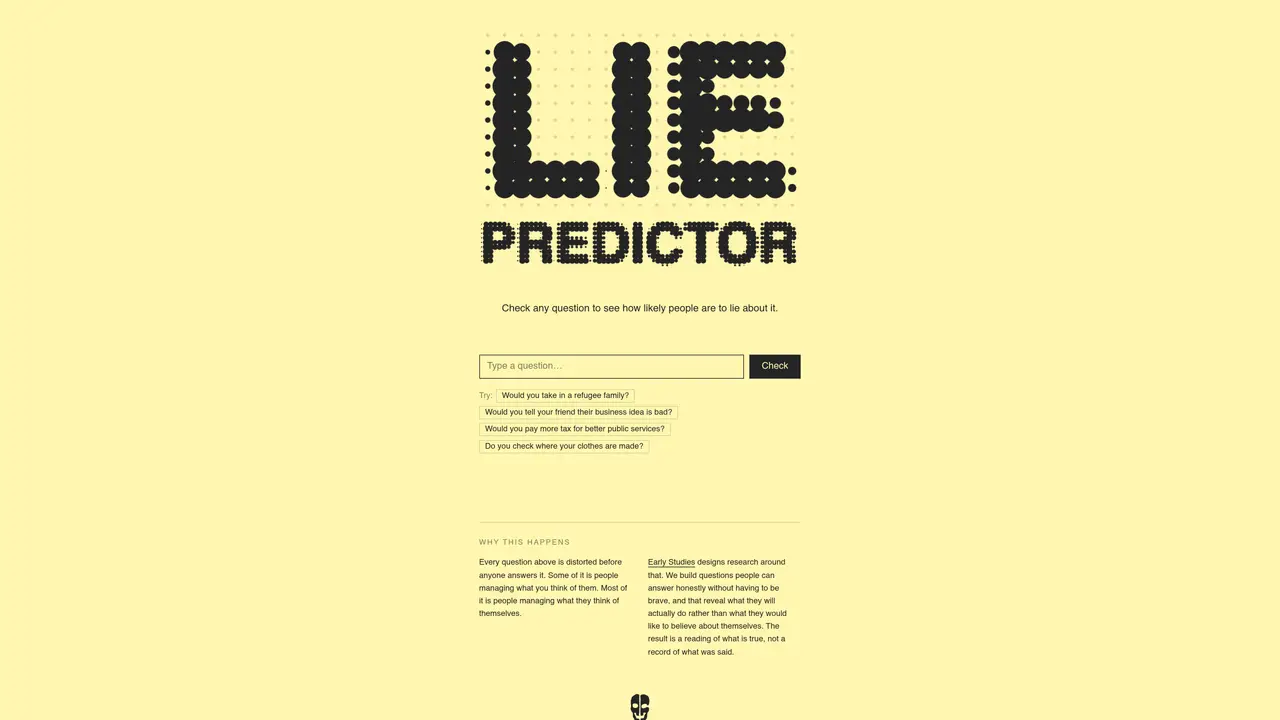
About Lie Predictor
Lie Predictor evaluates the likelihood that respondents will lie when answering specific questions by analyzing human behavior and impression management. The tool designs questions that encourage honest responses without requiring participants to be overtly courageous. These questions are structured to reveal actual intentions or behaviors rather than idealized self-perceptions. The output provides insights into underlying truths rather than a direct record of stated answers. This approach is particularly useful in research and analysis where understanding genuine responses is critical. By focusing on the distortions that occur before answers are given, Lie Predictor helps uncover what people will actually do versus what they believe or claim about themselves. The methodology is rooted in early studies that prioritize question design to minimize dishonesty while capturing authentic insights. It is intended for researchers, analysts, and organizations seeking to improve the accuracy of their data collection and interpretation.
Key features
- Question distortion to reduce bias
- Behavioral insight extraction
- Honesty-focused question design
- Truth-oriented response analysis
- Research-backed methodology
Use cases
- Market research to detect dishonest feedback
- Psychological studies on human honesty
- Brand perception analysis to identify misleading responses
Pros
- Assesses likelihood of deception in responses
- Designed to encourage honest answers
- Focuses on revealing actual behavior rather than stated beliefs
- Based on behavioral research
- Provides insights beyond direct responses
Cons
- No public access to the tool without signup
- Limited information on methodology or validation
- No details on supported languages or regions
- No pricing or availability information
Frequently asked questions about Lie Predictor
What does Lie Predictor do?
Lie Predictor evaluates how likely respondents are to lie when answering specific questions by analyzing human behavior and impression management. It designs questions that encourage honest responses and reveals underlying truths rather than recorded answers.
Who is Lie Predictor designed for?
The tool is designed for researchers, analysts, and organizations that require accurate insights into genuine responses, such as market researchers, social scientists, and data-driven decision-makers.
How does Lie Predictor work?
Lie Predictor works by designing questions that minimize dishonesty and reveal actual intentions or behaviors. It analyzes distortions in responses to provide a reading of underlying truths rather than what respondents claim.
What kind of questions can Lie Predictor evaluate?
The tool can evaluate any type of question to determine the likelihood of dishonest responses, focusing on areas where impression management or self-perception distortions are common.
Can Lie Predictor be integrated with other research tools?
The website does not mention specific integrations, but the tool is designed to complement research methodologies where accurate data collection is essential.
How do I get started with Lie Predictor?
Users can sign up on the Lie Predictor website to access the tool and receive updates, such as the Gray Lies Study, which provides insights into common distortions in research.